
He Came Home Early and Found His Wife Pressuring the Woman Who Raised Him to Sign Away Her Place in the Family—Then One Folder Changed Everything
“Sign it, Margaret.”
Evan Mercer heard his wife’s voice before he reached the living room.
It wasn’t loud.
That made it worse.
Claire sounded calm, almost patient, as if she were asking someone to approve a grocery list instead of staring down the woman who had raised Evan from childhood.
Evan stopped in the hallway.
His suitcase was still in his hand.
He had landed in Austin almost six hours earlier than planned after canceling the final meeting of a three-day business trip. Nobody at home knew he was coming back.
That had been intentional.
He couldn’t explain why.
All morning, something had bothered him.
Not fear.
Not exactly.
Just the feeling that he had been away from his own life for too long.
Now he understood why.
“I already told you,” Margaret said quietly. “I’m not signing anything until Evan reads it.”
Claire let out a slow breath.
“You keep saying that as if Evan has time to read every piece of paper that crosses this house.”
“He has time for this one.”
Evan set his suitcase down without making a sound.
Through the open doorway, he could see the back of his wife’s cream-colored chair.
Claire sat with perfect posture beside the long coffee table.
A folder rested in front of her.
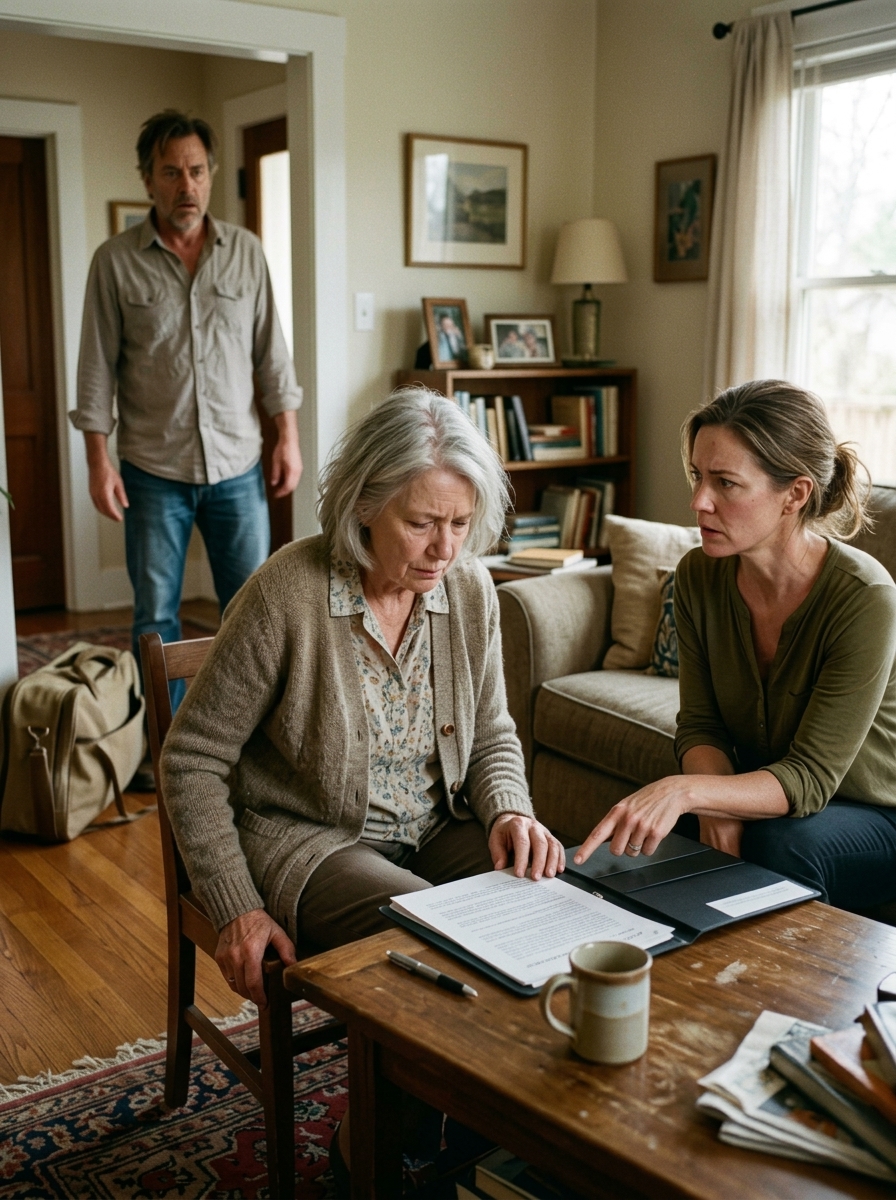
Across from her sat Margaret Mercer, the seventy-one-year-old woman who had adopted Evan when he was a scared nine-year-old boy with one backpack and no idea where he would sleep the next month.
Margaret’s cardigan was buttoned wrong.
Evan noticed that immediately.
She always dressed carefully, even if she was only spending the afternoon reading on the back porch.
Now her silver hair looked hurriedly combed, and one hand was wrapped tightly around the arm of her chair.
The other rested beside a pen.
Claire pushed the pen toward her.
“You’re making this more dramatic than it needs to be.”
Margaret didn’t touch it.
Claire leaned back.
“The guesthouse is beautiful. You’ll have privacy. Your own kitchen. Your own entrance. Nobody is putting you out.”
Margaret looked at her.
“You told the staff my things were being moved Monday.”
Claire’s mouth tightened.
“I said we were preparing.”
“You told them before you asked me.”
“It’s my home too.”
Margaret lowered her eyes.
“No one said it wasn’t.”
There was something in her voice Evan had never heard before.
Defeat.
He stepped into the room.
“Preparing for what?”
Claire turned so fast that the folder slipped from her fingers.
Margaret looked up.
Her face changed instantly.
Not relief.
Something deeper.
The look of a person who had been holding a heavy box alone and had finally seen someone reach for the other side.
“Evan,” she whispered.
Claire stood.
“You’re home.”
“I can see that.”
“You weren’t supposed to be back until tonight.”
“I changed my schedule.”
His eyes moved to the folder.
“What are you asking her to sign?”
Claire glanced at Margaret, then back at him.
“Nothing important.”
Margaret said nothing.
Evan walked to the coffee table.
The first page carried a simple heading.
RESIDENTIAL TRANSITION AGREEMENT.
Below it were several paragraphs describing Margaret’s voluntary decision to relocate from the main house to a smaller detached property at the far edge of Evan’s estate.
There were sections about household privacy.
Guest restrictions.
Property access.
Staff communication.
Even rules about when Margaret could use the main kitchen.
Evan looked at Claire.
“What is this?”
“A practical arrangement.”
“You wrote rules for my mother to enter my kitchen?”
Claire’s expression hardened.
“Our kitchen, Evan.”
Margaret looked down.
Evan turned another page.
That was when his stomach tightened.
The agreement wasn’t only about where Margaret lived.
Subscribe to Tatticle!
Get updates on the latest posts and more from Tatticle straight to your inbox.
Website
Your Email…
Subscribe
We use your personal data for interest-based advertising, as outlined in our Privacy Notice.
It also contained a clause stating that she voluntarily relinquished any expectation of influence over future household, estate, or family decisions.
Another section referenced previous gifts.
Another mentioned family assets.
And another declared that Margaret had no expectation of receiving additional financial support beyond a fixed monthly amount.
Evan read the section twice.
Then a third time.
“Who prepared this?”
Claire crossed her arms.
“You’re reacting before understanding the context.”
“That wasn’t my question.”
“I had someone draft it.”
“Who?”
“A private consultant.”
“What consultant?”
Claire shook her head.
“This is exactly why I didn’t want to do this while you were exhausted from work.”
Evan gave a short laugh.
There was no humor in it.
“You didn’t want to do it while I was here at all.”
Margaret reached for the folder.
“Evan, please.”
He turned toward her.
She looked embarrassed.
That hurt him more than Claire’s paperwork.
Margaret had spent her entire life making sure he never felt ashamed of where he came from.
Now she was sitting in his home looking as if she had done something wrong simply by occupying a chair.
“How long has this been happening?” he asked.
Margaret’s eyes flickered toward Claire.
Claire answered first.
“Nothing has been happening.”
Evan looked at his mother.
“Mom.”
Margaret swallowed.
“A few months.”
The room went still.
Evan stared at her.
“A few months?”
She nodded.
Claire stepped forward.
“That is not a fair description.”
“What would be fair?”
“We’ve had disagreements.”
“About what?”
Claire gestured toward Margaret.
“Boundaries. Privacy. Household decisions. Things married couples are allowed to have.”
Margaret looked at Evan.
“I never wanted to interfere.”
“I know.”
“I told her I could move if that would help.”
Evan’s chest tightened.
“You told her that?”
Claire gave an impatient sigh.
“She offered.”
“After what?”
No one answered.
Evan looked again at the documents.
The carefully placed signature tabs.
The pen.
The prepared moving plan.
Then he saw something else.
A second folder sat partly hidden beneath the first.
He pulled it free.
Claire’s face changed.
Only slightly.
But Evan saw it.
“What’s this?”
“Evan.”
He opened it.
Inside were copies of household expense reports.
Property maintenance schedules.
Staffing plans.
Bank summaries for accounts Evan rarely reviewed personally.
A yellow note was attached to the top page.
MARGARET—REVIEWED.
Evan frowned.
“Why is Mom’s name on these?”
Claire reached for the folder.
“Those are internal.”
He moved it away.
“Internal to what?”
“Our household.”
“Then I should probably know what’s in them.”
Claire stared at him.
For the first time since he entered the room, her polished calm disappeared.
“Not everything has to become a crisis.”
“No,” Evan said. “But hiding documents from me while pressuring my mother to sign something when I’m out of town feels like a good place to start asking questions.”
Margaret stood slowly.
“I think I should go upstairs.”
Evan immediately softened.
“You don’t have to.”
“I’m tired.”
He walked to her.
Margaret gave him the same little smile she had used when he was nine and pretending not to be scared.
“I’m all right.”
He knew she wasn’t.
He also knew she wouldn’t discuss Claire while Claire was standing five feet away.
So he kissed her forehead.
“I’ll come check on you.”
Margaret nodded.
Then she walked from the room.
Evan watched until she disappeared around the corner.
Only then did he turn back to his wife.
Claire was collecting the papers.
“Leave them.”
She stopped.
“I said leave them.”
Her eyes narrowed.
“You don’t speak to me like an employee.”
“I’m not.”
“Then stop treating me like I committed some terrible offense.”
Evan stared at her.
“I don’t know what you’ve done yet.”
That sentence landed between them.
Claire’s face went pale.
And that was the first moment Evan understood that the paperwork on the table might not be the whole story.
Three years earlier, Claire Dawson had been the easiest person in Evan’s life.
At least, that was how he had seen her then.
They met at a charity dinner hosted by a retired executive Evan knew through business.
Claire was thirty-three.
Evan was thirty-five.
She was quick, funny, composed, and completely unimpressed by the attention surrounding him.
Most people asked about his company within minutes.
Claire asked if he knew how to cook.
He laughed.
She said she was serious.
He admitted that his best meal involved scrambled eggs and toast.
Claire told him that anyone who built a national software company but couldn’t make dinner without burning something needed a more balanced life.
It was the first conversation in months that made Evan forget to check his phone.
They married eighteen months later.
Margaret liked her.
At least in the beginning.
“She looks at you like you’re a person,” Margaret once told him.
Evan remembered smiling.
“That sounds like a low standard.”
“You’d be surprised.”
Margaret had always been able to say one sentence that stayed in his head for weeks.
She was never impressed by money.
Maybe that was because she had lived most of her life without much of it.
When Evan first came to her home at nine, Margaret was forty-four and worked as an office manager for a small construction supply business.
Her house outside San Marcos had two bedrooms.
The hallway carpet was worn.
The air conditioner rattled every summer.
The kitchen table leaned slightly to one side because one leg had been repaired twice.
To Evan, it looked like a palace.
Before Margaret, he had spent months moving between temporary homes after his birth mother disappeared from his life.
He had learned not to unpack fully.
That way leaving hurt less.
The first night in Margaret’s house, he slept with his backpack under the bed.
The second night, he did the same.
By the third week, she noticed.
She didn’t ask why.
She simply bought a small wooden dresser at a yard sale.
She cleaned it.
Painted it dark blue.
Then she placed it beside his bed.
“This is yours,” she said.
Evan remembered staring at it.
“For how long?”
Margaret had looked confused.
“For as long as you want it.”
He didn’t understand that answer.
Children who grew up secure might have.
Evan didn’t.
So Margaret opened the top drawer.
“You can put your socks here.”
He didn’t move.
She opened the next drawer.
“Shirts.”
Then the bottom one.
“Anything else.”
Evan looked at her.
“What if I leave?”
Margaret crouched so they were eye level.
“Then we’ll deal with that if it happens.”
That night, Evan put one pair of socks in the top drawer.
A week later, the backpack was empty.
Years later, when he sold his first company stake for more money than Margaret had earned in her entire working life, the dresser was still in his childhood room.
She refused to throw it away.
“It works,” she said.
Evan bought her a new house.
She stayed in the old one.
He bought her a better car.
She drove her twelve-year-old sedan until the transmission finally gave up.
He offered vacations.
She asked if he would come too.
Often, he couldn’t.
Business consumed him.
First there were five employees.
Then twenty.
Then hundreds.
Then offices in other states.
Investors.
Boards.
Contracts.
Flights.
Interviews.
Meetings that seemed important until another meeting replaced them.
By thirty-eight, Evan’s wealth had reached a level that made newspapers use words like empire.
He disliked the word.
Margaret hated it.
“You make software,” she told him. “Caesar had an empire.”
He had laughed so hard he nearly spilled his coffee.
When Margaret finally agreed to move into Evan’s home after retirement, it wasn’t because she wanted luxury.
It was because he asked her.
Several times.
He worried about her living alone.
She worried about becoming a burden.
Eventually, they compromised.
She would take the smaller suite near the garden.
She would pay for her own groceries even though Evan thought that was ridiculous.
And she would continue making her own appointments, handling her own money, and telling him when he was acting foolish.
The arrangement worked.
For two years, it worked beautifully.
Then Evan married Claire.
At first, Margaret gave them space.
She skipped dinners.
Stayed with friends.
Took weekend trips.
When Evan told her she didn’t have to disappear every time Claire wanted privacy, Margaret shrugged.
“Newlyweds need room.”
Claire heard that and hugged her.
“You’re always welcome.”
Evan remembered that sentence too.
Now, standing beside the paperwork Claire wanted Margaret to sign, he wondered when “always welcome” had turned into scheduled kitchen access.
That evening, Evan sat alone in his office with the folders spread across his desk.
Claire had gone upstairs.
They had barely spoken since the confrontation.
Evan didn’t chase her.
He had spent too many years in business learning that people often revealed more when silence made them uncomfortable.
The residential agreement bothered him.
But the second folder bothered him more.
The financial summaries were mostly ordinary.
Household maintenance.
Property taxes.
Transportation.
Staffing.
Insurance.
Renovations.
Nothing jumped off the page.
Then Evan noticed dates.
Several expenses connected to Margaret had increased sharply in the previous four months.
Transportation services.
Personal shopping.
Home assistance.
Dining.
Special requests.
Altogether, the records made it appear that Margaret was spending tens of thousands of dollars every month through Evan’s household accounts.
He knew that was impossible.
Margaret still complained when a diner charged more than four dollars for coffee.
He opened his laptop.
Evan’s business world ran on data.
He trusted patterns.
Patterns did not care about excuses.
He compared the household summary with direct invoices stored in his personal files.
Within twenty minutes, he found the first mismatch.
A charge labeled MARGARET—PRIVATE CAR SERVICE did not belong to Margaret.
It was a driver Claire used.
Another expense labeled MARGARET—FURNISHINGS appeared to cover decorative pieces delivered to a guest room Claire had redesigned.
A monthly personal assistant charge assigned to Margaret belonged to someone Claire had hired for herself.
Evan kept going.
His disbelief became something colder.
More than forty expenses had been assigned to Margaret’s name.
Some were small.
Some were not.
But together they told a story.
They made Margaret look expensive.
Dependent.
Demanding.
And financially careless.
Evan leaned back.
He remembered a conversation with Claire two months earlier.
They had been eating dinner after a long day.
Claire had said, almost casually, “Your mom seems to be spending more lately.”
Evan had barely looked up.
“On what?”
“Little things. Transportation. Help around the house. Personal requests.”
“If she needs something, let her have it.”
Claire smiled.
“That’s what I thought you’d say.”
Evan closed his eyes.
He had given permission without checking.
Not because he didn’t care.
Because he trusted Claire.
That trust now felt embarrassingly convenient.
He opened his email and searched Margaret’s name.
Most messages were routine.
Then he found one from Claire sent five months earlier.
SUBJECT: HOUSEHOLD PLANNING.
The email had gone to Evan and two administrative employees.
Evan had never replied.
He had probably skimmed it between meetings.
The message said Margaret’s expanding needs were becoming difficult for staff to manage and suggested creating clearer boundaries.
Evan searched further.
Another email.
Then another.
Each was carefully worded.
Nothing openly harsh.
Nothing that would have alarmed him by itself.
Margaret prefers separate transportation.
Margaret requested additional support.
Margaret is uncomfortable with shared spaces.
Margaret may benefit from a quieter living arrangement.
Margaret has become more particular about household routines.
Evan read them twice.
He knew his mother.
She asked waitresses if refilling coffee was too much trouble.
She apologized to furniture when she bumped into it.
Once, after moving into Evan’s house, she had secretly washed her own towels because she felt guilty that someone else was doing laundry for her.
The woman described in Claire’s emails did not exist.
Evan’s phone buzzed.
A message from his chief assistant.
You asked me last month if the household budget changed. I assumed you meant overall totals. There have been several internal recategorizations since spring. Do you want the detailed ledger?
Evan stared at the message.
He typed one word.
Yes.
A minute later, the file arrived.
He opened it.
And there it was.
The paper trail.
Not theft.
Not disappearing money.
Something more subtle.
Claire had been building a narrative.
Expense by expense.
Email by email.
Decision by decision.
She had been making Margaret look like a problem.
Evan rubbed both hands across his face.
A soft knock came at the door.
Margaret stood outside.
“Can I come in?”
He closed the laptop halfway.
“Always.”
She entered carrying two mugs.
“I made tea.”
“You shouldn’t be taking care of me right now.”
Margaret gave him a familiar look.
“I made tea, Evan. I didn’t donate a kidney.”
Despite everything, he smiled.
She sat across from him.
For a few moments, neither spoke.
Then Margaret looked at the documents.
“You found the expenses.”
His smile disappeared.
“You knew?”
“Some.”
“How much?”
She folded her hands.
“A month ago, I asked why the driver told me I had used twelve trips when I had only gone out twice.”
“And?”
“Claire said the records were complicated.”
“Why didn’t you tell me?”
Margaret looked toward the dark window.
“You were in Chicago that week.”
“That is not an answer.”
“You had that big meeting.”
“So?”
“You sounded tired.”
Evan stared at her.
“You thought this wasn’t important enough to bother me?”
“No.”
“Then what?”
Margaret’s voice softened.
“I thought your marriage was important enough not to damage with something I might have misunderstood.”
Evan looked down.
Margaret continued.
“And every time I considered mentioning something, I told myself I could handle it.”
“Handle what?”
She hesitated.
“Claire becoming unhappy with me.”
“She was making you look financially irresponsible.”
“I didn’t know how much of that was happening.”
“She was preparing documents to move you out.”
Margaret’s eyes lowered.
“I knew that part.”
“How?”
“She mentioned it weeks ago.”
Evan stood so abruptly that the chair rolled backward.
“Weeks?”
Margaret flinched.
He immediately caught himself.
“Sorry.”
“It’s all right.”
“No, it isn’t.”
He walked across the office.
“Why would you agree to any of this?”
“I didn’t.”
“But you were sitting there with a pen.”
“Because she asked me to hear her out.”
“And then?”
“And then she said the household would be easier if I had my own place.”
“You do have your own place. Your suite is practically an apartment.”
“She meant farther away.”
“How far?”
Margaret gave him a sad smile.
“Far enough.”
Evan turned away.
That simple answer broke something in him.
He had spent years building a home large enough that nobody he loved would ever feel crowded.
And somehow, under his own roof, the woman who gave him a home was being made to feel like extra furniture.
“How did I miss this?”
Margaret didn’t answer.
He looked at her.
“Mom.”
“You were working.”
“That’s not an excuse.”
“No.”
The word was gentle.
That made it sharper.
Evan returned to the desk.
“Did Claire ever tell you I wanted you to move?”
Margaret was silent.
His stomach dropped.
“Did she?”
“Not exactly.”
“What does that mean?”
“She said you were worried about my expenses.”
Evan stared at her.
“What?”
“She said you didn’t want to embarrass me by discussing money directly.”
“I never said that.”
“I know that now.”
“I never even thought that.”
“I know.”
Evan felt sick.
Margaret continued carefully.
“She said the guesthouse arrangement was partly your idea.”
His hands went flat on the desk.
“No.”
“She said you wanted more privacy after the two of you married.”
“No.”
“She said you were trying to find a kind way to handle it.”
“No.”
Margaret looked at him.
“I wanted to believe she was misunderstanding you.”
“She wasn’t misunderstanding me. She was using my name.”
Silence filled the office.
Evan stared at the documents.
There were no dramatic threats.
No shouting.
No single outrageous event he could point to and say, There. That was the moment everything changed.
Instead, Claire had worked through implication.
A sentence here.
An expense there.
A suggestion repeated until it sounded like fact.
And Evan had provided the perfect environment for it.
He was always gone.
Always busy.
Always trusting that silence meant peace.
“I need to ask you something,” Margaret said.
He looked at her.
“Don’t make a decision tonight because you’re angry.”
Evan almost laughed.
“You’re defending her?”
“No.”
“Then why?”
“Because anger makes everything feel simple.”
“This feels pretty simple.”
“It isn’t.”
“She lied to you about me.”
“Yes.”
“She lied to me about you.”
“Yes.”
“She built fake expense reports around your name.”
“Misleading reports.”
“Mom.”
Margaret held up one hand.
“I’m not minimizing it. I’m reminding you that you have to live with whatever you decide after the anger passes.”
Evan sat down.
For a moment, he was nine years old again.
Scared.
Confused.
Waiting for Margaret to explain the world without making him feel foolish for not understanding it.
“What would you do?”
She shook her head.
“This is your marriage.”
“I’m asking you.”
“And I’m not going to choose for you.”
Of course she wasn’t.
Margaret had never confused love with control.
That was one of the reasons Evan loved her.
She stood.
“At least sleep before you change your whole life.”
Then she walked toward the door.
“Mom?”
Margaret turned.
“I am sorry.”
“For what?”
“For not seeing any of this.”
Her expression softened.
“That part matters more than the paperwork.”
Then she left.
Evan did not sleep.
At 1:17 in the morning, he was still reading.
By 2:05, he had found more emails.
By 3:40, he had built a timeline.
It started slowly.
Eight months earlier, Claire had asked household employees to direct Margaret’s requests through her.
Six months earlier, several expenses had been reassigned under Margaret’s category.
Five months earlier, Claire began describing Margaret’s “increasing needs” in emails.
Four months earlier, Claire suggested a separate residence.
Three months earlier, she requested an estimate to renovate the distant guesthouse.
Two months earlier, she had a private consultant draft what she called a family living agreement.
Three weeks earlier, she asked staff to inventory Margaret’s furniture.
The previous Friday, she scheduled movers for Monday.
Evan had been expected home Monday night.
Everything would have been underway before he saw it.
At 4:12, he found something that made him stop.
An email from Claire to the estate manager.
Please remove the blue dresser from Margaret’s room during the transition. It does not match the guesthouse furniture. Place it in storage or donate if Margaret agrees.
The blue dresser.
Evan read the sentence until the words blurred.
He walked out of the office.
The house was silent.
He crossed the hallway, climbed the stairs, and entered the small room beside Margaret’s suite.
The dresser was there.
Still dark blue.
Still uneven around the handles because Margaret had painted it in her garage twenty-nine years earlier.
Evan opened the top drawer.
Inside were old photographs.
School pictures.
Baseball cards.
A cracked plastic watch.
His first business card.
A folded note he had written Margaret when he was fourteen.
SORRY I WAS RUDE. I’M STILL NOT CLEANING THE GARAGE.
He laughed once.
Then covered his face.
When he was a child, that dresser represented permanence.
It had been the first piece of furniture anyone ever told him was his.
Now someone had nearly ordered it removed because it did not match.
And Evan had been too busy to know.
At breakfast, Claire appeared at 7:30 looking as polished as if nothing had happened.
Evan was sitting alone at the kitchen table.
The blue dresser’s top drawer sat beside him.
Claire stopped.
“What is that?”
“You know.”
Her eyes moved to the old photographs.
“You were in the storage room?”
“It isn’t storage.”
“I didn’t mean—”
“Sit down.”
Claire remained standing.
“Evan, if this is going to be another interrogation—”
“Sit down.”
She stared at him.
Then she pulled out a chair.
Evan turned his laptop toward her.
“I read the household ledger.”
Claire said nothing.
“I read your emails.”
Still nothing.
“I read the expense recategorizations.”
She looked toward the window.
“And I found the moving schedule.”
Claire exhaled.
“Fine.”
“Fine?”
“Yes. Fine. I arranged it.”
“You arranged to move my mother out while I was traveling.”
“She was moving two hundred yards away.”
“That isn’t the point.”
“It is absolutely the point. You’re speaking as though I was sending her across the country.”
“You told her I wanted it.”
Claire looked at him.
“She needed to understand that this wasn’t only about me.”
“But it was.”
“No, Evan. It wasn’t.”
He leaned back.
“Explain.”
For several seconds, Claire said nothing.
Then she folded her hands on the table.
“When we married, I thought we were building a life together.”
“We were.”
“No. I was joining a life that already had a permanent third person in it.”
Evan stared at her.
“My mother lives here.”
“Exactly.”
“She has her own suite.”
“She is still here.”
“That was never a secret.”
“I knew where she lived. I didn’t understand what that meant.”
“What does it mean?”
Claire’s voice remained controlled.
“It means she is part of every decision whether she says anything or not.”
“That doesn’t make sense.”
“It does if you live here.”
“She never interferes.”
“You don’t see it.”
“Then tell me.”
Claire looked down.
“If we change something in the kitchen, the staff ask whether Margaret is comfortable with it.”
“Because she uses the kitchen.”
“If I plan a dinner, someone asks whether Margaret is joining.”
“That is called inviting someone who lives in the house.”
“If we travel, you ask whether she needs anything before we leave.”
“She’s my mother.”
“And that is always the answer.”
Evan was quiet.
Claire’s voice cracked slightly.
“You don’t understand what it feels like to know there is one person in your life you will always choose before me.”
Evan watched her carefully.
“That does not explain the fake expenses.”
“They were not fake.”
“You assigned your driver to her category.”
“The driver serves the household.”
“Then why put it under Mom?”
“Because I was trying to show you what maintaining three separate adult lives under one roof actually costs.”
“You put your assistant under her name.”
“The assistant handled household matters.”
“She handled your calendar.”
“She handled more than that.”
“You labeled furniture you ordered as Margaret’s.”
Claire’s face tightened.
“You were never going to look at details.”
That sentence stopped him.
Evan leaned forward.
“Say that again.”
Claire realized too late what she had admitted.
He waited.
Finally she said, “You trusted me to run the house.”
“I did.”
“And I did run it.”
“By making my mother look like a burden?”
“I needed you to understand that something had to change.”
“So you changed the facts.”
“I organized them differently.”
“You changed the facts.”
Claire’s composure slipped.
“You were never here, Evan!”
The words echoed through the kitchen.
Then silence.
Claire’s voice lowered.
“You flew everywhere. You took calls during dinner. You canceled weekends. You slept with your phone on the nightstand and checked messages before you even looked at me in the morning.”
Evan didn’t interrupt.
“I tried telling you I wasn’t happy.”
“You told me you wanted us to travel more.”
“Because that was the only time I got you alone.”
“You could have said exactly what you’re saying now.”
“I did.”
“No. You hinted.”
“Because every time I criticized this arrangement, you looked at me like I was criticizing the woman who saved your life.”
Evan sat back.
There it was.
Not justification.
But truth.
A piece of it.
He had made Margaret untouchable in his mind.
Not because Margaret demanded it.
Because Evan did.
Any discomfort involving her immediately felt like ingratitude.
Claire had likely noticed that.
Maybe she had tried to speak.
Maybe he had failed to listen.
But understanding that did not erase what she had done next.
“You were lonely,” Evan said.
Claire’s eyes filled.
“Yes.”
“You felt second.”
“Yes.”
“You felt like this wasn’t your house.”
“Yes.”
He nodded slowly.
“I should have heard that.”
Claire’s shoulders lowered.
For one moment, she looked relieved.
Then Evan continued.
“But you still lied.”
Her face changed.
“You told my mother I wanted her gone.”
“I told her you wanted privacy.”
“I never said that.”
“You wanted privacy whether you admitted it or not.”
“No. You wanted me to want it.”
Claire looked away.
“You manipulated financial records.”
“I did not steal anything.”
“I didn’t say you did.”
“Then stop talking like I’m some criminal.”
“I’m talking like my wife spent months building a false story because she knew I wasn’t paying attention.”
Claire stood.
“And what exactly are you going to do? Throw away our marriage over a guesthouse?”
Evan looked at her.
“No.”
Claire paused.
“I’m going to decide what our marriage means after I understand everything you did.”
For the first time, fear replaced anger in her expression.
“Everything?”
“Yes.”
“There is nothing else.”
Evan closed the laptop.
“I hope that’s true.”
It wasn’t.
By noon, Evan discovered the third folder.
Not in the house.
In his own digital archive.
Six months earlier, Claire had asked Evan to approve an updated family administrative plan.
He had signed electronically between two business calls.
He remembered almost nothing about it.
The document itself was harmless.
It allowed Claire to coordinate certain household bills and property matters.
But attached to the same email thread was a draft note Claire later sent Margaret.
The wording was careful.
Evan wants to simplify future planning and reduce confusion about expectations.
Margaret had replied:
I don’t expect anything from Evan except honesty and an occasional dinner when he is home.
Claire answered:
Of course. This is just about preventing misunderstandings later.
Two weeks after that exchange, Claire created the first draft of the agreement Margaret had refused to sign.
Evan kept searching.
He found calendar entries.
Notes.
Property estimates.
Then an email with the subject FUTURE OPTIONS.
Claire had asked an accountant to model what household costs would look like if Margaret’s living expenses were capped at a fixed amount.
Again, nothing illegal.
Nothing stolen.
Nothing physically dangerous.
But it exposed the plan.
Claire wasn’t only trying to gain privacy.
She was trying to formalize Margaret’s place in Evan’s life.
To turn a family bond into an allowance.
A room.
A schedule.
A controlled obligation.
At 2:00, Evan called Claire into his office.
Margaret was not present.
He wanted to keep her out of the conversation unless she chose otherwise.
He showed Claire the email.
She read it silently.
“You were planning to cap Mom’s expenses?”
“I was planning responsibly.”
“With money I earned?”
“Our money.”
Evan nodded.
“That’s fair.”
Claire seemed surprised.
He continued.
“It became our money when we married. But Margaret was my responsibility long before that.”
“She is not a child.”
“I know.”
“Then why are you financially responsible for her?”
“Because I choose to be.”
“There. That is the problem.”
Evan frowned.
“What?”
“There is no limit.”
“To what?”
“To what you would give her.”
“She doesn’t ask for anything.”
“That makes it worse.”
Evan stared at her.
Claire pressed both hands against the desk.
“You don’t understand. She never asks. She never complains. She never demands. So I’m the one who looks selfish for wanting boundaries.”
“This isn’t about how she behaves.”
“It absolutely is. Everyone loves Margaret.”
“That sounds like a strange complaint.”
Claire gave a bitter little laugh.
“The staff adore her. Your friends ask about her. Your employees remember her birthday. At our own anniversary dinner, three people came over to greet her before they greeted me.”
Evan’s face softened.
“Claire.”
“Don’t.”
“I didn’t know you felt that invisible.”
“You didn’t know a lot of things.”
That one landed.
Because it was true.
Evan had missed her loneliness.
He had missed his mother’s discomfort.
He had missed months of manipulation.
He had built a billion-dollar company around tracking information while failing to notice the emotional temperature of his own home.
But again, remorse did not require surrendering judgment.
“I failed you in some ways,” he said.
Claire’s expression shifted.
“I was absent. I treated work like every problem was urgent and home like it would stay stable by itself. That was wrong.”
Claire sat slowly.
Evan continued.
“But being neglected does not give you permission to rewrite reality.”
Her eyes filled again.
“I was desperate.”
“You had options.”
“Such as?”
“Tell me plainly. Ask for counseling. Ask us to move. Ask Mom to join a conversation. Ask for a separate home for us if that’s what you wanted.”
“You would have said no.”
“Maybe.”
“That’s exactly why.”
Evan shook his head.
“No. You don’t get to skip someone’s choice because you’re afraid of the answer.”
Claire looked at him.
“You’re choosing her.”
“I’m choosing truth.”
“That sounds nice.”
“It also means I have to admit something you’re right about.”
She waited.
“I have used Margaret as proof that I’m a good person.”
Claire frowned.
Evan had never said it aloud before.
Maybe he had never even thought it clearly.
“I built a huge house and moved her into it. I paid for everything. I told myself that meant I was taking care of her.”
He looked toward the hallway.
“But I stopped giving her the thing she actually wanted.”
“Your time,” Claire said.
“Yes.”
Neither spoke for a while.
Then Claire whispered, “And me?”
Evan looked at her.
“You wanted that too.”
“Yes.”
“I stopped giving it to both of you.”
Claire wiped beneath one eye.
For one dangerous second, Evan wanted the conversation to end there.
He wanted insight to become forgiveness.
He wanted regret to become repair.
He wanted one honest moment to erase six dishonest months.
But life did not work that way.
Margaret had taught him that too.
“I need space,” Evan said.
Claire stiffened.
“Meaning?”
“I don’t know yet.”
“You want me to leave.”
“I want separate rooms while we decide what comes next.”
Claire looked at him in disbelief.
“In my own home?”
“Our home.”
“So I’m being punished.”
“No.”
“That’s exactly what this is.”
Evan shook his head.
“I’m not trying to punish you. I’m trying not to pretend trust still looks the way it did yesterday.”
Claire pushed back her chair.
“This family was never going to have room for me.”
She walked to the door.
Evan spoke before she reached it.
“There was room.”
Claire stopped.
“You just tried to create yours by shrinking someone else’s.”
She left without answering.
The next morning, Margaret was making pancakes.
Evan walked into the kitchen and stared.
“What are you doing?”
She glanced over her shoulder.
“Cooking.”
“I can see that.”
“Then we’re off to a strong start.”
He almost smiled.
“You don’t have to make breakfast.”
“I know.”
“Mom.”
She turned.
“What?”
“Yesterday was awful.”
“Yes.”
“And you’re making pancakes.”
“I was hungry.”
Evan sat at the kitchen island.
Margaret put a plate in front of him.
He looked at it.
Two pancakes.
One slightly darker than the other.
Butter melting in the middle.
For some reason, his eyes burned.
Margaret noticed.
“You’re not allowed to cry before syrup.”
He laughed despite himself.
Then the laugh became a breath he couldn’t quite steady.
Margaret sat beside him.
“I found the old note in the dresser,” he said.
“Which one?”
“The garage.”
She smiled.
“You were impossible that year.”
“I was fourteen.”
“Exactly.”
He looked down.
“Claire planned to have the dresser removed.”
Margaret’s smile faded.
“I know.”
“You knew that too?”
“She said it didn’t fit the new space.”
“And what did you say?”
“That I was keeping it.”
Evan nodded.
“Good.”
Margaret watched him.
“You think the dresser is about you.”
“It is.”
“It was yours.”
“It still is.”
“No.”
She shook her head.
“It’s a dresser.”
Evan looked at her.
Margaret continued.
“It meant something because of what happened around it. Not because of the wood.”
“It was the first thing anyone told me was mine.”
“I remember.”
“You gave me permanence.”
“No, Evan.”
He frowned.
“You eventually allowed yourself to believe permanence was possible. I only gave you drawers.”
He looked away.
Margaret’s voice softened.
“You’ve spent your whole adult life trying to guarantee that nobody you love can ever lose anything.”
Evan said nothing.
“Big house. Money. Staff. Cars. Security. Backup plans.”
“I wanted you comfortable.”
“I am.”
“Are you?”
“Yes.”
He looked at her.
“Even after all this?”
Margaret nodded.
“Comfort isn’t the same as getting everything your way.”
“You were being pushed out of your own home.”
“This is your home.”
“It’s yours too.”
“I appreciate that.”
“That sounded careful.”
“Because I’m trying to say something you won’t like.”
Evan waited.
Margaret folded her hands.
“I don’t want to live here anymore.”
His stomach dropped.
“No.”
She smiled sadly.
“See?”
“No. Absolutely not.”
“Evan.”
“You are not leaving because Claire wanted you out.”
“I’m leaving because I want my own little house again.”
“You have a suite.”
“I have a beautiful suite inside my son’s enormous house.”
“What’s wrong with that?”
“Nothing.”
“Then stay.”
Margaret laughed softly.
“You always were stubborn.”
“You taught me.”
“I taught you to think. You decided stubbornness was a bonus feature.”
Evan leaned closer.
“Mom, please.”
She took his hand.
“I was already thinking about moving before any of this.”
He stared at her.
“What?”
“I miss having neighbors.”
“You have neighbors.”
“They live behind gates.”
Evan nearly laughed.
“I miss walking to get coffee. I miss knowing the woman next door. I miss sitting on a porch where people passing by can actually see me.”
“We can find you something nearby.”
“That’s what I want.”
Evan studied her face.
“This isn’t Claire’s idea?”
“No.”
“You’re sure?”
“Yes.”
“You’re not trying to fix my marriage?”
“No.”
“Protect me?”
“No.”
“Make things easier?”
Margaret squeezed his fingers.
“I’m seventy-one years old. I’m allowed to want my own front porch.”
That ended the argument.
Mostly.
Evan found her a small one-story house fifteen minutes away.
Margaret rejected the first six.
One kitchen was too fancy.
One street was too quiet.
One yard was too large.
One porch faced the wrong direction.
“What direction should it face?” Evan asked.
“The street.”
“Most porches do.”
“Then why did that one look at a hedge?”
Finally, she found a two-bedroom brick house in an older neighborhood lined with oak trees.
There was a diner three blocks away.
A library within walking distance.
A grocery store close enough that Margaret said she could “get one tomato without organizing an expedition.”
Evan offered to buy the house.
Margaret refused.
He offered again.
She refused again.
They compromised.
Margaret sold her old San Marcos house, which she had kept rented for years, and used the money toward the new place.
Evan covered renovations she actually wanted.
Not marble.
Not luxury fixtures.
Grab bars in the bathroom.
Better lighting.
A wider back step.
Fresh kitchen cabinets.
And a new electrical panel because Margaret said she had no intention of “becoming famous for an extension cord.”
The blue dresser went into the guest room.
Evan carried it himself.
Margaret stood in the doorway.
“You know we could ask the movers.”
“No.”
“You’re thirty-eight, not eighteen.”
“I know.”
“You have people for this.”
“I know.”
“You paid those people.”
“I know.”
She smiled.
“Fine.”
He set the dresser against the wall.
For a moment, they both looked at it.
Then Margaret opened the top drawer.
Still smooth.
Still blue.
Still theirs.
“You should take it,” she said.
Evan looked at her.
“Why?”
“Because it was yours.”
“It belongs here.”
“Why?”
He thought about that.
Then he smiled.
“Because somebody might need a drawer someday.”
Margaret’s eyes softened.
“Exactly.”
Claire moved into the guest wing while Evan and she attended private counseling.
There was no dramatic public scandal.
No reporters on the driveway.
No humiliating announcement.
Evan refused to turn the most painful part of his life into entertainment for strangers.
He informed the few people who needed to know that he and Claire were taking time apart.
That was all.
Inside the house, the conversations were harder.
Claire admitted she had resented Margaret for almost a year.
She admitted she had felt embarrassed by that resentment.
Then, instead of confronting it honestly, she had tried to make her feelings appear objective.
Costs.
Schedules.
Efficiency.
Boundaries.
Documents.
Numbers looked cleaner than jealousy.
She also admitted something Evan had not expected.
“I didn’t want her money.”
They were sitting across from each other in a quiet room off the library.
Evan nodded.
“I know.”
Claire looked surprised.
“You do?”
“I checked everything.”
“All of it?”
“Everything I could.”
She winced.
“I didn’t take anything.”
“No.”
“I know what you probably thought.”
“For a few hours, I didn’t know what to think.”
“I never wanted your company. I never cared about inheriting anything.”
“I believe you.”
Claire stared at her hands.
“I wanted to matter more.”
Evan was silent.
“I know how ugly that sounds.”
“It sounds honest.”
“I thought if Margaret needed less, there would be more room for us.”
“Time isn’t a pie.”
“No.”
“But attention can feel like one.”
Claire nodded.
Evan understood that better now.
He had spent years telling himself that love had no limits.
Maybe love didn’t.
But hours did.
Energy did.
Presence did.
A person could love ten people and still fail every one of them by never being available.
“What happens now?” Claire asked.
“I don’t know.”
“You really don’t?”
“No.”
She looked disappointed.
Months earlier, Evan might have given a quick answer simply because uncertainty made him uncomfortable.
He no longer wanted to live that way.
“I can forgive you,” he said.
Claire looked up.
Her eyes widened.
“But forgiveness and trust aren’t the same thing.”
Her expression fell.
“I know.”
“I need to see whether trust can come back.”
“And if it can’t?”
“Then we have to be honest about that too.”
Claire nodded slowly.
For once, neither of them tried to control what came next.
Margaret moved into her house on a Thursday.
On Friday morning, Evan received a photograph.
A coffee mug.
A newspaper.
Two feet in fuzzy slippers resting on the porch railing.
Underneath, Margaret had typed:
My terrible new life.
Evan laughed so loudly during a meeting that twelve executives looked at him.
He showed them nothing.
But he saved the photograph.
The following Sunday, he drove to Margaret’s house before noon.
She opened the door wearing an old Texas State sweatshirt and an expression of suspicion.
“Why are you here?”
“You invited me.”
“I said lunch.”
“It’s eleven forty-five.”
“That is not lunch.”
“It’s close.”
“You have spent too much time with corporate schedules.”
He stepped inside.
The house smelled like tomato soup and toasted bread.
Nothing in it matched perfectly.
Margaret’s old chairs sat beside a new rug.
Her inexpensive kitchen clock hung above modern cabinets.
The blue dresser was visible through the hallway.
Evan felt something loosen inside him.
This looked like her.
Not a designer’s version of her.
Not his version.
Hers.
They ate grilled cheese sandwiches at a small kitchen table.
Halfway through lunch, Margaret asked about Claire.
Evan put down his sandwich.
“We’re still trying.”
“That’s all?”
“That’s all.”
Margaret nodded.
“You don’t want details?”
“No.”
“You’re not curious?”
“Of course I’m curious.”
“Then why not ask?”
“Because curiosity doesn’t automatically create entitlement.”
Evan stared at her.
“Do you practice these lines?”
“Yes. Every morning in the mirror.”
He laughed.
Then Margaret became serious.
“Claire called me.”
Evan stopped.
“When?”
“Yesterday.”
“What did she want?”
“To apologize.”
His jaw tightened.
“Did she?”
“Yes.”
“And?”
“I listened.”
“That’s it?”
“She apologized.”
“Did you forgive her?”
Margaret looked at him.
“That’s between Claire and me.”
“Mom.”
“No.”
He leaned back.
“Fine.”
Margaret picked up her sandwich.
After a moment, Evan asked, “Are you going to see her again?”
Margaret gave him a look.
“That is also between Claire and me.”
“You enjoy this.”
“A little.”
Over the next three months, Evan changed more than his calendar.
He changed how he lived inside it.
Two nights a week, his phone stayed outside the dining room.
Friday evenings became unavailable for business unless something genuinely urgent happened.
Sunday lunch with Margaret was protected.
Not because he owed her.
Because he enjoyed it.
That difference mattered.
He stopped calling every act of presence a responsibility.
Sometimes it was simply life.
Claire changed too.
At first, Evan distrusted every improvement.
When she started managing her own schedule without involving the household staff, he wondered if she was performing.
When she apologized directly to employees she had pulled into the tension, he wondered if it was strategy.
When she returned control of the household accounts without being asked, he wondered what she wanted.
That was the damage distrust caused.
Even good behavior became suspicious.
Claire understood.
She did not ask Evan to “move on.”
She did not say he was punishing her.
She did not demand deadlines.
Instead, she began doing something she had avoided for years.
She spoke plainly.
“I’m angry that you canceled dinner again,” she would say.
Or, “I need an evening with you this week.”
Or, “I feel left out when decisions are made without me.”
Or even, “I’m jealous right now, and I know that isn’t Margaret’s fault.”
Those sentences were uncomfortable.
They were also clean.
No hidden accounts.
No strategic emails.
No stories built from distorted numbers.
Just truth.
Evan tried to answer the same way.
“I’m overwhelmed.”
“I need quiet.”
“I disagree.”
“I can’t fix that tonight.”
“I was wrong.”
Simple words.
Hard words.
One evening, Claire asked him something that stayed with him.
“Why was building a company easier for you than building a marriage?”
Evan thought for a long time.
“Because companies tell you when something is wrong.”
“How?”
“Numbers fall. Customers leave. Projects miss deadlines. People send reports.”
“And marriages?”
“Sometimes people say ‘fine.’”
Claire almost smiled.
“I said that a lot.”
“So did I.”
A year earlier, Evan might have ended the conversation with a joke.
Now he kept going.
“I also knew what success looked like at work.”
“And at home?”
“I thought no conflict meant success.”
Claire nodded.
“That explains a lot.”
By late fall, Margaret had become more social than either Evan or Claire expected.
She joined a book club.
Became friends with a retired school secretary across the street.
Started volunteering two mornings a week at the neighborhood library.
She complained that everyone there was “bossy.”
Then she baked them banana bread.
One Sunday, Evan arrived and found three folding chairs on the porch.
“Who’s coming?”
Margaret looked innocent.
“No one.”
“Then why three chairs?”
The answer arrived ten minutes later.
Claire parked at the curb.
Evan turned toward Margaret.
“You invited her?”
Margaret continued arranging napkins.
“Yes.”
“You didn’t tell me.”
“No.”
“Why?”
“Because you would have overthought it.”
Claire walked toward the porch carrying a pie.
She looked nervous.
Evan stood.
For several seconds, nobody spoke.
Then Margaret pointed at the pie.
“Did you make that?”
Claire shook her head.
“No.”
“Good.”
Claire blinked.
Margaret smiled.
“I’ve had your homemade pie.”
Claire started laughing.
The tension broke.
Not disappeared.
Broke.
Enough for air to get through.
They sat on the porch for nearly two hours.
Nobody discussed the agreement.
Nobody discussed money.
Nobody discussed what had happened months earlier.
They talked about ordinary things.
A neighbor’s noisy leaf blower.
A restaurant Margaret disliked because the chairs were uncomfortable.
Claire’s plan to repaint one of the bedrooms.
Evan’s inability to remember where anything belonged in a grocery store.
It was not reconciliation.
It was not a perfect ending.
It was three people deciding that the past could be acknowledged without becoming the only thing in the room.
As Claire prepared to leave, Margaret walked her to the porch steps.
Evan stayed back.
He didn’t hear what they said.
He didn’t ask later.
That surprised him.
Months before, uncertainty would have bothered him.
Now he understood that love did not mean having access to every conversation.
Some things belonged to other people.
That night, Evan and Claire drove home together.
Halfway there, Claire said, “She told me something.”
Evan kept his eyes on the road.
“You don’t have to tell me.”
Claire smiled slightly.
“That’s new.”
“I’m growing.”
“She said I spent too much time trying to become the most important woman in your life.”
Evan glanced at her.
Claire continued.
“And that I was competing in a contest that didn’t exist.”
He was quiet.
“What did you say?”
“I told her it felt real to me.”
“And?”
“She said feelings can be real without being facts.”
Evan smiled.
“That sounds like her.”
Claire looked out the window.
“I wish I’d understood that sooner.”
“So do I.”
She turned toward him.
“You still sound angry sometimes.”
“I am sometimes.”
Claire nodded.
“I’m sorry.”
“I know.”
This time, he meant it differently.
Not as dismissal.
As recognition.
Winter came.
Then spring.
The first anniversary of the day Evan returned home early arrived without fanfare.
He remembered it anyway.
He was sitting in Margaret’s kitchen eating toast when he noticed the date on his phone.
Margaret saw his expression.
“What?”
“Nothing.”
“That face is never nothing.”
“A year ago today.”
She understood immediately.
“Oh.”
They sat quietly.
Evan looked around the little house.
A bowl of oranges.
A stack of library books.
A half-finished puzzle on a side table.
Her slippers beside the back door.
The blue dresser visible down the hall.
“Do you ever wish I hadn’t come home early?” he asked.
Margaret frowned.
“What kind of question is that?”
“If I hadn’t, maybe none of this would have happened.”
She shook her head.
“It was already happening.”
“You know what I mean.”
“Yes.”
She spread jam on her toast.
“If you had come home Monday instead, the movers might have started.”
Evan’s face tightened.
“And I would still have said no.”
“You think?”
“I know.”
“What if you believed I wanted it?”
Margaret looked at him.
“Then I would have asked you.”
“Eventually.”
“Yes.”
“And if I said I did?”
Her face softened.
“I would have moved.”
That answer hurt.
Evan looked down.
Margaret reached across the table.
“But then you would have had to live with what you chose.”
He nodded.
“That’s the part I keep thinking about.”
“What?”
“I almost made a choice without knowing I was making it.”
Margaret waited.
“I let silence decide things for me.”
That was the truth he had carried for a year.
He had not ordered Margaret out.
He had not mistreated her.
He had not approved Claire’s plan.
But he had built a life where people could make major decisions around him because his absence had become predictable.
He had confused providing with participating.
He had confused trust with inattention.
He had confused success with being needed everywhere except the places he loved most.
Margaret squeezed his hand.
“You noticed eventually.”
“I got lucky.”
“Yes.”
The blunt answer made him laugh.
Margaret smiled.
“Sometimes people get lucky. The important question is what they do afterward.”
What Evan did afterward was surprisingly ordinary.
He worked less.
Not dramatically less.
He still ran a massive company.
People still depended on him.
Flights still happened.
Meetings still filled his calendar.
Problems did not disappear because he had discovered emotional wisdom.
But he stopped treating every business request like a fire.
He delegated.
He said no.
He went home.
He learned that his company could survive an evening without him.
His family could too.
But survival had never been the goal.
Presence was.
A few months later, Evan made another decision.
He sold the giant house.
Claire was surprised.
Margaret was delighted.
“I hated that driveway,” she said.
Evan laughed.
“You never said that.”
“It took forever to get anywhere.”
Claire and Evan bought a smaller home closer to the city.
Still beautiful.
Still far beyond what most people would consider modest.
But it had fewer unused rooms.
A smaller dining table.
No distant guesthouse.
No formal wing separating people from one another.
On moving day, Evan stood in the empty living room of the old house.
Claire came in carrying two cups of coffee.
She handed him one.
“Feeling sentimental?”
“A little.”
“This place was supposed to mean we made it.”
Evan nodded.
“Did we?”
Claire looked around.
“Depends what ‘it’ was.”
He smiled.
A year earlier, that answer might have unsettled him.
Now it felt honest.
Their marriage survived.
Not because Evan forgot.
Not because Claire convinced him the paperwork had been harmless.
And not because Margaret pushed them together.
It survived because Claire stopped defending what she had done long enough to understand why she had done it.
And Evan stopped treating his own failures as irrelevant simply because they were less obvious.
Claire had manipulated.
Evan had disappeared into work.
One did not cancel the other.
Both had consequences.
Trust returned slowly.
So slowly that neither could name the day it came back.
Maybe it was the first time Claire complained about Margaret openly instead of smiling and pretending nothing bothered her.
Maybe it was the night Evan admitted he wanted to cancel their weekend away because of a work issue, then handed his phone to his assistant and went anyway.
Maybe it was Sunday lunch when Margaret criticized both of them for arguing about paint colors and they started laughing.
Maybe trust was not one large door reopening.
Maybe it was a hundred small ones.
Margaret never moved back in.
She had no interest.
Her porch became the center of the family instead.
On Sundays, Evan and Claire drove over.
Sometimes they brought food.
Sometimes Margaret cooked.
Sometimes nobody felt like cooking, and they walked to the little diner down the street where Margaret knew two servers by name.
Evan usually left his phone in the car.
Not always.
He was still himself.
But often enough.
One Sunday afternoon, Margaret disappeared into the guest room and returned holding a small cardboard box.
She placed it in front of Evan.
“What’s this?”
“Open it.”
Inside were the contents of the blue dresser’s top drawer.
His school photographs.
The plastic watch.
The old business card.
The garage apology.
And beneath them, a photograph Evan had never seen.
He was nine years old.
Sitting on the bedroom floor.
The freshly painted blue dresser stood behind him.
His backpack was open.
Clothes were scattered around it.
Evan stared at the picture.
“Who took this?”
Margaret smiled.
“I did.”
“I don’t remember.”
“You were busy.”
He studied the boy in the photograph.
Thin shoulders.
Uneven haircut.
Serious face.
One sock in his hand.
He looked terrified.
He also looked determined.
“What was I doing?”
“Unpacking.”
Evan swallowed.
“All of it?”
“All of it.”
He looked at Margaret.
“You knew that mattered.”
“Of course I knew.”
“Why didn’t you say anything?”
“What was I supposed to say?”
“I don’t know.”
She smiled.
“Some moments become important because nobody announces them.”
Evan looked back at the photograph.
At nine years old, putting clothes into a dresser had been the bravest thing he knew how to do.
It meant believing he might stay.
At thirty-nine, he finally understood that adulthood required the same risk.
You unpacked.
You trusted.
You built a home.
And sometimes someone disappointed you.
Sometimes you disappointed them.
Sometimes the life you thought was permanent changed.
The answer was not to keep your suitcase packed forever.
Evan placed the photograph back in the box.
Claire had been sitting quietly beside him.
Now she reached for his hand.
He let her take it.
Margaret looked at them and smiled.
No speeches.
No dramatic declarations.
No promise that nobody would ever make another mistake.
Just three people on a porch.
Older.
Wiser.
Still imperfect.
Still choosing to stay present.
Evan had spent half his life believing money could create security.
It could buy strong doors.
Reliable cars.
Comfortable homes.
Good food.
Time-saving help.
It could solve many real problems, and he never pretended otherwise.
But money could not tell him when his mother felt unwanted.
It could not tell him when his wife felt invisible.
It could not make him listen.
It could not make Claire honest.
It could not turn a giant house into a family.
Those things required something far less glamorous.
Attention.
Conversation.
Humility.
The willingness to hear an uncomfortable truth before it became a quiet disaster.
Years earlier, Margaret had given a frightened boy three empty drawers.
She never called it a rescue.
She never reminded Evan what he owed her.
She simply gave him space and waited for him to believe he belonged.
Now, decades later, Evan finally understood the lesson hidden inside that simple act.
Real love did not tighten its grip.
It made room.
Claire had nearly lost their marriage because she tried to create room for herself by reducing Margaret’s place.
Evan had nearly lost both women emotionally because he thought providing them with everything meant he could be absent.
Margaret, as usual, understood before either of them.
One Sunday evening, the three of them were still on the porch when the light began fading across the street.
Claire gathered the empty plates.
Evan reached for them.
“I’ve got it.”
Claire raised an eyebrow.
“You?”
“I know where the dishwasher is.”
Margaret laughed.
“That’s growth.”
Evan carried the dishes inside.
When he returned, Margaret was sitting alone for a moment while Claire answered a phone call near the sidewalk.
Evan lowered himself into the chair beside her.
“You good?” he asked.
Margaret looked toward the street.
“Very.”
“You need anything?”
She smiled.
“That question again.”
“What?”
“You’ve asked me that your whole adult life.”
“I’m helpful.”
“You’re anxious.”
“Same thing.”
“No.”
He laughed.
Then Margaret looked at him.
“You know what I needed most from you?”
“What?”
“You showing up.”
Evan glanced toward Claire.
Then back at Margaret.
“I’m trying.”
“I know.”
He sat quietly beside her.
A year and a half earlier, he would have checked his phone.
He would have thought about Monday.
He would have mentally prepared for the next meeting before Sunday had even ended.
Now he simply sat.
The neighborhood was ordinary.
A dog barked somewhere down the block.
A man pulled a trash bin toward the curb.
A teenager rode past on a bicycle.
Someone nearby was grilling dinner.
Nothing impressive happened.
And that was exactly why Evan remembered it.
He had spent years chasing moments important enough to justify his time.
Deals.
Launches.
Awards.
Numbers with too many zeros.
But the life he had nearly missed was made mostly of ordinary Sundays.
Coffee.
Pancakes.
Diners.
Old furniture.
Honest arguments.
Uncomfortable apologies.
Second chances that arrived without guarantees.
Claire came back to the porch and sat beside him.
Margaret stretched out her legs.
Nobody said anything for a while.
Evan looked at the two women beside him.
Once, he might have tried to decide which relationship mattered more.
Now he understood how wrong the question was.
Love was not proven by ranking people.
It was proven by how honestly you showed up for each of them.
Margaret had taught him that when he was nine.
Claire had forced him to confront it at thirty-eight.
And Evan intended to spend the rest of his life remembering it.
Not because he was a billionaire.
Not because he had a large company.
Not because he could solve every problem.
He couldn’t.
The most important problem in his life had grown for months inside his own home while he was looking somewhere else.
What saved the family was not money.
It was the moment people finally stopped hiding behind schedules, expenses, polite smiles, and carefully chosen words.
The truth was painful.
But once it was spoken, everyone could finally choose what to do with it.
Margaret chose her own home.
Claire chose accountability.
Evan chose presence.
And together, imperfectly, they built something better than the polished life they had before.
They built a family where nobody had to become smaller so someone else could belong.
A family where difficult feelings could be spoken before they became secret plans.
A family where forgiveness did not mean pretending nothing happened.
And a family where an old blue dresser still stood in a guest room, waiting with three empty drawers for anyone who needed to believe they had a place to stay.