
I Told the Neighbor Girl I Was Finished Fixing Things. Then She Brought Me a Broken Lawn Mower and Refused to Believe Me.
“You don’t have to stand up,” she said. “You can just tell me what I’m doing wrong.”
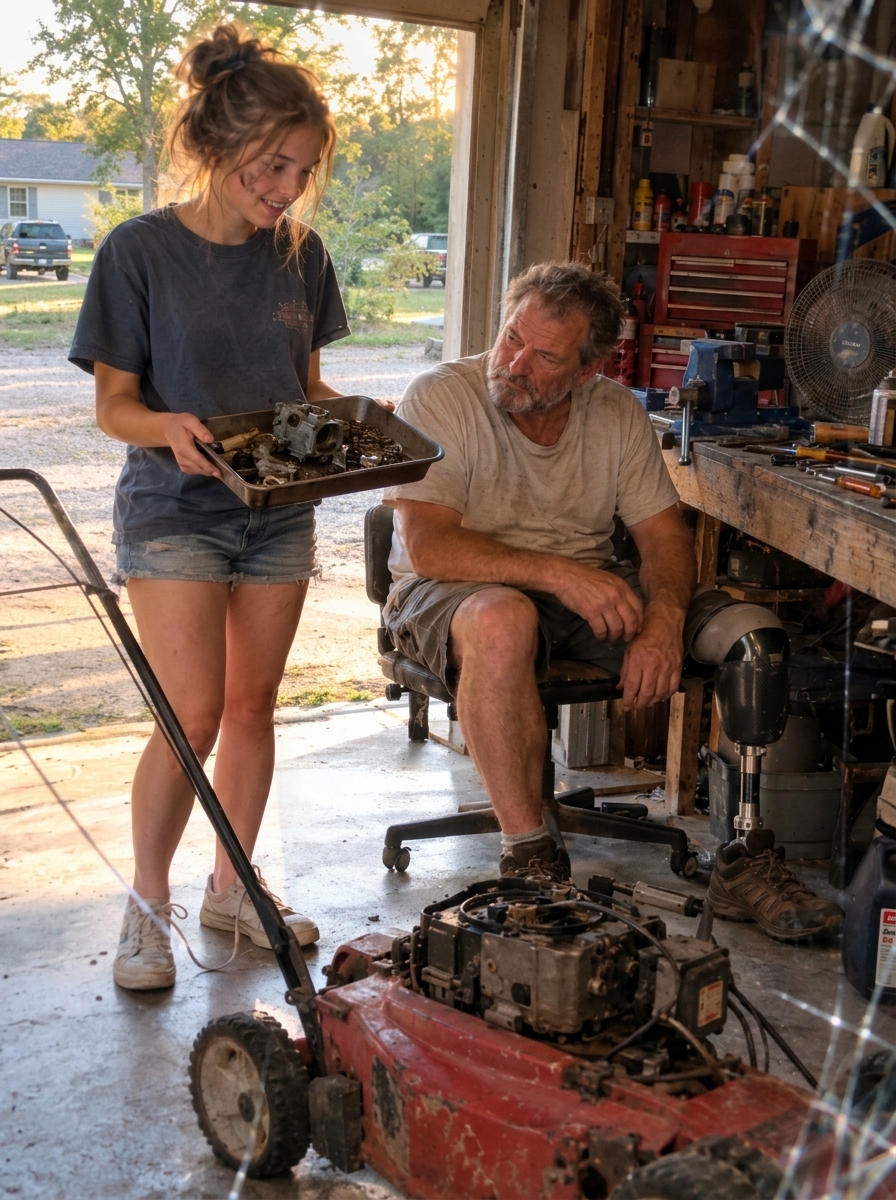
Seventeen years old, standing in my garage doorway with a greasy carburetor in a baking pan. One shoelace untied. A streak of dirt across her cheek.
I looked at the pieces, then at her.
“From the looks of that pan, we could be here awhile.”
“That’s okay,” she said. “I told my mom I’d be late.”
My name is Deacon Webb. I’m fifty-eight, and for thirty-four years, people around our little Alabama town brought me things that wouldn’t run.
Trucks that coughed. Tillers that quit halfway through a garden. Lawn mowers that had spent the winter outside because somebody kept meaning to put them away.
Then an accident took part of my left leg, and I became the thing everybody kept meaning to check on.
People were good to me. I need to say that.
They built a handrail beside my steps. Brought casseroles. Drove me to appointments. My brother cut my grass without asking, which was the only way I would’ve let him.
But eventually, folks went back to their lives.
I stayed home with mine.
The garage sat thirty feet from my back door. I could get there fine once I learned my way around with the prosthetic leg, though some days were harder than others.
Getting there wasn’t the trouble.
Knowing what to do with myself once I arrived was.
I covered my old engine bench with a faded canvas tarp. Underneath were the vise my father had given me, a little rebuilding stand, and sockets arranged in an order nobody understood but me.
I told people I was taking a break.
After eight months, they stopped asking when the break would end.
Then Willa knocked.
She lived two houses down with her mother and grandfather. I remembered her as a little kid riding a pink bicycle with one training wheel that never touched the ground.
Now she was tall enough to look through the screen door without standing on her toes.
“Granddad’s mower won’t start,” she said. “Mom says you used to fix those.”
Used to.
Two harmless words. I found a way to resent them anyway.
“Not anymore.”
“Could you look at it?”
“No, ma’am.”
She glanced past me toward the garage.
“You sell your tools?”
“No.”
“Then how come—”
“Because I’m finished fixing things.”
She stood there a second, chewing the inside of her cheek.
Then she said, “Okay,” and left.
I figured that was the end of it.
Three days later, she came back with the baking pan.
“I watched some videos,” she told me.
“That explains the loose parts.”
“They didn’t show what to do when this spring fell off.”
“Did you take a picture before you pulled it apart?”
She looked down into the pan.
I sighed.
She waited.
Finally, I dragged a chair over beside the small folding table where I’d been stacking unopened mail.
“Set it there.”
Her face brightened so fast I had to look away.
“I’m telling you what to do,” I said. “You’re doing it.”
“That’s what I asked.”
That first evening, she dropped the same screw three times.
She called the carburetor “the little metal lung,” argued that a part shouldn’t have two names, and asked why I kept telling her to slow down when I’d also complained about how long she was taking.
“You always this contrary?” I asked.
“Mom says it’s why she has gray hair.”
For the first time in a long while, I laughed without somebody trying to make me.
She came back Thursday with the mower in a borrowed garden cart.
It was an old red push mower, faded almost pink along the top. A strip of electrical tape held the foam grip together.
“That thing belongs in a museum,” I said.
“Granddad says that about your truck.”
“Your granddad owes me forty dollars from 2009.”
“He said you might mention that.”
We worked with the garage door open. A box fan rattled in the corner, and the evening smelled like warm pavement and somebody’s supper cooking.
Willa turned the wrenches. I talked.
When my leg bothered me, I shifted in the chair. She noticed but didn’t announce it, didn’t ask whether we should quit, didn’t give me that worried look I’d come to dread.
She just moved the parts tray closer.
On the fourth evening, I asked why she was going to all this trouble.
“Your mother could get somebody to cut the yard.”
“She does.”
“Then what do you need the mower for?”
Willa wiped her hands on a rag before answering.
“Granddad used to do everybody’s yard. Ours, the lady next door, that empty house when it was for sale.”
I nodded. I remembered.
“His hands hurt now. He can still do some things, but every time he starts something, Mom says, ‘Let me get that.’ I say it, too.”
She picked at a loose thread on the rag.
Subscribe to Tatticle!
Get updates on the latest posts and more from Tatticle straight to your inbox.
Website
Your Email…
Subscribe
We use your personal data for interest-based advertising, as outlined in our Privacy Notice.
“Last week, he told somebody on the phone he was just taking up room.”
I looked toward my covered bench.
“He doesn’t have to mow the whole yard,” she said. “I thought maybe he could do a strip. Or show me how he gets those straight lines.”
“Has he asked you to fix it?”
“No. He told me not to bother.”
She smiled a little.
“I figured you two might get along.”
That night, after she went home, I stayed in the garage.
There was a small trail of dirt where she’d rolled the mower in. A socket sat on the floor beneath the table. She had written “TAKE PICTURE FIRST” on a piece of cardboard and propped it against the wall.
For months, that garage had looked exactly the way I’d left it.
Now there was evidence somebody expected to come back.
The next afternoon, I went out before she arrived.
I sorted the parts we still needed. Found a better light. Cleared a drawer for the tools she kept reaching for.
When Willa walked in, she noticed all of it.
She had the good sense not to say much.
“Am I late?”
“Clock’s right there.”
“You could’ve just said you missed me.”
“Get your safety glasses.”
It took us two more evenings.
When that mower finally started, it sputtered, shook, and settled into a steady rumble.
Willa threw both hands in the air.
I hollered, “Well, look at that!”
She was grinning at me, and I realized I was standing beside my chair. I’d gotten up without planning it, too interested in the engine to think about anything else.
We shut it down, and she wheeled it home.
About twenty minutes later, she returned with her grandfather.
He ran one hand over the taped handle, then looked at me.
“Appreciate what you did, Deacon.”
“She did the work.”
Willa started to object.
I shook my head.
“She did,” I told him. “Every bit of it.”
The old man looked at his granddaughter differently then. Like he’d been watching her grow taller and somehow missed the rest.
“Guess you’ll have to help me keep it going,” he said.
“I guess you’ll have to teach me those straight lines.”
They took it home together, walking slowly enough for each other.
Willa came back the next evening empty-handed.
“What broke now?” I asked.
“Nothing.”
“Then what are you doing here?”
She leaned against the doorframe.
“What should we tackle next?”
I almost told her there wasn’t anything.
The words were right there, worn smooth from use.
Instead, I looked around the garage. There was an old tiller in the corner. My brother’s generator. Plenty of things I’d decided were somebody else’s problem.
I took hold of the canvas tarp and pulled.
Dust rose in the evening light. My father’s vise was right where I’d left it.
“Bring a notebook tomorrow,” I said.
Willa smiled.
I still have difficult days. Some mornings, getting out to the garage takes longer than I’d like.
But there are two chairs beside the bench now, and I’ve learned to leave the second one clear.
Sometimes the kindest thing you can say to someone is, “I still need you.”
PART 2: The Girl I Taught to Fix Engines Made a Choice Her Mother Couldn’t Accept—and Somehow Asked Me to Defend It
Three weeks after I told Willa to bring a notebook, her mother walked into my garage holding a college brochure like it was evidence in a criminal case.
“Deacon,” she said, “I need you to stop encouraging this.”
Willa was standing at my bench with half a pressure washer pump spread in front of her.
She froze.
I looked at the brochure.
Then at Willa.
Then at her mother.
“Encouraging what?”
Her mother pointed toward the workbench.
“This.”
That was how Part Two started.
Not with something broken.
With three people who all believed they were trying to fix the same girl.
And not one of us agreeing on what was wrong.
By then, Willa had been coming to my garage almost every afternoon.
Sometimes she brought something that needed repair.
Sometimes she brought nothing but questions.
She kept that notebook tucked in the back pocket of her jeans, edges curled from sweat and grease.
The first page still said:
TAKE PICTURE FIRST.
I had added underneath it:
AND DON’T PUT SCREWS WHERE YOUR ELBOW CAN FIND THEM.
She had responded:
VERY FUNNY.
There were diagrams now.
Fuel lines.
Belts.
Spark plugs.
Notes about compression and air filters and why you should never trust a bolt that felt “almost tight enough.”
Her handwriting changed depending on how excited she was.
Neat at first.
Slanted when she understood something.
Nearly unreadable when she thought she had figured something out before I did.
I pretended not to enjoy that part.
One Saturday morning, she rebuilt the pull starter on my brother’s generator without me touching it.
She pulled the cord.
The engine fired.
She looked at me.
I shrugged.
“Beginner’s luck.”
“You say that every time.”
“One day I’ll be right.”
My brother, Dean, had been standing by the garage door watching.
He handed her twenty dollars.
She stared at it.
“What’s this?”
“Labor.”
“I was practicing.”
“You practiced on my generator.”
She looked at me like I was supposed to settle the matter.
“Take it,” I said.
“But—”
“First rule of working for family.”
She smiled.
“Charge extra?”
“That’s the second rule.”
Dean called me something unkind under his breath.
It felt good.
Normal.
That might have been the dangerous part.
The garage started feeling normal again.
Word traveled because words always travel in little towns, especially when people have nothing better to do than remember what everybody else once said they’d never do again.
Somebody told somebody that Deacon Webb was fixing things.
I corrected that the first six times.
“Willa’s learning.”
People heard what they wanted.
A weed trimmer appeared beside my garage one morning with a note taped to the handle.
NO RUSH. — FRANK
I carried it back to Frank’s porch.
He brought it back the next day.
I returned it again.
On the third day, Willa said, “You two planning to keep exercising with that thing?”
I pointed at her.
“Don’t get involved.”
She waited until I went inside for coffee.
When I came back out, the trimmer was on the bench.
“You have betrayed me.”
“Frank said he’ll pay.”
“That makes it worse.”
She grinned.
We fixed it.
Actually, she fixed it.
I showed her where to look.
She found the cracked fuel line herself.
Frank paid her thirty dollars and gave me a bag of tomatoes.
“I did nothing,” I told him.
“I know,” Frank said. “That’s why you get vegetables.”
The following week, there was a leaf blower.
Then a chain saw that hadn’t run in four years.
Then a little garden cultivator belonging to Mrs. Raines from three streets over.
I drew a line when somebody tried to leave an entire riding mower.
“Absolutely not.”
Willa looked disappointed.
“That one has a cup holder.”
“That one weighs more than both of us put together.”
“We have a jack.”
“We have common sense, too. Somewhere.”
The riding mower left.
For the first time since my accident, I began opening the garage door before breakfast.
Not every morning.
I wish I could tell you recovery moves in a straight line.
It doesn’t.
Some mornings the socket where my leg ended felt sore before I even put the prosthetic on.
Some days I hated the weight of it.
Some days I hated needing to think about things I used to do without thinking.
Steps.
Uneven ground.
Standing too long.
Whether a chair was close.
Whether rain had made the driveway slick.
There were mornings I sat on the edge of my bed staring at the prosthetic and feeling like I was negotiating with a piece of equipment I had never ordered.
On those mornings, the garage could wait.
Willa learned that.
She never came to the back door asking why I wasn’t outside.
She never said, “Are you okay?”
I appreciated that more than I could explain.
Instead, she would send a message.
I’m going through the carburetor parts. Don’t worry, I’m only losing the important pieces.
That usually got me moving.
She had figured out something plenty of grown people never did.
Helping somebody and hovering over somebody are not the same thing.
Needing help did not mean I wanted to become a full-time audience for everybody’s concern.
She understood because of her grandfather.
I think that was why we worked.
Her grandfather, Lowell, started coming over sometimes.
He was seventy-six and had arthritis in both hands.
He could still do more than his family thought he should.
Not everything.
But more.
That bothered him.
He and I sat near the open garage door while Willa worked.
Two older men giving instructions nobody had requested.
“You’re cross-threading that,” Lowell would say.
“She’s not,” I’d tell him.
“She’s thinking about it.”
“You can’t think about cross-threading.”
“You’d be surprised what that girl can accomplish.”
Willa would close her eyes.
“You know I can hear both of you.”
That was usually when we laughed.
She started mowing with Lowell once a week.
Not the whole yard.
He would take the first two passes.
Slow.
Careful.
Then he’d sit under the pecan tree drinking sweet tea while Willa finished.
The stripes weren’t perfectly straight.
He complained.
She told him to get stronger glasses.
He told her that was disrespectful.
She asked where she had learned it.
He laughed so hard he nearly spilled his tea.
For a while, I thought maybe that was all the story was going to be.
An old mower.
A girl learning tools.
Two men finding useful places to sit.
I should have known better.
Real life rarely stays inside the lesson you think it is teaching.
The pressure washer arrived on a Tuesday.
It belonged to Willa’s mother, Rachel.
She used it around the small property management office where she worked.
The pump had stopped building pressure.
Willa hauled the machine into my garage after school.
“You get permission?”
“For the pressure washer?”
“For touching your mother’s equipment.”
“She said if I can fix it, I can save her a repair bill.”
“That sounds dangerously close to approval.”
“Don’t get excited.”
She was quieter than usual.
I noticed around fifteen minutes in.
Normally, Willa filled silence like it offended her personally.
That afternoon, she barely spoke.
She pulled the pump.
Set the bolts in a tray.
Took pictures without being reminded.
That last part worried me.
“You sick?”
“No.”
“Boy trouble?”
She gave me such a look I nearly apologized.
Nearly.
“Girl trouble?”
“No.”
“School?”
She kept working.
That was my answer.
I waited.
There are people who believe teenagers will tell you anything if you ask enough questions.
Those people have apparently never met a teenager.
I picked up a rag and cleaned a wrench that was already clean.
Finally, she said, “Did you always know you wanted to be a mechanic?”
“No.”
She looked up.
“You didn’t?”
“At seventeen, I wanted a motorcycle, a mustache, and enough money to move somewhere nobody knew me.”
“What happened?”
“Couldn’t grow the mustache.”
She tried not to smile.
“What did you think you’d do?”
“I didn’t know.”
I leaned back.
“My father knew engines. I liked working with him. Then I got hired at a repair shop after graduation. One thing led to another.”
“So nobody had a plan for you?”
“My mother had plans.”
“What plans?”
“For me to wear clean clothes.”
That finally got a laugh.
Then she looked back at the pump.
“My mom has a plan.”
There it was.
I waited.
Willa reached into her back pocket and pulled out a folded envelope.
She set it beside the pressure washer.
Inside was a letter.
A nice letter.
Heavy paper.
Official-looking seal from a private college I had heard people around town mention with the tone they usually reserved for country clubs and heart surgeons.
She had been accepted to a summer academic program.
Engineering.
Six weeks.
Housing included.
Some kind of scholarship covered most of the cost.
I read it twice.
“Willa.”
“I know.”
“This is impressive.”
“I know.”
“You sound thrilled.”
She put a wrench down.
“I don’t want to go.”
I looked at her.
She kept staring at the pump.
“Why?”
“I just don’t.”
“That explanation might work on your mother.”
“It didn’t.”
I folded the letter.
“What’s the real reason?”
She rubbed the dirt off one thumbnail.
“They keep talking about engineering like it means designing things on computers.”
“Engineers do more than that.”
“I know.”
“Then what?”
She took a breath.
“I like this.”
She gestured around my garage.
Not much to look at.
Oil stains.
Old cabinets.
Fans that rattled.
Tools accumulated over decades.
My father’s vise.
A refrigerator that had been old when I bought it.
“This what?”
“Fixing things.”
I didn’t answer.
She continued.
“I like figuring out why something doesn’t work.”
“That’s engineering.”
“No.”
She shook her head.
“I like touching it.”
That shut me up.
She searched for the words.
“I like taking something apart and seeing what somebody else made. I like getting grease on my hands. I like when you can hear the difference after you fix it.”
She looked embarrassed now.
Like she was confessing something.
“I like when somebody thinks they need a new machine and you can make the old one run.”
I understood that feeling better than she knew.
I also understood something she didn’t.
Liking a thing and making a life from it are two different questions.
“Your mother wants you to go to that program?”
“She already told everybody.”
“That’s not what I asked.”
“Yes.”
She picked the wrench back up.
“She keeps saying nobody in our family has had an opportunity like this.”
“Maybe they haven’t.”
“She says I’m good at math.”
“Are you?”
“Yes.”
“Then that’s unfortunate.”
She smiled despite herself.
“She wants me to study engineering somewhere big.”
“Would that be terrible?”
“No.”
The word came too quickly.
Then she said it again.
“No. It wouldn’t be terrible.”
That was the trouble.
If Rachel had been demanding something cruel or ridiculous, the problem would have been easy.
She wasn’t.
She wanted her daughter educated.
She wanted doors opened.
She wanted Willa to have choices Rachel believed she had never been offered.
Those are not bad things.
That is what made what happened next difficult.
“What do you want?” I asked.
Willa looked toward the open door.
“My school has a program with the technical college.”
I knew about it.
Students could spend part of the school day learning welding, industrial maintenance, electrical work, automotive systems, things like that.
She said, “They have small-engine and equipment repair.”
I nodded.
“Mom says that can be my hobby.”
“And you?”
“I think maybe it could be my work.”
I felt something tighten inside me.
Not because I disapproved.
Because suddenly I understood why she had asked me.
This wasn’t a carburetor.
There was no diagram.
No torque setting.
No part number.
If I told her one thing and she regretted it, I couldn’t order another future from a catalog.
“You’re seventeen,” I said.
“I know my age.”
“You’re allowed to not know yet.”
“That’s what I keep saying.”
“Your mother’s allowed to worry.”
“I know.”
She sounded annoyed that I wasn’t immediately taking her side.
Good.
That meant I was doing something right.
“I thought you’d understand.”
“I do understand.”
“Then why are you defending her?”
“Understanding you doesn’t require me to declare everybody else stupid.”
She looked away.
That one landed.
I softened my voice.
“Willa, your mother probably looks at you and sees every chance she didn’t have.”
“And I’m supposed to live the life she didn’t get?”
“No.”
I paused.
“But you ought to understand what she thinks she’s protecting.”
Willa blinked hard once.
Then turned back toward the pressure washer.
“I’m taking this pump apart.”
“Excellent idea.”
We didn’t solve her future that afternoon.
We did solve the pressure problem.
One battle at a time.
Rachel arrived around six.
She stepped into the garage still wearing the clothes she worked in.
Blouse.
Slacks.
Flats that immediately found the one spot on my floor with spilled oil absorbent.
She looked at the pressure washer.
Then the parts.
Then me.
Then she noticed the acceptance letter.
Her face changed.
“You showed him?”
Willa straightened.
“I asked him a question.”
Rachel folded her arms.
“What question?”
“About what I should do.”
That is when Rachel looked at me in a way I knew instantly.
She thought I had already answered.
“Deacon,” she said, “I need you to stop encouraging this.”
“Encouraging what?”
She pointed toward the workbench.
“This.”
Willa’s face went red.
“Mom.”
“I’m not saying there’s anything wrong with it.”
Rachel looked at me quickly.
“I mean no disrespect.”
“None taken yet.”
She sighed.
“I’ve spent seventeen years telling her she can do anything.”
“And now I picked the wrong anything,” Willa said.
“That is not what I said.”
“It’s what you mean.”
Rachel turned toward her daughter.
“You have options people would give anything for.”
“I know.”
“Then why are you acting like I’m punishing you?”
“I’m not.”
“You refuse to even visit the campus.”
“Because I don’t want to go there.”
“You haven’t seen it.”
“I don’t want to live there.”
“For six weeks.”
“And then what?”
“Then maybe you realize the world is bigger than this town.”
That sentence changed the air.
Willa looked at her mother.
I looked down at my hands.
Rachel heard it, too.
I could tell by the way her face shifted.
But words do not return to your mouth just because you regret them.
Willa glanced around the garage.
At Lowell’s mower parts.
At my father’s vise.
At the drawer I had cleared for her.
“So that’s what this is really about.”
“I didn’t say—”
“You think staying here means I failed.”
“No.”
“You think people who work with their hands failed.”
“No, Willa.”
“Then say you’d be proud if I did this.”
Rachel opened her mouth.
Nothing came out.
That silence hurt worse than if she had yelled.
Willa grabbed her notebook.
She walked past her mother.
Rachel called her name.
Willa kept going.
The garage became very quiet.
I remained seated.
Rachel stared through the open door until her daughter disappeared around the hedge.
Then she closed her eyes.
“I handled that badly.”
“Yep.”
She looked at me.
“You could soften it.”
“You came to the wrong garage.”
She gave a tired little laugh.
Then she sat in Willa’s chair.
That bothered me.
I don’t know why.
Maybe because by then it had become Willa’s chair.
Rachel looked around.
“I don’t think this is beneath her.”
“I believe you.”
“My father was a welder.”
“I remember.”
“He came home exhausted.”
“That happens.”
“His shoulders hurt before he was fifty.”
“That happens, too.”
“He used to tell me, ‘Use your head so you don’t have to use your back.’”
I nodded.
“That generation said a lot of things while lifting objects they should’ve asked for help with.”
She smiled faintly.
Then her eyes filled.
“I was twenty when I had Willa.”
I knew that.
“Her father and I were barely adults.”
I didn’t know where he was now.
Hadn’t seen him in years.
Rachel didn’t talk about him.
She said, “I worked two jobs for a while. I took classes at night. Quit. Started again. Quit again.”
Her voice dropped.
“I kept telling myself Willa would never have to make every decision based on what bill was due Friday.”
That I understood.
She looked at the tools.
“When her teachers said she was gifted in math, I thought…”
She stopped.
“What?”
“That maybe all that struggling had bought something.”
There are moments when you realize an argument has two people standing on opposite sides of the same fear.
Rachel was afraid her daughter would make her life smaller.
Willa was afraid her mother would choose her life for her.
Neither one wanted the other hurt.
That did not make either one feel less hurt.
“She thinks I’m ashamed of people who do this kind of work,” Rachel said.
“Are you?”
“No.”
Then she hesitated.
I raised an eyebrow.
“That pause is gonna cost you.”
Rachel rubbed her forehead.
“I’m scared she’s choosing it because it’s comfortable.”
I considered that.
“She is comfortable here.”
“That’s what I mean.”
“She’s also good.”
“I know she’s good.”
“She learns faster than I did.”
“That’s not helping.”
“I’m not trying to help you win.”
She looked at me.
“I thought you were supposed to be the reasonable adult.”
“I lost part of a leg and started arguing with teenagers in my garage.”
“Fair point.”
We sat there for a while.
Then Rachel said something I did not expect.
“Would you have wanted this life for your own kid?”
I looked at her.
I never had children.
Everybody around town knew that.
My marriage had ended years ago, quietly enough that most people never learned which one of us left first.
Neither did I, if I’m being truthful.
Some endings happen a little every day.
Rachel immediately regretted the question.
“I’m sorry.”
“It’s okay.”
“No, that was—”
“I said it’s okay.”
I looked toward the bench.
“Would I want this exact life?”
I thought about thirty-four years of repairs.
Customers who paid late.
Customers who never paid.
Summer heat.
Winter mornings.
Cut knuckles.
A bad back even before the accident.
The smell of gasoline in clothes no washing machine fully removed.
Then I thought about the fathers teaching sons.
Granddaughters fixing grandfathers’ mowers.
People driving away with something working again.
The satisfaction of turning a key and hearing an engine catch.
The thousands of times somebody had said, “I thought I was gonna have to replace it.”
The pride.
The headaches.
The independence.
The long days.
The good days.
“No,” I said finally.
Rachel looked surprised.
“I wouldn’t want my life for anybody.”
I tapped the bench with one finger.
“I’d want them to get their own.”
She was quiet.
“So what do I do?”
“You ask the wrong man.”
“You’re the man she listens to.”
That sentence sat wrong with me.
I turned toward her.
“No.”
Rachel frowned.
“What?”
“I’m one of the people she listens to.”
“That’s what I meant.”
“Not the same thing.”
She waited.
I said, “Don’t make me important by making yourself smaller.”
Her face tightened.
“She’s your daughter.”
“She barely talks to me lately.”
“She’s seventeen. Barely talking is one of their primary functions.”
That almost got another smile.
Then I added, “She wants you to be proud.”
“I am proud.”
“Then say it without attaching instructions.”
Rachel looked down.
That night, after she left, I covered the pressure washer parts with a rag.
Willa did not come back.
Not Wednesday.
Not Thursday.
Her chair stayed empty.
I told myself that was fine.
Teenagers had school.
Friends.
Jobs.
Lives.
I had managed fifty-eight years without waiting for Willa Hayes to appear in my driveway.
Friday afternoon, I cleaned the same section of bench four times.
Around five, Lowell wandered over.
“Where’s the boss?”
“I’m the boss.”
He stared at me.
“Where’s Willa?”
“Home, I assume.”
He leaned against the doorway.
“You two fight?”
“No.”
“Rachel?”
I glared at him.
“Small town.”
“That’s not an explanation.”
“It’s the only one you’re getting.”
Lowell lowered himself into Willa’s chair.
Everybody was sitting in that chair except Willa.
I was beginning to take it personally.
“She wants the technical program,” he said.
“I know.”
“Rachel wants college.”
“I know.”
“What do you think?”
“I think everybody needs to stop asking me.”
“That sounds like you have an opinion.”
“I have seventeen opinions.”
“Which one’s right?”
“That’s the problem.”
Lowell nodded.
Then he looked toward the covered pressure washer.
“When Rachel was little, she wanted to be a singer.”
I stared at him.
“Rachel?”
“Yep.”
“Your Rachel?”
“Could sing, too.”
I tried to imagine it.
Failed.
“She got offered a place in some youth choir in Birmingham.”
“What happened?”
“I told her no.”
That surprised me.
“You did?”
“Too far.”
He rubbed one stiff thumb across his knuckles.
“Cost money. We didn’t have much.”
He smiled without humor.
“I told her singing wasn’t a job.”
There it was.
A story repeating itself while wearing different clothes.
“Ever tell Willa that?”
“No.”
“Why not?”
“Because it ain’t my story to use against my daughter.”
I respected him for that.
“Ever tell Rachel you regret it?”
He looked at me.
“No.”
“Why?”
“Because apparently I’m old enough to know better and still dumb enough not to.”
I laughed.
He didn’t.
Then he said, “Maybe you ought to start charging for all this wisdom.”
“Then you’d owe me from 2009 plus interest.”
“That mower debt is fictional.”
“History will judge you.”
The next morning, Willa showed up at nine.
No greeting.
No explanation.
She put a battered portable air compressor on the bench.
“Mr. Bennett says it makes a terrible noise.”
“I know Mr. Bennett. Could be him making the noise.”
She tried not to smile.
I let her unpack her tools.
Five minutes passed.
Then I said, “Your chair missed you.”
“I heard people have been using it.”
I looked at her.
“Small town.”
She rolled her eyes.
We worked.
Or she worked.
I watched her test the compressor.
She listened closely.
Shut it off.
Adjusted something.
Started it again.
There is a particular look people get when they are trying to hear a mechanical problem.
Head tilted.
Eyes unfocused.
Like the answer might be hiding inside the noise.
Willa had that look now.
Natural.
Unforced.
She heard the rattle.
Found the loose mounting plate.
Then she discovered a worn rubber foot.
“Not bad,” I said.
“I know.”
There it was.
I had missed that.
When we finished, she wiped her hands.
“Mom apologized.”
“Good.”
“She still wants me to go.”
“That’s allowed.”
“She says you agree with her.”
I almost fell out of my chair.
“I absolutely did not say that.”
Willa grinned.
“Good.”
“You two need to stop using me like a witness in court.”
“She said you told her you wouldn’t want your life for anybody.”
I went still.
Rachel had repeated that.
Of course she had.
Willa waited.
“You said that?”
“Yes.”
Her expression changed.
Not angry.
Worse.
Disappointed.
I hated it immediately.
“You think I shouldn’t do this.”
“I didn’t say that.”
“You said you wouldn’t want your life for anybody.”
“Correct.”
“What’s the difference?”
“About thirty-four years.”
She folded her arms.
I sighed.
“Sit down.”
“I’m fine.”
“Then stand there dramatically.”
She sat.
I turned my chair toward her.
“When you look at this garage, what do you see?”
She looked around.
“Tools.”
“Try harder.”
“My genius mentor.”
“Strike one.”
She smiled despite herself.
Then thought.
“A place where things get fixed.”
“That’s what I saw at seventeen.”
“And now?”
I looked toward the driveway.
“I see every Saturday I worked while somebody else was at the lake.”
She listened.
“I see money I didn’t make because somebody said they’d pay Friday.”
I tapped my prosthetic lightly.
“I see a body that doesn’t work the way it used to.”
“That wasn’t because of the job.”
“No. But years of work leave marks before accidents ever happen.”
She nodded.
“I see good things, too.”
I ran my palm over the edge of the bench.
“More good than bad, most days.”
Then I looked directly at her.
“But if you choose this because you think I need you here, I’ll put every tool in this garage on the curb tomorrow.”
Her mouth opened.
“That’s not—”
“I mean it.”
“I’m not choosing it because of you.”
“Good.”
“Maybe you’re choosing for me because of what happened to you.”
That one caught me.
She continued.
“You spent your whole life fixing things. Then you got hurt, and suddenly everybody treated you like your useful part was over.”
I stared at her.
“So maybe you think the safe thing is for me to get some job where I sit behind a desk.”
“I never said that.”
“You didn’t have to.”
She was angry now.
Not disrespectful.
Just certain.
At seventeen, certainty comes in industrial quantities.
“You’re all doing the same thing,” she said.
“Who?”
“You. Mom. Granddad.”
“Your granddad is on your side.”
“No. Granddad wants me to stay because he doesn’t want everybody leaving.”
I had not considered that.
“Mom wants me to go because she thinks leaving means I’m doing better.”
She pointed at me.
“And you want me to keep every door open so nobody can blame you later.”
I blinked.
“That is an extremely rude amount of insight.”
She stood.
“I don’t want everybody’s reasons.”
Her eyes shone.
“I want mine.”
Then she left.
Again.
I sat alone in the garage.
On the wall, her cardboard sign still read:
TAKE PICTURE FIRST.
Maybe that was useful advice for more than carburetors.
Before pulling something apart, understand how it was put together.
I had been looking at Willa’s decision like there were two choices.
College.
Or tools.
Stay.
Or leave.
Success.
Or settling.
That was how everybody else was looking at it, too.
Maybe that was the first thing we had wrong.
Monday morning, I drove to her high school.
I had not been inside that building since sometime around the first Bush administration.
The floors smelled exactly the same.
I don’t know what schools use to clean tile, but apparently the recipe is protected by federal law.
I found the career counselor.
A woman named Mrs. Palmer.
I explained that I was a neighbor.
Not family.
Not guardian.
Not anybody with authority.
I said I wanted information.
She gave me information.
The technical program was not a dead end.
Students could earn certifications.
They could take general academic courses.
Some transferred later into engineering technology programs.
Some apprenticed.
Some went straight to work.
Some changed direction entirely.
In other words, it was education.
Just not the kind Rachel had pictured.
Then I called the summer program listed on Willa’s letter.
I asked questions there, too.
It was also not what Willa had pictured.
They had hands-on labs.
Mechanical design.
Manufacturing demonstrations.
A machine shop tour.
Teams building small prototypes.
It was not six weeks staring at a computer.
In other words, it was education.
Just not the kind Willa had pictured.
Everybody had been arguing about symbols.
Not facts.
College represented opportunity to Rachel.
The trade program represented choice to Willa.
Staying represented family to Lowell.
The garage represented purpose to me.
We had piled all that meaning onto two programs and then acted like the brochures themselves were fighting.
I called a meeting.
Nobody wanted to call it a meeting.
So I called it supper.
That got them there.
Tuesday evening, Rachel brought baked chicken.
Lowell brought potato salad.
Willa brought suspicion.
Dean wandered over because he smelled food and had no respect for family boundaries.
I pointed at him.
“You’re not part of this.”
“I brought rolls.”
“You may stay.”
We ate at a folding table in the garage because my dining room had not comfortably seated five people since I bought the house.
For the first ten minutes, nobody mentioned Willa’s future.
We discussed weather.
Someone’s new fence.
Whether Dean’s truck had always made that noise.
“It has not,” I told him.
“It’s fine.”
“Your definition of fine is why mechanics have mortgages.”
Eventually Willa put her fork down.
“Why are we here?”
“Because apparently I’m tired of people storming out of my garage.”
Rachel looked at her plate.
Willa looked at me.
I set two folders on the table.
“One is the technical program.”
Willa recognized it.
“The other is your summer program.”
Rachel looked interested.
I said, “I called both.”
Willa frowned.
“You called them?”
“Yes.”
“Why?”
“Because all four of us have been arguing confidently about things none of us bothered to investigate.”
Lowell lifted his fork.
“I haven’t been arguing.”
Rachel and Willa said, “Yes, you have,” at the same time.
He returned to his potato salad.
I explained what I had learned.
Nobody interrupted.
That was a small miracle.
Then I turned to Rachel.
“The summer program has hands-on mechanical work.”
She nodded.
I looked at Willa.
“And the technical program doesn’t lock you into one future.”
Willa said nothing.
“You can take certifications and still go on to college later.”
“I know.”
“Your mother didn’t.”
Rachel looked at her daughter.
“You knew that?”
“Yes.”
“Why didn’t you tell me?”
“Would you have listened?”
Rachel flinched.
Willa regretted it.
I saw that immediately.
Before either one could retreat into pride, I said, “Good. Now we’re finally at the real problem.”
Dean reached for another roll.
“This is better than television.”
“Go home.”
He stayed.
Rachel took a breath.
“I would have listened.”
Willa looked skeptical.
“I should have listened,” Rachel corrected.
That was better.
Then Rachel said, “I’m still afraid.”
Willa looked at her.
“Of what?”
Rachel did not hide behind the word “opportunity” this time.
“Money.”
Simple.
Uncomfortable.
Real.
“I don’t want you struggling.”
Willa’s face softened a little.
Rachel continued.
“I don’t want you thirty-five years old worrying one broken transmission can wipe out your savings.”
Nobody spoke.
“I don’t want you dependent on somebody else.”
Willa glanced around the garage.
“You think people in trades are dependent?”
“No.”
“I think you can be dependent in a suit, too,” Dean said.
We all turned toward him.
“What?”
He shrugged.
“My factory closed eight years ago. Half the office people got laid off before the maintenance crew did.”
I stared at him.
“That may be the smartest thing you’ve said since 1997.”
“Thank you.”
“It wasn’t praise.”
Rachel looked at Willa.
“I’m not saying a degree guarantees anything.”
“Then why does it feel like you think it guarantees I’ll be okay?”
Rachel didn’t answer quickly.
“Because I want something to guarantee you’ll be okay.”
There it was.
Every parent’s impossible wish, spoken out loud.
Willa’s eyes filled.
“Nothing does.”
“I know.”
“You can’t pick the safe life for me.”
“I know.”
Rachel’s voice cracked.
“I’m trying to learn that.”
Lowell stared down at his plate.
Then he said, “Rachel.”
She looked over.
He rubbed his hands together.
“I need to tell you something.”
His voice sounded different.
Smaller.
He told her about the choir.
About saying no.
About money.
About fear.
About dismissing singing as something that could not become a life.
Rachel did not move for a long time.
“I remember.”
Lowell looked surprised.
“You do?”
“Of course I remember.”
“I thought maybe—”
“I was sixteen.”
She gave a sad laugh.
“I remember everything.”
Lowell nodded.
“I was scared.”
“I know.”
“I thought I was keeping you from being disappointed.”
Rachel looked at him.
“You were.”
He blinked.
She continued.
“I was disappointed.”
That hurt him.
But she reached across the table and put her hand over his.
“I also understand now.”
He nodded once.
Tears stood in his eyes.
Nobody made a big scene about it.
Sometimes forgiveness does not need music.
Sometimes it looks like an old man putting his other hand over his daughter’s fingers.
Then Willa said, “I don’t want to wake up at forty and hate you.”
Rachel laughed through tears.
“Well, that’s comforting.”
“You know what I mean.”
“I do.”
“I also don’t want to wake up at forty and realize you were right.”
“That would be worse,” Dean said.
I pointed toward the driveway.
“Last warning.”
Willa laughed.
The tension broke.
Then I said the thing nobody expected.
“I think Willa should go to the summer program.”
Her head snapped toward me.
“What?”
Rachel sat straighter.
I held up one hand.
“And I think she should enroll in the technical track next semester.”
Now Rachel stared at me.
Willa blinked.
Lowell smiled.
Dean reached for another roll.
Willa said, “Both?”
“Why not?”
“The summer program is six weeks.”
“You have six weeks.”
“I have a job.”
“You can ask for leave.”
“What if I hate it?”
“Excellent.”
She frowned.
“Excellent?”
“Then you’ll know.”
I pointed at the technical program folder.
“And if you take that course and hate doing this every day, you’ll know that, too.”
Willa looked at me.
“You always say not to replace parts until you know what failed.”
“Correct.”
“So your advice is diagnostic testing.”
“Now you’re learning.”
Rachel leaned back.
“But what about applications?”
“What about them?”
“She’ll need to start thinking about college applications soon.”
I shrugged.
“Then she can apply.”
Willa looked horrified.
“Why would I apply if I might not go?”
“So the choice stays yours.”
That quieted everybody.
I looked at her.
“There is a difference between refusing a door and never having the key.”
She stared at the table.
“That sounds like something you practiced.”
“I thought of it while chewing chicken.”
Dean nodded.
“Good chicken.”
Rachel ignored him.
She looked at her daughter.
“If you do both…”
Willa waited.
“I can live with that.”
“Live with it?”
Rachel smiled.
“I am trying not to attach instructions to my pride.”
Willa smiled back.
“I’d be proud.”
There.
No condition.
No “if.”
No “but.”
Just proud.
Willa looked down quickly.
Teenagers will face a seized engine with less fear than a sincere compliment from a parent.
After supper, she stayed behind.
We washed dishes in the utility sink.
She handed me a plate.
“You really think I should go?”
“I really think you should find out what you’re turning down.”
“What if everybody there is smarter than me?”
“Some will be.”
“That’s encouraging.”
“You asked.”
“What if I’m the worst one?”
“Then you’ll have plenty of people to learn from.”
She dried a fork.
“What if I’m the best one?”
“Then try harder.”
She shook her head.
“You know what I mean.”
I did.
She was scared.
Finally.
That made me feel better.
Fear meant she understood the choice mattered.
“Willa.”
She looked at me.
“You don’t owe this town your future.”
She went quiet.
“You don’t owe your granddad staying.”
I continued.
“You don’t owe your mother leaving.”
Then I tapped the bench.
“And you sure don’t owe me this garage.”
Her eyes filled again.
“You’re getting emotional in your old age.”
“I’m fifty-eight.”
“Ancient.”
“Go home.”
She went to the summer program.
Rachel drove her.
Lowell checked the route three times even though nobody asked him.
I stood in my driveway when they left at six that morning.
Willa rolled down the window.
“You sure you can survive six weeks?”
“I survived before you learned what a carburetor was.”
“You’ll put the screws in the wrong tray.”
“Goodbye, Willa.”
She grinned.
Then they were gone.
The garage felt enormous.
For the first week, I hated it.
There were still two chairs beside the bench.
One stayed empty.
Then something unexpected happened.
A fourteen-year-old boy named Mason showed up pushing a weed eater.
“You Mr. Webb?”
“Depends.”
“My uncle said you teach people to fix stuff.”
“I teach one person.”
He looked around.
“Where is she?”
“Gone.”
“Oh.”
He started backing away.
“What’s wrong with that weed eater?”
He stopped.
I immediately regretted asking.
By the end of the afternoon, there were three chairs beside the bench.
Mason did not become another Willa.
Thank goodness.
One Willa was enough.
He talked less.
Dropped more screws.
Had the mechanical intuition of a folding chair.
But he listened.
Then Mrs. Raines’ grandson came.
Then a girl named Keisha from the next neighborhood who wanted to know how lawn equipment worked because she planned to help her aunt with a landscaping business.
Then Mr. Bennett started coming by, not to learn anything, but because his wife had died the previous winter and apparently my garage was the one place people let him sit without asking how he was “holding up.”
That phrase had begun to irritate him.
I understood.
By the fourth week, Saturday mornings looked ridiculous.
Teenagers.
Old men.
Broken equipment.
Cold drinks in a cooler.
A handwritten sign on the wall:
IF DEACON SAYS “DON’T TOUCH THAT,” ASK WHY BEFORE TOUCHING IT.
I knew exactly who had written it.
Willa sent messages from the program.
Pictures of machines.
Metal parts.
A small robotic arm.
A team project involving a water pump.
She complained about dorm food.
Mentioned a girl from Arizona who could solve equations faster than anybody she had ever met.
She mentioned a boy from Ohio who had already built a go-kart from scrap.
She did not sound intimidated anymore.
She sounded alive.
One evening she called.
Not messaged.
Called.
“That sounds serious,” I said.
“I think I like it.”
The sentence came out almost apologetically.
I smiled.
“Terrible news.”
“No, I mean I really like it.”
“I understood you.”
“The machine lab is amazing.”
“Good.”
“And there’s an instructor here who started as a diesel technician.”
“Good.”
“And one of the graduate students did the technical college route before transferring.”
“Good.”
She paused.
“You aren’t surprised?”
“No.”
“You thought I’d like it?”
“I thought you might.”
“Then why didn’t you tell me?”
“Because then you’d have spent six weeks trying to prove me wrong.”
Silence.
“That is unfair.”
“Is it inaccurate?”
Another silence.
“I hate talking to you.”
“Get in line.”
Then her voice changed.
“What if Mom was right?”
I knew what she meant.
“What if I should go to college?”
“Then go.”
“What about the technical program?”
“Take it.”
“What about working with engines?”
“Do that.”
“I can’t do everything.”
“No.”
There was the lesson.
The one nobody likes.
You can be anything is a nice thing to tell children.
You cannot be everything is what adults eventually learn.
Every choice opens roads.
Every choice closes some, at least for a while.
That does not mean you choose once and become trapped forever.
But it does mean time is real.
Money is real.
Bodies get older.
People change.
Plans cost something.
“You don’t have to decide your whole life this summer,” I told her.
“I know.”
“Do you?”
“No.”
“Good.”
She laughed.
When Willa came home six weeks later, she got out of Rachel’s car carrying two duffel bags and talking before both feet hit the driveway.
She had changed.
Not dramatically.
Still the untied shoelace.
Still the same laugh.
Still dirt under one thumbnail somehow.
But she stood differently.
Like the world had become larger without making home smaller.
She hugged Lowell.
Hugged Rachel.
Then walked straight to my garage.
She stopped in the doorway.
Three teenagers were working around the bench.
Mr. Bennett sat in the corner drinking iced tea.
Dean was explaining something incorrectly.
Willa looked at the extra chairs.
Then at me.
“What happened?”
I shrugged.
“Things got out of control.”
She stared at the wall.
At the new shelves.
At Mason’s notebook.
At the handwritten safety rules.
Then she looked back at me.
“You replaced me.”
“Repeatedly.”
She smiled.
Her eyes got wet.
“Move over.”
Mason looked up.
“Who are you?”
Willa put her duffel bag down.
“I’m the one who knows where he hides the good sockets.”
I pointed at her.
“Those were confidential.”
That fall, Willa enrolled in the technical program.
She also applied to colleges.
That confused people.
Apparently society prefers a young person’s future to fit neatly inside one sentence.
People asked her what she was “going to be.”
She started answering:
“I don’t know yet.”
Some adults hated that answer.
I loved it.
She learned welding basics.
Electrical diagnostics.
Engine repair.
She kept her advanced math classes.
Rachel toured two colleges with her.
Lowell taught her how to sharpen mower blades by hand.
I taught her how to tell a customer that the repair would cost more than the machine was worth.
That was harder than carburetors.
By spring, Willa had choices.
Real ones.
A college had offered her financial aid to study mechanical engineering.
The technical college offered her an apprenticeship placement with a regional equipment company.
She could work four days a week and take classes the fifth.
Rachel favored college.
Lowell favored the apprenticeship.
I refused to answer.
This made all three of them furious.
One Saturday, Willa cornered me beside the tool cabinet.
“You said you’d help.”
“I did help.”
“No. You’ve become annoyingly neutral.”
“I spent a year teaching you how to diagnose problems.”
“This isn’t an engine.”
“No kidding.”
“I want your opinion.”
“You want permission.”
She stopped.
That made her mad.
Because it was true.
“You want me to say the choice you already prefer is the correct one.”
“What if I do?”
“Then you don’t need me.”
She stared at me.
“What would you choose?”
“At seventeen?”
“Yes.”
“The apprenticeship.”
Her face brightened.
I held up a finger.
“At fifty-eight?”
She waited.
“I’d probably choose college.”
Her face fell.
“Helpful.”
“You asked what I’d choose. Trouble is, neither person is you.”
She crossed her arms.
“What am I supposed to do with that?”
“Grow up, apparently.”
She groaned.
Then she sat in her chair.
For almost ten minutes, neither of us spoke.
Eventually she said, “College feels like the bigger opportunity.”
“Maybe.”
“The apprenticeship feels like me.”
That was the first useful sentence.
I turned toward her.
“Then the question isn’t which future looks bigger.”
“What is it?”
“Which one do you want badly enough to accept the parts you won’t like?”
She frowned.
I explained.
“If you choose college, don’t choose the brochure.”
Choose the late-night studying.
The classes that make you feel stupid.
The cost.
Being away.
Sitting through things that bore you because they get you somewhere you want to go.
“And if you choose the apprenticeship, don’t choose the shiny toolbox.”
Choose early mornings.
Dirty clothes.
Starting at the bottom.
Being the young woman in a place where some people may still assume the guy beside you knows more before you speak.
Choose sore hands.
Choose learning what your body can handle.
Choose being patient when somebody calls what you do ‘just a trade.’”
She listened.
“Every life looks good if you only picture the parts people post pictures of.”
That one stayed with her.
A week later, she made her decision.
I will tell you what she chose.
But I need to tell you what happened first.
Because the night before she was supposed to accept one offer and decline the other, Lowell had a small problem with his mower.
Nothing dramatic.
The starter rope broke.
He wheeled it toward my garage himself.
Willa found him halfway down the sidewalk.
“Granddad, what are you doing?”
“Taking this to Deacon.”
“I can do it.”
“I know.”
“I’ll bring it.”
“I can bring it.”
She reached for the handle.
He held on.
They stood there.
Two stubborn people.
Same blood.
Same argument from opposite ends of a lifetime.
Then Willa slowly let go.
“Okay.”
Lowell pushed.
Not fast.
Not easily.
But himself.
She walked beside him.
That mattered.
They arrived at my garage together.
Lowell sat down.
Willa replaced the starter rope.
I watched.
When she finished, Lowell tested it.
One pull.
The engine started.
He smiled.
Then he shut it off.
“You know,” he said, “when you first fixed this mower, I thought you were doing it for me.”
Willa wiped her hands.
“I was.”
“No.”
He shook his head.
“You were giving me something back.”
She looked at him.
He continued.
“Turns out Deacon was right.”
“Careful,” I said. “That sentence is addictive.”
Lowell ignored me.
“A person needs to feel useful.”
Willa nodded.
Then he said, “But useful ain’t the same as needed.”
That caught all of us.
“What do you mean?” she asked.
He looked at his granddaughter.
“If you think we need you to stay, you’ll stay too long.”
Willa’s eyes filled.
“If you think we need you to leave and become something impressive, you’ll go for the wrong reason.”
He put one stiff hand over hers.
“Your mama and me will be all right.”
I looked away.
Some moments do not belong to the person telling the story.
The next morning, Willa accepted the college offer.
Rachel cried.
Lowell pretended not to.
I congratulated her.
Then Willa handed me another piece of paper.
She had also arranged to spend summers and some breaks working with the equipment company through a paid trainee program.
“You found a third door,” I said.
“You always said to check the whole system before ordering parts.”
“I am creating a monster.”
She left Alabama that August.
Not forever.
That was important to Lowell.
Not as important as he pretended.
The morning she left, she came by the garage before sunrise.
The second chair was empty.
Her chair.
She put her notebook on my bench.
I pushed it back toward her.
“Take it.”
“I filled it.”
“Start another.”
She shook her head.
“This one stays here.”
“Why?”
She opened to the first page.
TAKE PICTURE FIRST.
Then all the pages after it.
Notes.
Mistakes.
Drawings.
Questions.
A life beginning to take shape in pencil and grease stains.
She flipped to the final page.
There was one sentence.
DON’T LET THE SECOND CHAIR STAY EMPTY.
I stared at it longer than I should have.
“You get that dramatic tendency from your grandfather.”
“Mom says I get it from him.”
“That’s what I said.”
She hugged me.
I am not a man who enjoys surprise hugs.
At least that is what I continue telling people.
When she stepped back, she looked around the garage.
“You going to be okay?”
There was a time when that question would have irritated me.
Not anymore.
“I’ll have difficult days.”
She nodded.
We both knew that answer was larger than my leg.
“Me too,” she said.
“That’s usually how life works.”
She picked up her backpack.
Then stopped at the door.
“Deacon?”
“What?”
“You weren’t finished fixing things.”
I looked around the garage.
Mason’s toolbox sat under the bench.
Keisha had left a pair of gloves.
Mr. Bennett’s iced-tea cup was still beside his chair.
A broken trimmer waited near the door with somebody’s phone number taped to it.
“No,” I said.
“I guess I wasn’t.”
She smiled.
Then she left.
These days, people still bring machines.
Sometimes we repair them.
Sometimes we tell the owner it is time to let the old thing go.
There is wisdom in both.
The Saturday group still meets.
Nobody officially named it.
That would make it sound organized.
We are not organized.
We are a garage full of people ranging from fourteen to seventy-eight who occasionally remember where they put the ten-millimeter socket.
Willa comes home when she can.
The first Thanksgiving, she walked into the garage wearing a university sweatshirt.
Lowell looked at it.
“Expensive shirt.”
Rachel smacked his arm.
Then Willa rolled up the sleeves and helped Mason diagnose a fuel problem.
The next summer, she arrived in work boots from her equipment job.
Rachel took a picture.
Nobody mentioned the college brochure.
Nobody needed to.
I keep Willa’s first notebook in the drawer beside my father’s old wrench set.
And the second chair?
It is rarely empty anymore.
That turned out to be the part I misunderstood from the beginning.
I thought Willa needed me because I knew how to fix engines.
Maybe she did, for a while.
But that wasn’t the gift she gave me.
She reminded me that being useful doesn’t mean doing everything yourself.
Sometimes usefulness means teaching.
Sometimes it means listening.
Sometimes it means letting an old man push his own mower even though you could move it faster.
Sometimes it means allowing your daughter to choose a future that frightens you.
And sometimes it means telling a seventeen-year-old girl that there is no single respectable way to build a life.
College can be honorable.
A trade can be honorable.
Leaving home can take courage.
Staying can take courage.
Working with your mind is not better than working with your hands.
Working with your hands does not make education unnecessary.
The mistake is thinking somebody else’s definition of success has to become yours.
Rachel wanted security for her daughter.
Lowell wanted family nearby.
I wanted Willa to avoid regret.
Willa wanted room to become herself.
None of those desires were wrong.
But love becomes a burden when we turn our fear into somebody else’s instructions.
That is something I understand better now.
I spent months believing losing part of my leg had ended the life in which people needed me.
Then a girl walked into my garage carrying a carburetor in a baking pan and refused to accept my answer.
I thought I was teaching her how to repair an old lawn mower.
Instead, she taught all of us something harder.
You can love someone without choosing for them.
You can protect them without shrinking their world.
You can give advice without demanding obedience.
And when somebody you love is standing between two good roads, sometimes the kindest thing you can say is not:
“Take mine.”
Sometimes it is:
“I trust you to choose.”
There are still two chairs beside my workbench.
But now there are six more stacked against the wall.
Just in case.