
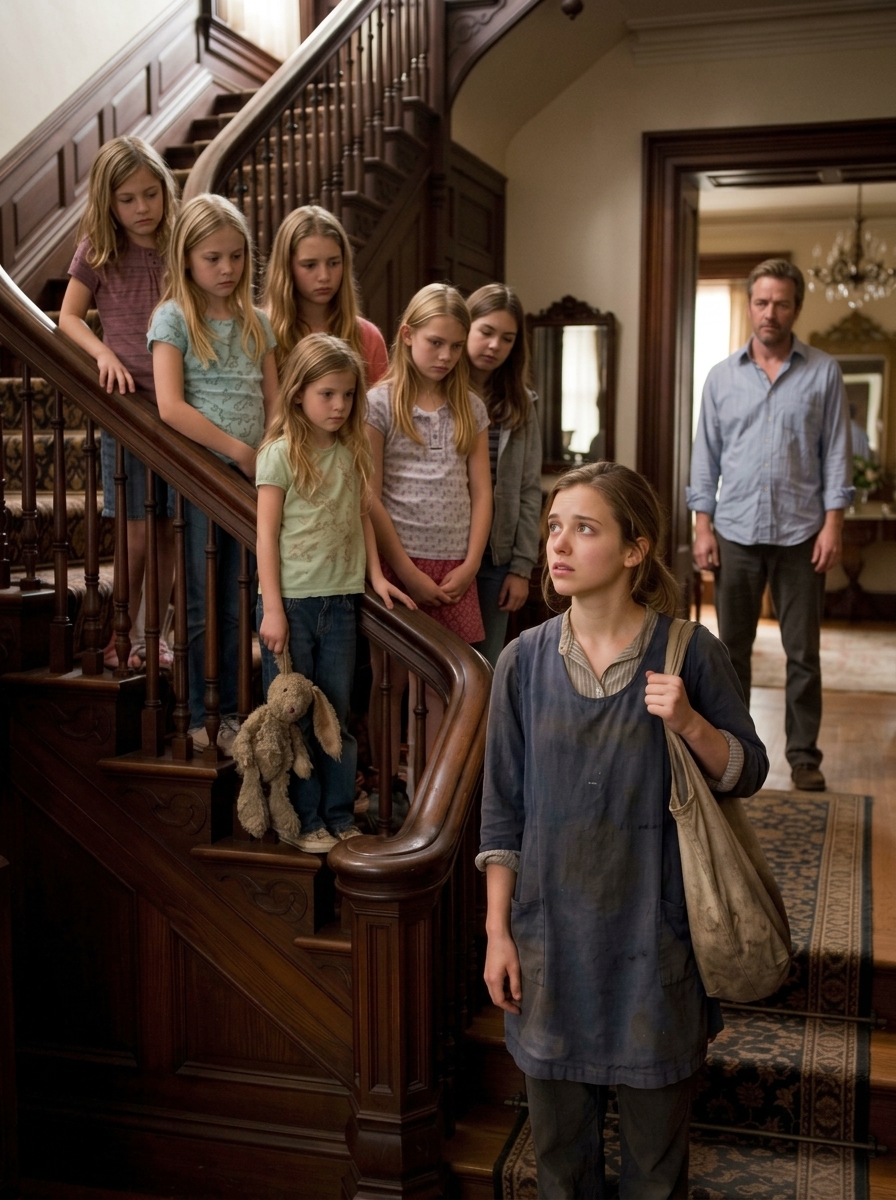
The Millionaire Burned Through Thirty-Seven Nannies in Fourteen Days—Then a Young Housekeeper Walked Into His Silent Mansion, Faced Six Broken Daughters, and Did the One Thing Their Father Never Could: She Stayed
“You’re number thirty-eight.”
The oldest girl said it from the staircase like a warning, not an introduction.
Sarah Coleman looked up from the front hall and saw all six sisters lined across the steps like they had practiced it. The oldest, Madison, stood stiff as a fence post, her face flat and unreadable. Brooke kept tugging at the sleeve of her sweater. Lily’s eyes darted everywhere at once. Emma looked pale enough to disappear into the wall. The twins, Ava and Mia, wore matching little smiles that didn’t reach their eyes. And tiny Chloe held a ragged stuffed rabbit by one ear like it was the last thing in the world she trusted.
Sarah set down her cleaning bag.
“Then I guess I better make number thirty-eight count.”
Nobody smiled.
For almost three weeks, the Hawthorne house had become the kind of address people whispered about in service circles and then avoided. It sat above San Francisco in one of those quiet, rich neighborhoods where the hedges were trimmed, the windows were spotless, and the homes looked too perfect to hold real pain.
But this one did.
Women had come in and left in tears. One had locked herself in the laundry room until a guard came to get her out. Another ran through the front gate at sunrise with blue paint dripping down her hair, screaming that the girls were cursed and that somebody whispered inside the walls after midnight.
Daniel Hawthorne had watched that one leave from his office window.
At thirty-seven, he was the kind of man business magazines liked to put on covers. Self-made. Sharp. Controlled. The founder of a giant cybersecurity company with offices in three states and investors who treated his time like gold.
None of that had helped him when his wife died.
None of it had helped his daughters either.
Now the man standing in front of Sarah looked like somebody who had not slept in weeks. His dress shirt was wrinkled. His jaw was rough with stubble. His eyes were bloodshot from grief and fear and the private kind of guilt fathers don’t know how to say out loud.
“It’s only cleaning,” he told her too fast, like he was trying to protect himself from being disappointed again. “My daughters are… struggling. I can’t promise anything easy.”
Right then, something crashed upstairs.
Then came laughter.
Not happy laughter.
The kind that made the house feel colder.
Sarah didn’t flinch. “I’m not here for easy.”
Back in her small apartment near the Mission, her rent was late, her sneakers were worn thin, and her college tuition bill was taped to the refrigerator with a magnet that had started to crack. She worked long cleaning shifts during the day and studied childhood trauma at night because some wounds don’t let go unless you turn and face them.
At seventeen, she had lost her little brother in a house fire.
Ever since then, fear had changed shape for her. Loud things didn’t scare her much. Silence did not scare her at all. Grief was a language she already spoke.
So she walked into the Hawthorne kitchen, found a note tucked inside a drawer in a woman’s neat handwriting, and read it twice.
Chloe likes banana pancakes shaped like animals.
Sarah made them without saying a word.
She left the plate on the table and walked away.
When she came back, little Chloe was eating with both hands, staring down at the pancakes like somebody had just performed a miracle in front of her.
Sarah didn’t say, See? She didn’t ask for praise.
She just washed the pan.
The twins came next.
They hid a rubber spider in her mop bucket and waited for the scream. Sarah lifted it out by one leg, studied it carefully, and handed it back.
“Not bad,” she said. “But if you really want to scare somebody, you need better timing.”
For the first time, the twins looked thrown off.
A woman who did not scare easy was new to them.
When Emma wet the bed, Sarah didn’t make a face, didn’t sigh, didn’t call for anyone else. She stripped the sheets and said softly, “Sometimes fear gets tangled up in the body. It happens.”
Emma stood there trembling, waiting to be shamed.
Instead, Sarah handed her a clean blanket.
That child followed her around for the next two days like a ghost learning how to trust.
Lily was harder.
Lily had panic in her blood now. One minute she would be fine, the next she would be gasping, fingers clawing at her own chest, eyes wide like she was trapped somewhere nobody else could see.
The first time it happened, Sarah found her curled under a table.
She dropped to the floor beside her.
“Look at me,” Sarah said gently. “Not the fear. Me.”
Lily tried. Failed. Tried again.
“That’s it. Breathe in for four. Hold it. Let it go slow.”
By the time the shaking eased, Lily’s face was wet.
“How do you know how to do that?” she whispered.
Sarah leaned back against the cabinet.
“Because once, somebody stayed with me long enough to teach me.”
Brooke had stopped playing piano after her mother died.
The instrument sat in the living room like a closed mouth.
One evening Sarah passed by and heard a single note. Then another. Then a mistake. Then a shaky little melody that almost collapsed halfway through.
She didn’t go in.
She just stood in the doorway long enough for Brooke to see that nobody was going to rush her, praise her too hard, or make the moment bigger than it was.
The girl finished the line with one finger.
The next night she played it again.
Madison was the one Sarah worried about most.
Twelve years old and already carrying herself like the second parent in the house. She watched everything. Counted everything. Measured every promise before she believed it. She tucked the twins in. She checked on Chloe. She cleaned up after everyone when she thought no one noticed.
Grief had turned her into a soldier.
And children are not supposed to have to become soldiers inside their own homes.
Daniel noticed the changes before he understood them.
He started coming home earlier.
At first he stood in the doorway while his daughters ate dinner together. Then he sat at the far end of the table. Then one evening Chloe crawled into his lap halfway through mashed potatoes, and the look on his face nearly broke Sarah’s heart.
Like he had forgotten he was still allowed to be loved.
Later that night, he found Sarah folding towels in the laundry room.
“What did you do,” he asked, “that I couldn’t?”
Sarah kept folding.
“I didn’t try to make them be okay.”
Daniel stared at her.
“I just stayed.”
For a while, that seemed like enough.
Then came the night everything broke open.
Madison locked herself in the upstairs bathroom.
By the time they got the door open, the world had turned into sirens and shouting and Daniel yelling his daughter’s name like it was the only word left inside him.
The hospital waiting room was bright in the cruel way hospitals always are. Plastic chairs. Burnt coffee. Vending machine hum. Doctors moving fast with blank faces that gave away nothing.
Daniel sat bent forward, elbows on his knees, hands hanging loose between them.
Then he started crying.
Not neat tears. Not quiet ones.
The kind a man saves up for too long until his whole body gives out under the weight.
Sarah sat beside him and said nothing.
Sometimes words are just noise around pain that deep.
So she stayed.
When Madison finally came back home days later, thinner and quieter and alive, nothing in that house went back to pretending. That was the real beginning. Not the pancakes. Not the piano. Not even the first laugh.
The beginning was the moment they all stopped acting like grief was something you beat by being tougher than it.
They began family counseling.
Daniel took fewer meetings.
The girls started saying their mother’s name out loud again.
Pictures of Eleanor went back up in the house, not hidden away like they were dangerous.
Months later, Sarah graduated with honors.
She walked across the stage in a borrowed dress, and when she looked out into the crowd, the whole Hawthorne family was there in the front row. Daniel in a dark suit. Madison sitting straight and proud. Brooke crying already. Lily waving both hands. Emma clutching flowers too tightly. The twins bouncing in their seats. Chloe asleep against Daniel’s shoulder until the applause woke her.
Sarah almost missed her own name being called.
Later, with Daniel’s funding and Sarah’s training, they opened a counseling center for grieving children in Eleanor’s memory. Nothing flashy. No giant sign. Just a warm place with soft chairs, books in the waiting room, and people who knew how to sit with pain instead of running from it.
One spring afternoon, beneath a magnolia tree blooming beside the center, the girls gathered around Sarah after a memorial event for their mother.
Madison stepped closer first.
Her voice was calm, but her chin trembled.
“You didn’t replace her,” she said. “You helped us survive losing her.”
Sarah covered her mouth and cried so hard she had to bend forward.
Chloe wrapped little arms around her leg.
The twins leaned into her sides.
Brooke wiped her own face with both hands.
Lily whispered, “We’re still here.”
Sarah looked at all of them, then at Daniel, standing a few feet away with tears in his eyes and gratitude written all over his tired face.
“That’s enough,” she said.
And it was.
The house that had scared everybody away did not become perfect.
That is not how healing works.
The grief stayed.
But love learned how to stay longer.