
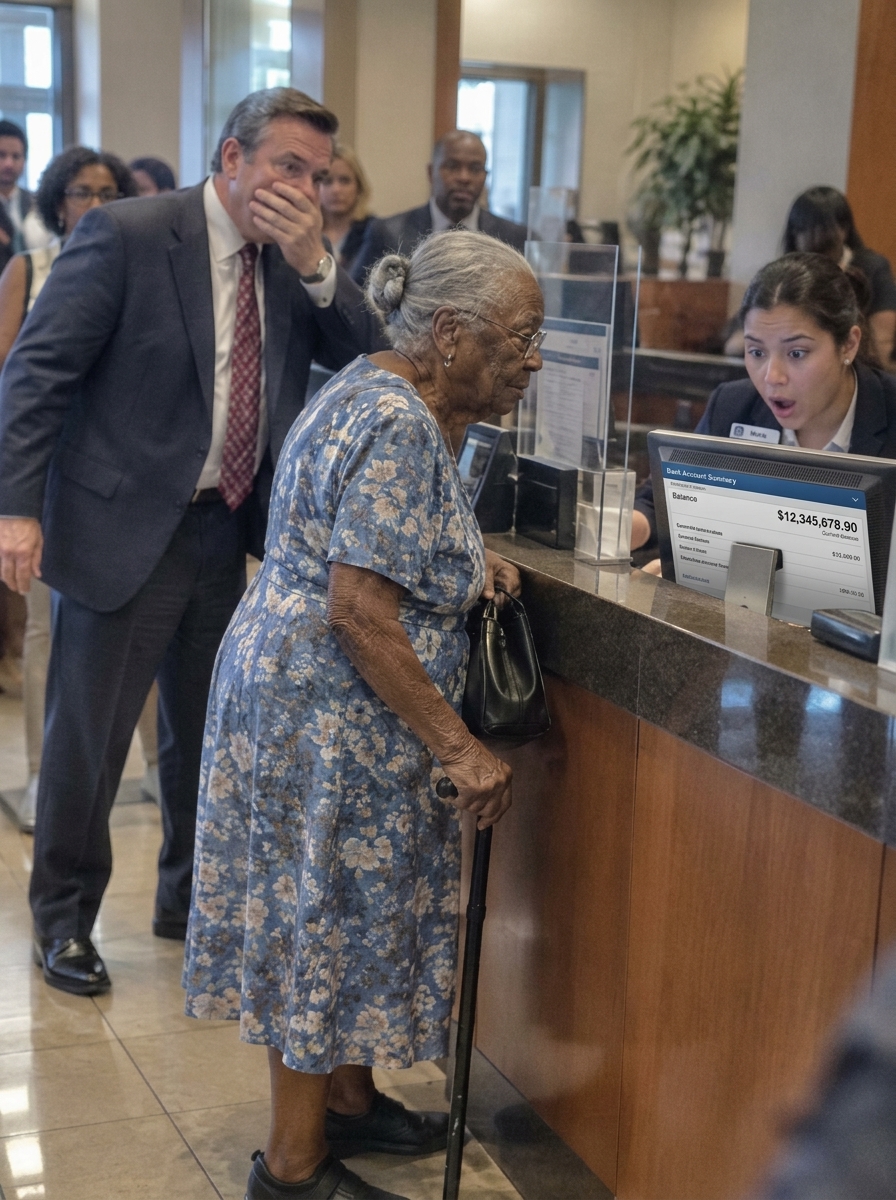
A 90-Year-Old Black Woman Whispered, “I Just Need to Check My Balance,” and the Loudest Man in the Bank Mocked Her—Until the Teller Read the Number Out Loud and the Whole Lobby Went Silent
“Ma’am, the ATM is outside.”
The man said it loud enough for half the lobby to hear.
A few people looked up from their phones. A few others pretended not to. Nobody stepped in.
Miss Evelyn Carter tightened her hand around the handle of her cane and turned, slow and steady.
She was ninety years old, small in the shoulders, dressed in a faded blue flowered dress and old orthopedic shoes. Her gray hair was pinned back neat. Her purse was soft with age, the kind of bag a person keeps for years because it still does its job.
She looked at the man behind her.
He was the kind of man people noticed the second he walked in. Expensive watch. Sharp suit. Bright tie. Loud voice. The kind of confidence that always seemed to need an audience.
He had been sighing through the whole line, glancing at his watch, muttering about wasted time and people who shouldn’t hold things up.
Now he gave her a thin smile that wasn’t kindness at all.
“If you’re only checking a balance,” he said, “you don’t need to stand in line with everybody else handling serious business.”
Miss Evelyn studied him for one long second.
Then she said, calm as church on Sunday, “Baby, I’ve been doing business in places like this since before you learned how to shave. You worry about your own money.”
A few heads turned harder at that.
The teller, a young woman with tired eyes and a patient smile, finally called Miss Evelyn forward.
“Good afternoon, ma’am,” she said softly.
Miss Evelyn handed over an old bank card, edges worn smooth.
“Sugar, I just want to check my balance.”
“Of course.”
The teller ran the card.
The man behind Miss Evelyn let out a little laugh under his breath, but he wanted people to hear it. You could tell.
He leaned one elbow on the counter divider and said, “This ought to be good.”
The teller’s fingers froze on the keyboard.
At first she frowned.
Then she blinked.
Then she leaned in closer to the screen like maybe she thought she had read it wrong.
The color drained from her face.
“Ma’am,” she said.
Miss Evelyn waited.
The teller swallowed. “I’m sorry. Let me verify that one more time.”
Behind them, the man chuckled again. “Yeah, better do that.”
The teller checked again.
Then a third time.
When she looked up, the whole mood around the counter had changed.
“Mrs. Carter,” she said, voice barely above a whisper, “your available balance is forty-eight million, seven hundred sixty-two thousand, three hundred nineteen dollars and forty-two cents.”
The lobby went so quiet it felt like the air had been pulled out of it.
Nobody moved.
Nobody coughed.
Even the man behind her stopped breathing for a second.
“What?” he snapped.
The teller didn’t answer him. She was still staring at Miss Evelyn.
Miss Evelyn only nodded, like she had expected no more and no less.
“That sounds about right,” she said. “Did the interest post this morning?”
“Yes, ma’am,” the teller said.
The man stepped closer, all color gone from his face.
“That’s impossible.”
The teller straightened a little. “Sir, please step back.”
“There’s no way,” he said, louder now. “She must have the wrong account. Or there’s a system issue. Or—”
“There is no issue, sir.”
His mouth opened, but nothing came out.
Miss Evelyn took the printed receipt with careful fingers and slipped it into her purse.
Then she looked over at him.
Not mean. Not smug.
Just steady.
“You seem troubled,” she said.
The man’s face had gone stiff with embarrassment, but pride made him reckless.
“I just don’t understand how someone like you has that kind of money.”
The words sat there ugly in the silence.
Someone near the chairs muttered, “Lord.”
But Miss Evelyn did not flinch.
“Someone like me?” she asked.
He tried to recover. “I just mean…”
“No,” she said. “I heard what you meant.”
The teller looked ready to disappear.
So did half the people standing nearby.
Miss Evelyn rested both hands on her cane and drew one long breath.
“My husband and I started with nothing,” she said. “Less than nothing, some days.”
Her voice was soft, but the whole room leaned toward it.
“We lived outside a small Oklahoma town in a clapboard house with a roof that leaked every spring. My husband worked sunup to dark. I took in sewing, cleaned homes, cooked for church dinners, and stretched one chicken three ways when I had to.”
Nobody interrupted.
“In 1962, we bought a piece of land folks laughed at. Hard dirt. Scrub grass. Too far out. Too dry. Too forgotten. People said we had thrown our money away.”
She smiled to herself, just a little.
“But my husband believed in land the way some people believe in luck. He said, ‘Leave something alone long enough, and the world will tell you what it is.’”
The teller’s eyes were shining now.
Miss Evelyn went on.
“Years later, some drilling company came through. Then another. Then another. Turned out that ugly little patch of land was sitting on more value than anybody around us had guessed.”
The rich man stared at her like the floor had shifted under him.
“We never changed much after that,” she said. “Didn’t see the point. We paid off debts. Sent our babies to college. Helped family when it was right. Helped strangers when it was needed. Gave to churches. Paid for medicine for folks too proud to ask. Covered tuition for children whose parents were working two jobs and still coming up short.”
Her eyes moved across the marble floor, the polished counters, the high ceilings.
“Money can make noise if that’s what you want from it. But real money doesn’t have to shout.”
The man looked like he wished the ground would open.
Miss Evelyn tilted her head.
“It just sits still,” she said, “and waits for character to reveal itself.”
Nobody missed the meaning.
A woman by the door actually covered her mouth.
The man cleared his throat. “I didn’t mean to offend you.”
Miss Evelyn held his gaze.
“Son, most people mean exactly what they say. They just get sorry when the room stops agreeing with them.”
That one landed hard.
He looked away first.
Miss Evelyn turned back to the teller. “Thank you, baby. You have a gentle way about you.”
The teller blinked fast and smiled. “Thank you, ma’am.”
Miss Evelyn tucked her purse under her arm and started toward the door, her cane tapping softly over the marble.
Tap.
Tap.
Tap.
She was almost past the man when she stopped beside him.
He didn’t look at her.
She said, quiet enough that people had to strain to hear, “The saddest kind of poor is the kind that dresses itself up and still comes in empty.”
Then she kept walking.
No rush. No drama. No need.
Just that slow, sure step of somebody who had nothing left to prove to anyone.
By the time the glass doors closed behind her, the lobby was still frozen.
The man stood there with his jaw tight and his eyes fixed on the floor.
Nobody said a word to save him.
And after that day, people in town started telling stories.
About the elderly woman in the faded dress who came in every Friday to check her balance herself.
About how she still drove an old sedan with a cracked bit of trim on the door.
About how she still clipped coupons, still sat on her front porch in the evenings, still brought pound cake to neighbors who were sick.
Then more stories came.
Quiet scholarships started showing up for kids who couldn’t afford tuition.
A community center in an old neighborhood got restored.
Several historic churches that had been one storm away from closing their doors got repaired roof to floor.
A fund appeared to help seniors pay for home care, prescriptions, and wheelchair ramps.
Her name wasn’t printed big on any of it.
Sometimes it wasn’t printed at all.
That was how Miss Evelyn liked things.
The loud man from the bank still came in sometimes.
But he was different after that.
No more sharp comments.
No more impatient speeches.
No more talking down to tellers or older folks or anybody wearing work clothes.
Humiliation had done what money never could. It had introduced him to himself.
And every Friday, right around noon, Miss Evelyn would come through those same doors in one of her flowered dresses, purse on her arm, cane in hand.
She would smile at the teller and say the same words every time.
“Sugar, I just want to check my balance.”
But by then, everybody in that lobby knew she wasn’t only talking about money.
She was checking the balance of patience against pride.
Of dignity against arrogance.
Of old values against new noise.
And every single time, she left richer than the loud people in the room ever understood.