My mother-in-law secretly hid my daughter’s passport, forcing her to miss the family vacation we’d spent five months planning — then told everyone it was “a lesson in respect.” I didn’t argue. I did this. Three days later, their lives started to collapse…

I didn’t expect the worst moment of my year to arrive between a baggage scale and a line of strangers arguing about sunscreen, but that’s where it happened.
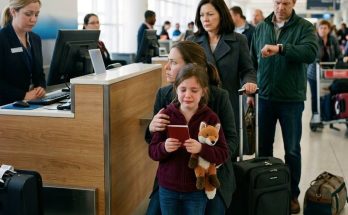
One second I was thinking about boarding groups and seat numbers, and the next, “Mom, they need my passport,” Ellie whispered and handed me an empty case.
Ellie is my 9-year-old.
She’s the kind of kid who tries her hardest at everything, even when she’s scared.
And she was so proud of being responsible for her own passport.
She’d been rehearsing this trip for weeks in her head, her big adventure, as she called it.
But none of that mattered at the moment her passport case opened like a magician’s trick with no punchline.
Nothing inside.
I blinked, checked again.
Nothing.
“Mom.” Ellie’s voice cracked. “It was in there. I put it in myself. I did.”
My heart dropped so fast I felt dizzy.
Behind us, my mother-in-law, Carol, leaned on her rolling suitcase and stared with the detached interest of someone watching a stranger assemble IKEA furniture incorrectly.
Next to her was her husband, George, who looked perpetually inconvenienced by the existence of other people.
Somewhere ahead, my sister-in-law Janelle, Brian’s golden, faultless sister, was herding her two boys through the security line like they were VIPs at an amusement park.
We were flying to Cancun.
International flight.
Passport required.
My stomach was already braced for airport chaos.
I hadn’t planned on bracing for this.
“We’ll find it,” I told Ellie, even though the words tasted like a lie.
We emptied her backpack.
No passport.
Checked her jacket.
No passport.
Checked my own purse, even though I knew it wasn’t there.
The airline agent gave us a sympathetic smile that made everything worse.
“I’m sorry,” she said quietly, “but without a passport, she cannot be checked in.”
Ellie’s face fell apart.
One second she was fighting tears.
The next, they flooded out like a dam breaking.
“I didn’t lose it,” she sobbed, panic taking over. “I didn’t. I didn’t. I swear I had it.”
“I know, sweetheart,” I murmured, pulling her close. “I know you’re sure you had it.”
Because honestly, what else was I supposed to believe?
Nobody sane jumps to, my mother-in-law must have stolen my child’s passport.
Carol stepped closer, voice honey-sweet and completely unhelpful.
“Poor thing. Maybe this will teach her to be more responsible with important things.”
I turned slowly.
“Not now, Carol.”
She raised her brows.
Innocent.
Fake.
“Just saying.”
Her husband chimed in.
“Well, we can’t all miss the trip because she misplaced something.”
Ellie sobbed harder.
I shielded her with my body, which is the only thing you can do when a child is experiencing pure humiliation in public.
My chest burned.
Someone behind us sighed loudly as if my daughter were an inconvenience in their personal travel documentary.
The agent cleared her throat again.
“If the rest of your family needs to continue checking in, they can step to the side.”
Of course they could.
Of course the world would spin on.
Carol spoke first.
“I mean, Anna, you shouldn’t let this ruin your trip. You paid for your seat. Brian can pick her up after work.”
“I’m not leaving my daughter here alone.”
“Oh, don’t be dramatic,” she said. “She’ll be home safe. It’s not the end of the world.”
To Ellie, choking on tears, it absolutely was.
I straightened.
“I’m taking her home.”
Carol blinked like that was a surprising choice.
Janelle, who had wandered back over, barely glanced up from her phone.
“You sure? It’s kind of a waste of money.”
I stared at her until she looked away.
Then I grabbed Ellie’s suitcase, wrapped my arm around her shaking shoulders, and walked away from the counter.
I didn’t look back.
Let them go to Cancun.
I needed to get my child out of a building where she’d just learned she was disposable.
Ellie cried the whole drive home.
That awful, uneven crying kids do when they think something truly bad is their fault.
By the time we got inside, she’d run out of tears and just sat curled on the couch with her fox, whispering, “I’m sorry,” into its fur.
I stroked her hair.
“It’s okay,” I said. “You’re okay. We’ll figure this out tomorrow.”
And I meant that.
At the time, I really did think there was something to figure out.
That we’d find the passport under a bed or wedged behind something.
That this was a mistake.
A painful one, but a mistake.
Brian came home from work just after 6.
I’d texted him earlier that something happened at the airport, but not the details.
He walked in looking worried, not shocked, until he saw Ellie curled on the couch with her fox.
“What happened?”
I told him.
Passport missing.
Ellie melting down.
We didn’t go.
Everyone else did.
He looked gutted.
He hugged Ellie gently.
She could only tolerate brief, light pressure, and she immediately started crying again.
“It’s okay,” he murmured. “We’re going to fix it.”
Fix it?
How?
We didn’t know yet.
But parents lie the way surgeons use clamps, strategically, to prevent bleeding.
We ordered takeout.
Ellie barely touched hers.
She fell asleep on the couch before 8:00 p.m., clutching her fox like it was keeping her on the planet.
I tucked her in, came back to the living room, sat next to Brian, and scrolled my phone like I was looking for answers in a digital void.
That’s when the photo came in.
Group chat, sent by Janelle’s 10-year-old son.
Sweet kid.
Too sweet to know he’d just dropped a grenade into our house.
The photo showed Ellie’s passport, closed, intact, unmistakably hers, sitting on a patterned blanket.
The message read, “Look what I found. It was with Grandma’s stuff. She must have packed it by accident.”
I stopped breathing.
Brian leaned over my shoulder.
“Is that?”
“Yes,” I whispered. “It is.”
We sat there in silence, staring at the screen, waiting for some explanation to magically appear.
It didn’t.
Brian stood.
“We’re calling her.”
He put the phone on speaker.
Carol answered immediately.
“Hi, honey. Are you coming tomorrow? It’s beautiful here. You should.”
“Mom,” Brian said, voice tight. “Why was Ellie’s passport with your things?”
A beat of silence.
Then a sigh.
Not guilty.
Not confused.
Annoyed.
“Well,” she said, “maybe now she’ll finally learn something.”
My fingers curled into fists.
Brian frowned at the phone.
“Learn what? What are you talking about?”
“She knows exactly what she did,” Carol said.
I cut in.
“No, she doesn’t. Spell it out.”
“You two coddle her,” Carol snapped. “She thinks she can act however she wants and still get rewarded. She needed consequences.”
Brian’s voice tightened.
“Consequences for what, Mom? What did she do?”
Carol’s answer was a slap.
“She refused to hug me again, and I won’t tolerate disrespect from a child.”
She knew Ellie has a small touch sensitivity issue.
Nothing dramatic, just something we’d explained countless times, and she ignored it anyway.
Ellie slept in the next room, unaware that a woman claiming to love her had sabotaged her world over a simple boundary.
In that moment, something shifted inside me.
Not anger.
Something sharper.
A clarity that felt like snapping glass.
Carol had no idea what she’d unleashed, but she was going to find out.
This didn’t start at the airport.
What Carol did that morning, sabotaging a child over a hug, wasn’t a glitch in her wiring.
It was the loudest version of something she’d been rehearsing for decades.
I just didn’t recognize the pattern fast enough, mostly because I walked into her family believing people mean well until proven otherwise.
That illusion died the day I met her.
Brian and I had been dating long enough that meeting his parents felt like unlocking a new level of adulthood.
I was excited, nervous, hopeful, all the normal things.
He didn’t warn me with anything dramatic.
He didn’t dare criticize his family out loud, but he did say one thing on the drive over.
“Just don’t judge them too quickly. My family warms up slowly.”
That was his gentle way of saying brace yourself without actually saying brace yourself.
I should have asked more questions.
We got there.
Carol and George opened the door.
Well, they opened it, but welcomed would be a generous verb.
Carol beamed at her daughter Janelle, who just happened to already be there, like she’d been layered onto the couch for decoration.
She launched into a monologue about Janelle’s promotion, Janelle’s haircut, Janelle’s stress levels, Janelle’s casserole recipe.
I wasn’t sure she even registered my name.
I could have introduced myself as a folding chair, and she would have reacted the same.
George gave me a limp handshake and immediately pivoted to asking Brian if he’d rotated his tires lately.
I stood there like an unpaid intern at someone else’s family reunion.
I kept waiting for someone, anyone, to ask me something simple like, “So, how did you two meet?”
Nope.
They didn’t care.
They had their own solar system, and I was not a planet.
I was space debris.
The whole night felt like watching a group performance I didn’t get a script for.
Carol lit up for every syllable that fell out of Janelle’s mouth.
When Brian talked, she nodded politely out of muscle memory and then redirected attention back to her star attraction.
And Brian, the way he shrank, shoulders in, voice softer, he turned into a background character in his own family.
And I didn’t understand why.
Not then.
Later, much later, when we were engaged and already planning Ellie’s nursery, I asked him about it.
“Did you always feel like that?” I said. “Like you’re waiting for permission to speak?”
He shrugged the way people do when they’ve carried something so long it blends into their spine.
“It’s just how things were. Nothing bad.”
But then came the stories.
Quietly, hesitantly, like he wasn’t sure he was allowed to tell them.
How Janelle got every privilege because she was sensitive and needed it more.
How he was the easy one who didn’t deserve special things because he didn’t fuss.
How once, when their parents could only afford one ticket to a big event, Carol told him, “She’ll appreciate it more. You understand, right?”
He was eight.
He stayed home mowing the lawn.
He told me that story like it was funny, like it happened to someone else.
But I could see the old bruise behind his eyes.
That bruise explained a lot, especially why he still defaulted to protecting Carol’s feelings over his own.
It also explained how Carol got away with inching deeper and deeper into our lives financially without Brian realizing he could say no.
It started small.
Can you spot us the electric bill?
Just this month.
Your dad’s prescription is expensive.
Could you help?
We’re a little behind on rent.
Then it grew.
Their phone lines on our plan.
A credit card for emergencies that somehow included weekly takeout.
Brian co-signing Janelle’s husband’s car loan because family helps family.
And then came the grand finale.
The condo.
Carol and George complained about their rental for years.
The neighbors, the noise, the rising rent, how they were too old to keep moving every few years.
Carol had a flair for tragic monologues.
“We’ll probably die in that cramped little place.”
Brian, bless him, absorbed all that guilt like a sponge.
He wanted to rescue them.
I wanted to rescue him.
So, when he suggested buying them a condo, something stable, modest, doable, I agreed.
We found a two-bedroom unit around $300,000.
Monthly mortgage about $1,700.
Fees about $300.
And guess who paid almost every cent?
Brian.
Because Carol and George weren’t liquid that month, or the next month, or ever again.
Apparently on move-in day, Carol didn’t brag that Brian bought them a home.
No, she bragged about the plant Janelle brought for their kitchen window.
“This family would fall apart without her,” she said.
Brian carried boxes for 4 hours.
She didn’t thank him once.
That was the day I realized Carol doesn’t love people.
She loves leverage.
But that didn’t become dangerous until Ellie was born.
Ellie was different from the start.
Smart, sensitive, observant.
She felt things deeply and quickly.
And when certain sensations overwhelmed her, crowded rooms, raised voices, tight hugs, her whole system would short circuit.
We learned how to help her through it.
Slow breathing.
Clear options.
The rule we repeated a hundred times.
You can say no thank you.
Your body is yours.
Brian embraced that immediately because deep down, he’d never been allowed to say no to anything.
Carol, meanwhile, treated Ellie’s boundaries like a personal insult.
If Ellie flinched away from a hug, Carol’s face tightened.
If Ellie said no thank you, Carol said kids today have no manners.
If Ellie forced herself to accept the hug anyway, because yes, she sometimes did, Carol would beam at the other grandkids like, see, this is how it should be.
The boys got effortless affection.
Ellie got performance expectations.
I didn’t understand how far Carol would take that until she took Ellie’s passport.
Brian didn’t either.
When he found out about the refused hug, the real reason Carol punished Ellie, his face changed.
Not anger.
Something older.
Something cracked.
“She made me apologize for things like that my whole life,” he said quietly.
He looked down the hall toward Ellie’s room.
“I can’t believe she did it to her,” he whispered.
No anger yet, just grief.
And then something else surfaced.
Resolve.
“She’s not doing this again,” he said.
“She’s not doing to our daughter what she did to me.”
His voice didn’t rise.
It didn’t need to.
It was the calm you hear right before a storm hits.
And Carol had no idea what kind of storm she’d just invited.
The next morning, we didn’t talk.
We didn’t plan.
We didn’t analyze.
We just started cutting.
It was almost automatic, like our bodies knew what to do before our brains caught up.
Maybe that’s what survival looks like in a family like ours.
Not screaming, not crying, just finally reaching for the off switch.
The first thing to go was the credit card Carol used like it was her birthright.
Brian opened the banking app, entered the security code, and said, “Removing authorized users.”
Click.
Carol gone.
George gone.
Janelle gone.
I swear the house felt lighter.
Then the phone plan.
Two lines.
His parents sat there on the account like squatters.
He clicked remove line for both without hesitation.
A little popup asked, “Are you sure you want to disconnect service?”
“Yes,” he said, almost to himself.
Click.
Then came the money transfers.
Months, years, whole seasons of, we’re a little short, just until Friday.
You know, we’d do the same for you.
All of it sitting right there in our transaction history like a museum exhibit of bad boundaries.
He canceled the automatic payment, deleted the shortcut, closed the window.
No ceremony, just the soft tap of a finger saying, we’re done.
While he did that, I typed up the email.
I kept it short because I didn’t have the emotional bandwidth for poetry.
We will no longer be providing financial support of any kind. The condo will be sold. You have 60 days to arrange new housing. There will be no unsupervised contact with Ellie moving forward. This decision is final.
I didn’t write, You hurt our child.
I didn’t write, You lied. You manipulated. You humiliated her.
I didn’t write, You stole her passport to punish a 9-year-old with a sensory disorder.
They knew what they did.
I pressed send.
I didn’t feel triumphant.
I didn’t feel guilty.
I just felt steady for the first time in years.
Then Brian closed his laptop, picked up his phone, and called the realtor.
No commentary, no explanations, no context.
“Hi,” he said. “We’re ready to sell the condo.”
The words hung in the kitchen like a door slamming shut.
The realtor asked follow-up questions.
He answered them in a voice I hadn’t heard from him before.
Calm.
Decisive.
Resolute.
When he hung up, he didn’t look relieved.
He looked like a man who had finally stopped bleeding.
For about 6 hours, the world was quiet.
It didn’t last.
The first message arrived at 4:17 p.m. from Carol.
The hotel says the card isn’t working. Fix it.
Then from Janelle.
What did you do? We’re stuck at the desk.
Then another from Carol.
My phone is saying service will end. What have you done?
Then the last one for the moment.
Why is a realtor contacting us about showings? What have you done?
No mention of Ellie.
No, how is she?
No, we shouldn’t have done that.
No, we’re sorry.
Just panic because their perks disappeared.
Brian stared at the screen for a second, then laughed the smallest, sharpest laugh.
“She thinks this is temporary,” he said.
“She thinks everything is temporary,” I said. “Except her entitlement.”
We didn’t answer.
Not a word.
Let them sit in the silence they’d earned.
A few hours after they returned from their trip, our doorbell rang like someone was trying to break in using sound waves alone.
Three sharp rings, then three more, then a long, furious one someone held down like a threat.
I opened the door just a crack.
Carol stood on our porch, gripping a wrinkled notice from the realtor as if it personally insulted her.
Her face was blotchy from travel and indignation.
George hovered behind her, already muttering.
Janelle stood with her arms crossed, playing backup singer to her mother’s rage.
Carol didn’t say hello.
She threw the paper toward me.
“What is this?”
I didn’t flinch.
“A notice.”
“You’re selling our home?” she shrieked.
“Brian’s home,” I said. “You lived there temporarily.”
George jabbed a finger.
“We raised you. You wouldn’t have anything without us.”
Brian stepped beside me, and for once, he didn’t fold into himself.
He didn’t apologize.
He didn’t soften.
“It’s not your home,” he said. “It’s mine. We paid every bill. You treated it like a throne.”
Carol’s mouth twitched.
“We deserve that place after everything we’ve done for you.”
“You stole our daughter’s passport,” he said.
“Because she needed discipline,” Carol snapped. “You let her walk all over you. A child needs to show respect.”
“She said no to a hug,” I said. “She wasn’t disrespectful. She was uncomfortable.”
Carol scoffed.
“Oh, please. She’s dramatic. She needs to learn the world doesn’t coddle her.”
Brian shook his head.
“You’re the only ones who’ve been coddled here, and that stops now.”
Janelle stepped forward.
“You’re punishing the whole family because she had a tantrum.”
“She’s nine,” I said. “She’s allowed tantrums. You’re 41, Janelle.”
That got a blink.
Carol tried one more time to grab control.
“You will stop this condo nonsense. We are not moving.”
Brian shook his head.
“You’ll leave when it sells.”
She stared at him like he’d spoken a language she’d never heard.
Then she grabbed the notice, ripped it down the center, and threw it at our feet.
“There,” she said. “It’s done.”
I almost laughed.
She still thought the world runs on whatever story she told herself.
“You should go,” I said.
Carol’s voice dropped to a hiss.
“You’ll regret this.”
“Maybe,” I said. “But our daughter won’t.”
I closed the door.
On the other side, Carol shouted something about betrayal, respect, and ingratitude, her greatest hits.
But it faded as they finally trudged off the porch.
Inside the quiet house, Ellie padded into the room, rubbing her eyes.
“Mom,” she whispered. “Did Grandma yell at you?”
“A little,” I said.
“Am I in trouble?”
“No,” I said. “You’re the only one we’re protecting.”
She leaned her head on my shoulder.
“Okay,” she murmured. “Can we have waffles for dinner?”
“Yes,” I said. “We absolutely can.”
Because at that point, the fire had already started.
And for once, it wasn’t burning us.
It was burning the bridge behind us.
I didn’t expect the war to start before breakfast, but apparently Carol prefers her battles served early.
At 7:12 a.m., my phone buzzed with the first shot.
A Facebook post.
Public.
Loud.
The digital equivalent of her standing on her porch with a megaphone.
We are being thrown out by our own son after all we’ve sacrificed. Please pray for us.
A photo of the condo building sat underneath the post, filtered to look slightly gray and tragic, like the weather itself was mourning her imagined suffering.
I stared at it, bleary-eyed, clutching my mug.
“Well,” I said to no one, “we’ve reached the theatrical stage of the apocalypse.”
Brian walked in, hair sticking up.
“What now?”
I turned the phone so he could see.
He sighed deeply.
“Of course.”
Before he could sit, my phone buzzed again.
Then again and again.
Relatives, older ones, the kind who still forward chain emails about angels saving children in parking lots.
One message read, Your parents told us you’re making them homeless. Surely this is a misunderstanding.
Another, This is shameful. They love Ellie so much.
And one from a cousin I barely tolerate.
You should be grateful they disciplined her instead of calling CPS.
I snorted.
“Disciplined for saying no thank you.”
Brian rubbed his temples.
“Don’t answer.”
“Oh, I won’t,” I said. “I’m saving my words for people who can read.”
But the smear campaign was only half the show.
By noon, the realtor called.
“It’s escalating,” she said carefully. “They didn’t open the door for this morning’s showing. They told the buyers they were too emotionally fragile.”
I pinched the bridge of my nose.
“I’m emotionally fragile, too. But here I am upright.”
“There’s more,” she said. “When they finally opened another time, the TV was blasting and George followed me around, pointing out structural issues that do not exist.”
“We need compliance,” she added, lowering her voice. “Or we won’t be able to sell.”
She didn’t have to say the rest.