
“Are you seriously doing this?”
Nathan Hale didn’t even turn around when his mother said it.
He just kept signing the last paper at the small private room beside the chapel, jaw tight, shoulders locked, like if he stopped moving for even one second, somebody would try to tear the day apart.
His mother did anyway.
“You are throwing your life away on a maid with three kids and three fathers trailing behind her like a storm.”
Emily stood near the door in her simple ivory dress, hands clasped so tightly her knuckles had gone white.
She didn’t defend herself.
She never did.
That was part of what broke him.
Nathan came from old money in a wealthy Connecticut town where people smiled to your face and stripped you alive the second you left the room.
He was thirty, the youngest chief executive in his family’s business group, disciplined, sharp, respected, and watched by everybody.
Emily was twenty-five.
Quiet.
Small-town.
Hardworking.
The kind of woman who moved through a room so gently people forgot she was there until everything around them was suddenly cleaner, calmer, softer.
She worked in his family’s estate.
Nobody knew much about her except what the other staff whispered when they thought she couldn’t hear.
That she came from a poor part of West Virginia.
That she sent almost every dollar home.
That every month, without fail, she mailed money for three children named Johnny, Paul, and Lily.
So the story wrote itself.
Three children.
Three men.
One fallen woman.
That was how they talked about her in the kitchen.
That was how they laughed about her in the laundry room.
That was how his mother spat the word maid, like it meant dirty.
Nathan had heard it all.
At first, Emily was just the woman who seemed to know when everyone else was pretending.
When his father’s old business friends came over and put on their polished voices, Emily noticed which of them talked down to the servers.
When his mother staged perfect charity dinners, Emily was the one quietly slipping leftovers to the groundskeeper’s grandson.
When Nathan got sick—really sick, the kind that strips a grown man down to weakness and sweat and fear—Emily was the one who stayed.
Not because she had to.
Because she chose to.
For nearly two weeks in a private hospital room, while executives texted and relatives sent flowers and disappeared, Emily sat beside his bed through the worst nights.
She wiped his face.
Helped him drink water.
Read medicine labels twice because she didn’t trust anyone to care the way she did.
Once, around three in the morning, Nathan woke up shaking with fever and found her asleep in a chair beside him, head tilted awkwardly against the wall, one hand still resting near his blanket like she’d refused to let go even in her sleep.
That was the moment something in him shifted.
Not pity.
Not rescue.
Love.
Steady and certain.
The kind that made everything else look cheap.
When he asked her out the first time, Emily looked like he had struck her.
“Sir, please don’t joke like that.”
“I’m not joking.”
“Yes, you are.”
“I’m not.”
Her eyes filled so fast it startled him.
“You don’t understand what comes with me.”
“Then tell me.”
She shook her head.
“I can’t.”
Nathan kept asking.
Not recklessly.
Not like some spoiled man chasing a scandal.
Patiently.
Carefully.
He showed up where she was, not with flowers or grand speeches, but with consistency.
Coffee left on the back porch before her early shift.
A quiet check-in when she looked tired.
A chair pulled out for her in the staff kitchen when no one else bothered.
He made it clear he wasn’t trying to save her.
He was trying to know her.
And little by little, Emily let herself believe the impossible.
When she finally said yes, the house erupted.
His mother nearly screamed.
His friends turned it into a joke.
“Man, you’re getting a full family package overnight.”
“You sure you want to spend your life paying for somebody else’s bad decisions?”
“You’re a brave guy. Or crazy.”
Nathan smiled less after that.
Spoke colder.
Cut conversations short.
Because the truth was, even while he defended Emily, some small wounded part of him believed the rumor too.
He told himself it didn’t matter.
He would love her anyway.
He would accept the children.
He would be the bigger man.
He thought that made him noble.
That was the lie he walked into marriage carrying.
The wedding itself was small.
No ballroom.
No magazine photos.
No society pages.
Just a quiet church, a few people, and a bride who looked like she might cry herself apart before she reached the altar.
When Nathan took Emily’s hands, they were ice-cold.
She looked up at him with red-rimmed eyes.
“Nathan… are you sure?”
He squeezed her fingers.
“I’ve never been more sure of anything.”
“You could still change your mind.”
“Not a chance.”
Her mouth trembled.
He thought it was fear of being judged.
He didn’t know it was fear of being known.
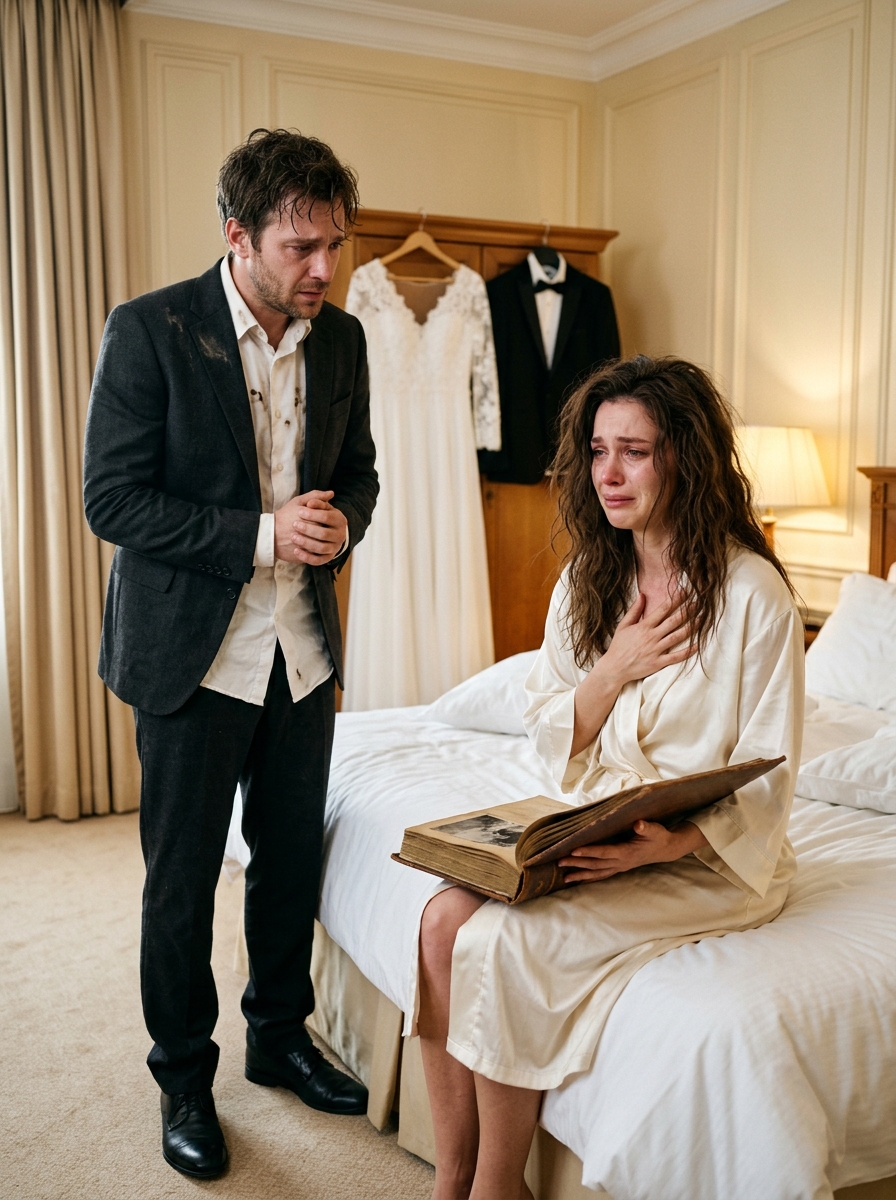
That night, the house was finally quiet.
For the first time all day, there were no whispers outside the door. No clinking glasses downstairs. No polite venom wrapped in family smiles.
Just the two of them in the master bedroom, surrounded by more luxury than Emily had probably ever imagined for herself.
She stood near the edge of the bed in her robe, staring at the floor.
Nathan moved toward her slowly.
Gentle.
Careful.
He thought he understood her nervousness.
He thought he knew what she was bracing for.
“Hey,” he said softly. “You don’t have to be afraid of me.”
Emily nodded, but she was trembling.
He touched her shoulder.
“I mean it. Whatever marks life left on you, whatever pain came before me, I’m not turning away.”
At that, something flashed across her face.
Not relief.
Not comfort.
Something closer to grief.
Nathan didn’t understand it.
Not yet.
“Emily,” he whispered, “look at me.”
She did.
And there was such deep sadness in her eyes that his chest tightened before he even knew why.
Slowly, like every movement cost her something, she loosened the tie on her robe.
It slid open.
She lowered the strap of her nightgown.
Nathan went still.
Completely still.
His breath caught so hard it hurt.
Her body was smooth.
Young.
Unmarked.
No faint silver lines across her stomach.
No looseness from childbirth.
No scars.
No evidence of three pregnancies.
No evidence of even one.
He blinked once, like maybe his eyes were lying.
Then again.
“Emily…”
His voice came out wrong.
Thin.
Confused.
“I thought…”
She closed her eyes.
“I know.”
“I thought you had three children.”
A long silence opened between them.
Then Emily stepped back, grabbed a worn canvas bag from the chair by the window, and held it against her chest like a shield.
When she looked up again, tears were already sliding down her face.
“I never lied to you,” she whispered. “I just never told you the whole truth.”
Nathan felt cold all over.
Not because he thought she had tricked him.
Because he suddenly understood there was a wound in this room he had never even seen.
“Then tell me now,” he said, quieter than before. “Please.”
Emily sat on the edge of the bed and pulled out an old photo album.
The cover was cracked.
The corners were bent.
It looked like something that had been carried through too many years with too much pain inside it.
She opened to the first page.
Nathan sat beside her.
The photo showed a much younger Emily, barely more than a girl, standing in front of a sagging house with peeling paint and a rusted porch railing.
Three children crowded around her.
A little boy with wary eyes.
Another boy, thinner, clinging to her arm.
A little girl with a crooked barrette and a smile that looked borrowed from better days.
Nathan stared.
“They’re not yours,” he said, though by then he already knew.
Emily shook her head.
“No.”
She turned the page.
The next picture hit harder.
A hospital bed.
A woman so pale she almost disappeared into the sheets.
Emily beside her, younger, wrecked with grief, gripping that woman’s hand with both of hers like she was trying to keep her from slipping away.
“That’s my sister, Rachel,” Emily said.
Nathan swallowed.
Emily kept her eyes on the album.
“She was older than me by eight years. She raised me half my life after our mother got sick. She worked every job she could find. Waitressing. Cleaning houses. Packing boxes at a warehouse.”
Her voice trembled, but she kept going.
“The first man promised he’d marry her. He left when she got pregnant.
“The second one promised he’d help with the baby. He left too.
“The third one wasn’t even around long enough to make promises.”
Nathan felt his hands curl into fists.
Not at Rachel.
At the men.
At the world.
At himself.
“She wasn’t reckless,” Emily said, like she had defended her sister a thousand times in her mind. “She was tired. She was poor. She kept hoping one person would stay.”
Emily turned one more page.
This time she didn’t show him a picture first.
She pulled a folded paper from the back of the album and handed it to him.
Nathan unfolded it slowly.
Official seal.
Official language.
Cause of death.
Complications after childbirth.
He read it twice before the words truly landed.
“She died?” he said, voice breaking.
Emily nodded.
“Seven years ago.”
Nathan looked at her.
“You were how old?”
“Eighteen.”
The room seemed to tilt.
Emily laughed once, but there was no joy in it.
“I was supposed to start community college that fall.”
Instead, Rachel died holding Emily’s hand in a county hospital two hours from home.
Emily told it in pieces.
Not like a speech.
Like a woman dragging glass out of her own chest.
Rachel had begged her not to let the children be split up.
Not to let the system take them.
Not to let Johnny end up with the father who didn’t want him.
Not to let Paul and Lily grow up hearing their mother had been trash.
So Emily said yes.
At eighteen.
With no money.
No husband.
No plan.
Just grief and terror and love.
“I quit school the next morning,” she said.
Nathan stared at her as if he had never seen her before.
“I sold almost everything I owned. Took whatever work I could. Cleaned motel rooms. Worked diner shifts. Packed groceries. Then I left for Connecticut because the pay was better.”
A tear slid down her cheek and dropped onto the album.
“I sent money home every month to the neighbor who watched them while I worked. Food, clothes, school supplies, doctor visits. Every single month.”
Nathan’s throat tightened so hard he could barely speak.
“Why didn’t you tell me?”
Emily looked at him then.
Really looked at him.
Not with accusation.
With exhaustion.
“Because people hear three children and they judge one way. They hear three orphaned children that aren’t legally yours, and they judge another.”
Nathan didn’t answer.
Because she was right.
She kept talking.
“If I told employers the truth, they worried I’d need too much time off. That I’d bring trouble. That I had baggage without rights. If I let them believe I was just some shameful woman with a messy past…” She inhaled shakily. “At least that made sense to them.”
Nathan shut his eyes.
Every cruel joke he’d heard came back with fresh poison.
Every smug remark from his friends.
Every hateful word from his mother.
Even his own private thoughts.
I’ll accept her.
I’ll love the children anyway.
As if she had been the burden.
As if he had been the generous one.
He felt sick.
“Johnny,” Emily said softly, wiping her face, “isn’t even Rachel’s by blood. He was her first husband’s little boy from another woman. Rachel raised him because nobody else would. After she died, I kept him too. Paul and Lily are my sister’s. But all three of them…” Her voice broke. “All three of them are mine in every way that matters.”
Nathan covered his mouth.
The woman beside him had not been hiding disgrace.
She had been carrying sacrifice so large nobody around her even had the decency to recognize it.
“They call me Aunt Emily,” she said with a sad smile. “They don’t even know I’m the only one left.”
That did it.
Nathan stood up too fast and had to turn away.
He walked to the window, pressed both hands against the glass, and tried to breathe.
Behind him, Emily’s voice came smaller.
“If you regret marrying me, I’ll understand.”
He turned so sharply she flinched.
“Don’t say that.”
She looked down.
“I should have told you sooner.”
“Yes,” he said.
The word hit between them.
Emily closed her eyes like she expected the rest to be a blade.
But Nathan was crying now.
Not neatly.
Not quietly.
His whole face had gone raw with it.
“Yes, you should have told me,” he said, voice shaking. “Not because I would’ve walked away. Because you should have never had to carry this alone.”
Emily stared at him.
Nathan dropped to his knees in front of her.
Right there on the polished floor in his wedding clothes, in the middle of that grand bedroom, all the money and status in the world suddenly looked ridiculous around them.
“I thought I was some good man for being willing to accept your past,” he said. “God, Emily… I thought I was the strong one.”
His tears hit her hands.
“You were raising three abandoned children while the rest of us sat in clean houses making up stories about you.”
Emily started crying harder.
“You saved three lives,” Nathan said. “You gave up your own life to do it, and you still came here every day and worked and smiled and cared for everybody else.”
He bowed his head over her hands.
“I am ashamed of every moment I let anybody talk about you like you were less.”
Emily’s fingers trembled against his.
“I didn’t want your pity.”
“You don’t have it,” he said immediately.
He looked up.
What was in his face then was not pity.
It was awe.
It was grief.
It was love stripped clean of ego.
“You have my respect,” he said. “You have my loyalty. And if you’ll let me, you have my whole life.”
Emily broke then.
Not in the dramatic way people do in movies.
In the real way.
Shoulders shaking.
Breath hitching.
Years of silence coming apart at the seams.
Nathan rose and pulled her into him, and she clung to him like she had been standing alone on the edge of a cliff for seven years and somebody had finally reached out.
For a long time, neither of them spoke.
Then Nathan leaned back just enough to look at her.
“Where are they now?”
Emily blinked, dazed.
“The kids?”
“Yes.”
“With a widow in my hometown. I send money every month. I visit when I can.”
Nathan nodded once.
“We’re bringing them here.”
Emily stared at him.
“What?”
“We’re bringing them here,” he repeated. “Not tomorrow. Not someday when it’s convenient. Now. They’re your family, which means they’re mine.”
Her mouth parted, but no sound came out.
“Nathan…”
“I married you,” he said. “All of you. Not the rumor. Not the version people whispered about. You.”
He brushed tears from her face with his thumbs.
“And I swear to God, nobody in this house is ever going to look down on those children again.”
Emily let out one broken sob that sounded almost like relief.
Outside that room, the world was still the same cruel place.
His mother was still downstairs somewhere nursing her outrage.
His friends were probably still making jokes over drinks.
The staff still carried old gossip in their mouths.
But inside that room, something had changed forever.
Nathan had married a woman he thought he understood.
Instead, he found a woman far braver than anyone in his world had ever deserved.
And for the first time in his life, he saw clearly how small wealth looked next to sacrifice.
He kissed her forehead.
Then her cheeks.
Then her trembling mouth.
And when he held her again, it wasn’t like a man claiming a bride.
It was like a man honoring a soldier who had survived a war nobody bothered to notice.
The next morning, the real scandal began.
Not because Nathan regretted the marriage.
Because he didn’t.
Not for one second.
It began when he sat across from his mother at breakfast, looked her dead in the eye, and told her three children would soon be living under his roof.
She nearly dropped her coffee cup.
“You cannot be serious.”
“I’ve never been more serious.”
“They are not blood.”
Nathan’s face went cold.
“Neither is kindness, but some people still manage it.”
She stared at him in stunned silence.
He pushed back from the table.
“And if anybody in this family humiliates my wife or those children again, they will lose access to me, this home, and every privilege that comes with my name.”
Then he walked out.
Because the truth was simple now.
The woman they mocked as damaged had done more with one wounded heart than most of them had done with lives full of comfort.
And Nathan Hale, for all his money and power, had only finally become worth something the night he learned to see her clearly.