
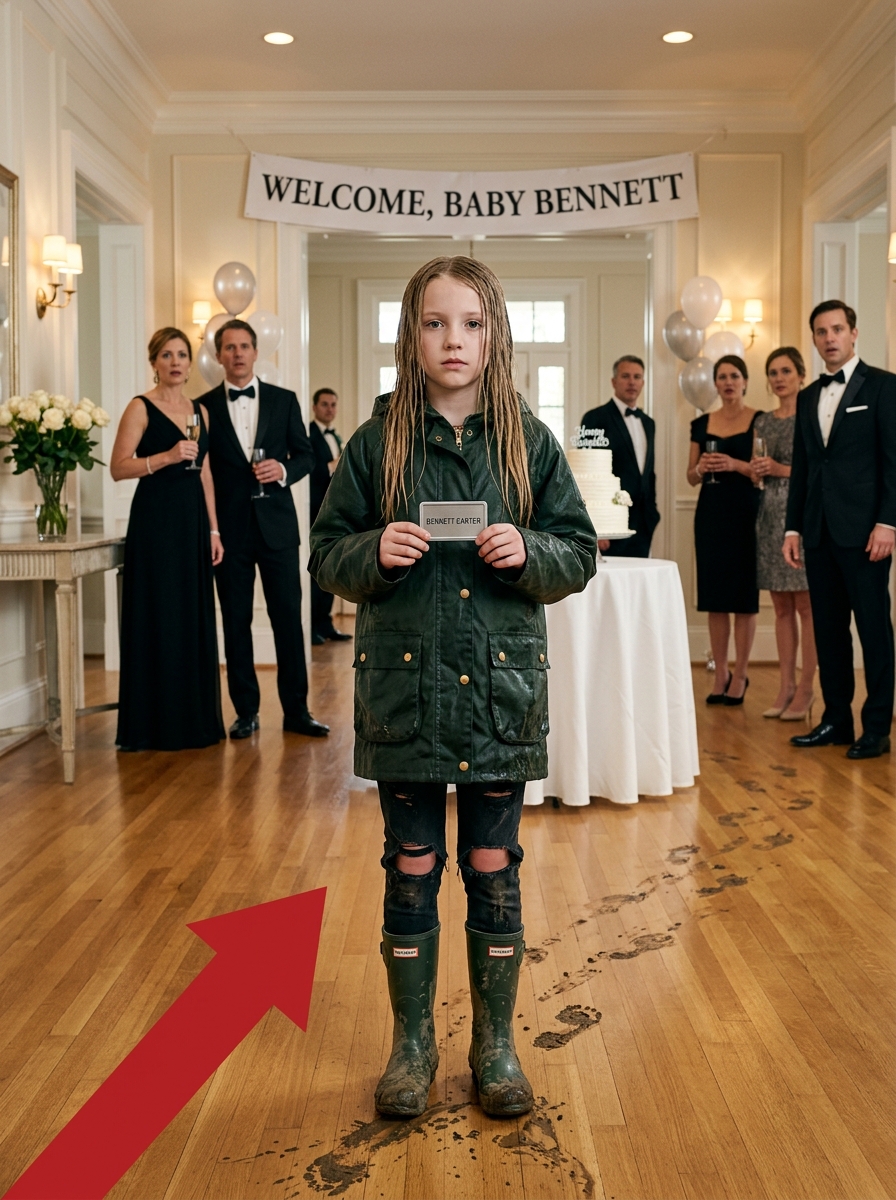
“Don’t touch me!”
The little girl’s voice cracked through the music, the laughter, the clinking glasses.
Every head in the room turned.
Mud dripped from her boots onto the polished hardwood. Rainwater ran off the sleeves of her oversized coat. She looked like she had been dragged in by the storm itself.
And in her shaking hand, she held a silver baby tag.
For one second, nobody moved.
Then the security men started toward her.
She took a step back and screamed louder, wild enough to cut straight through the string music.
“How are y’all standing here smiling,” she yelled, “when somebody threw a baby away like garbage?”
The mansion went dead quiet.
A woman near the flower arch let out a little gasp and pressed a hand to her chest.
At the center of the room stood Grant Carter and his wife, Evelyn Carter, smiling beside a giant welcome sign that read:
WELCOME, BABY BENNETT.
The party had been picture-perfect just seconds earlier.
White roses.
Silver balloons.
A three-tier cake.
Neighbors, business partners, women in pearl earrings, men in pressed jackets, all gathered under the soft glow of expensive lights in one of the biggest homes on the north side of town.
Now every face was frozen.
The little girl stood there like a wound nobody in the room knew how to explain.
Her name was Lily Brooks.
She was ten years old.
And about twelve hours earlier, she had been digging through a landfill on the edge of the city, trying to find enough scrap metal and cans to buy herself breakfast.
The storm had rolled in fast that night.
Wind howled over the heaps of broken furniture, soggy cardboard, and split trash bags. Rain came down so hard it made the world look blurred and crooked. Lightning flashed over the mounds of junk, turning bits of broken glass into sharp white teeth.
Lily moved through it all like she knew every inch.
Because she did.
She had learned how to survive in places most people wouldn’t even look at in daylight. She knew what sold, what cut, what smelled dangerous, and which piles were worth the climb.
Her coat hung off her like a blanket stolen from some bigger life. One boot was held together with tape. Her fingers were red and stiff from cold.
But she kept going.
Because hunger did not care if it was midnight.
“Just a little more,” she whispered to herself.
She had three dollars and some loose change in her pocket. If she got lucky, she could get something hot in the morning. Maybe eggs from the diner near the bus station if the cook was in a good mood.
She was heading back toward the alley where she slept when she heard it.
Not thunder.
Not a truck.
An engine.
Smooth. Quiet. Expensive.
Lily dropped low behind a stack of old tires and peered through the rain.
Headlights swept across the landfill road.
A black luxury sedan rolled slowly over the mud and stopped near a dip between two piles of garbage. The lights cut off.
The driver’s door stayed closed.
The back door opened.
A woman stepped out.
Even in the rain, Lily could tell she didn’t belong there.
Long camel coat. Heeled boots. Hair done, even though it was already falling apart in the storm. She held something bundled tightly in both arms and kept glancing around like she was scared somebody might see.
Lily’s stomach turned.
The woman hurried toward the edge of the trash pile, bent down, and laid the bundle inside a hollow between broken boxes and black bags.
She hesitated.
Then she shoved a torn cardboard box and two trash bags over it.
And ran.
By the time the car sped away, Lily was already moving.
She slipped and nearly fell in the mud getting there. Her hands shook as she yanked the wet cardboard aside.
Underneath was a cream-colored baby blanket.
Too clean.
Too soft.
Too warm.
Then it moved.
Lily stared.
A cry split the night.
Not loud. Weak. Thin. The kind of cry that sounded like it had already been going too long.
Her whole body went cold.
“Oh no,” she whispered.
She ripped the blanket open.
Inside was a baby boy, tiny and red-faced and shivering, his little mouth open in a desperate cry. His cheeks were wet. Rain had started soaking through the blanket.
For half a second Lily just looked at him, like her mind could not make sense of what her eyes were seeing.
Then instinct took over.
She pulled off her coat and wrapped it around him, pulling him tight against her chest.
“It’s okay,” she whispered, rocking him. “I got you. I got you.”
He cried harder for a moment, then pressed into the warmth.
Lily looked around, as if maybe the woman would come running back.
Nobody came.
Only thunder.
Only rain.
Only the stink of rotting trash and gasoline and wet paper all around them.
As she adjusted the blanket, her fingers brushed something cool against the baby’s neck.
A chain.
She lifted it carefully.
A small silver name tag hung from it.
Lightning flashed.
And in that bright white crack of light, she read the engraved name:
BENNETT CARTER.
Lily knew that name.
Everybody in town knew that name.
Grant and Evelyn Carter were the kind of rich people whose faces showed up in local magazines and charity event posters. They had a giant estate on the hill, gave speeches at fundraisers, hosted holiday drives, and smiled like their lives had never cracked in any ugly place.
Lily looked down at the baby.
Then back at the silver tag.
Then at the dark road where the car had disappeared.
“They threw you away?” she whispered.
The baby whimpered against her chest.
Lily swallowed hard.
“Well,” she said, voice trembling, “not anymore.”
She started walking.
The baby cried twice on the way back toward the city, and by the second time Lily knew exactly what it was.
Hunger.
Under the metal awning of a closed hardware store, she sat down and counted her money in the rain.
Three dollars and forty cents.
Everything she had.
Her stomach cramped so hard it made her dizzy.
She looked at the baby.
Then at the coins.
Then back at the baby.
“You win,” she muttered.
The only place still open was an all-night drugstore near the interstate.
When she walked in carrying the baby, the cashier looked at her like trouble had just walked through the door. His eyes dropped to her wet clothes, her muddy boots, the trembling bundle in her arms.
“We don’t do handouts,” he said.
“I ain’t asking,” Lily said.
Her voice came out harder than she expected.
She bought the smallest can of formula and the cheapest bottle she could find. At the register, she counted the coins out one by one.
She came up short.
Forty-eight cents.
The cashier sighed and reached for the formula.
Lily tightened her grip on it.
“Please,” she said.
Not for herself.
Never for herself.
For the baby.
Something in her face must have changed him.
He looked at the baby.
Looked back at her.
Then shoved the bottle and formula across the counter.
“Get out of here,” he muttered.
Lily didn’t say thank you.
She was too close to crying.
That night she sat awake in her cardboard shelter behind an abandoned laundromat, feeding a stranger’s child with money that should have fed her. Wind rattled the loose metal fence nearby. Water dripped through one corner of the shelter.
The baby drank like he had been waiting to be saved.
Lily held him after, tucked inside her coat, and watched him sleep.
By morning, she had made up her mind.
She walked clear across town with the baby wrapped to her chest.
Past boarded storefronts.
Past school buses.
Past people who looked right through her.
Past coffee shops where warm people laughed over breakfast.
Then farther north, where the roads widened, the lawns turned perfect, and every mailbox looked like it cost more than everything Lily owned.
The Carter estate rose behind stone walls and iron gates.
And even from the street, Lily could see it.
Cars lined the driveway.
White tents in the backyard.
Ribbons.
Flowers.
Servers moving with silver trays.
A giant printed sign near the gate welcomed guests to Baby Bennett’s homecoming celebration.
Lily stopped cold.
Her heart started pounding so hard it hurt.
She looked down at the baby in her arms.
Then back at the sign.
No.
No, no, no.
She edged along the wall until she found a place where stacked landscaping stones made a crooked step. She climbed, scraped her knee, and dropped into the garden on the other side.
She crouched behind trimmed hedges and stared through a wide glass window into the party.
There they were.
Grant Carter in a navy suit.
Evelyn Carter in a pale blue dress, smiling for guests.
And in Evelyn’s arms—
a baby.
Clean.
Dressed in white.
Sleeping peacefully.
Lily’s breath caught.
Her mind spun so fast she thought she might pass out.
Then she saw the woman standing three feet behind Evelyn.
Dark hair pinned tight.
Black uniform.
Sharp face.
Calm hands.
The housekeeper.
The same woman Lily had seen at the landfill in the storm.
The woman who had thrown the baby away.
Everything inside Lily snapped.
She didn’t think.
She didn’t plan.
She shoved open the side door and stormed straight into the party.
That was how she ended up standing in the middle of polished floors, soaked to the bone, screaming at millionaires.
Security kept coming.
Grant Carter’s face had gone pale.
Evelyn clutched the baby in her arms tighter and stared at Lily like she was trying to understand whether this was real.
Lily pointed straight at the housekeeper.
“She’s the one!” Lily shouted. “She left a baby out in the trash last night! I found him! He had this on!”
She hurled the silver name tag across the room.
It landed at Evelyn’s feet.
Evelyn bent slowly, picked it up, and stared.
Then she looked down at the baby in her arms.
His neck was bare.
Her face emptied.
“Grant,” she whispered.
The room started buzzing.
The housekeeper took one step backward.
Then another.
One of the guests said, “What is going on?”
Lily’s voice shook, but she kept going.
“The baby I found had that tag on,” she said. “And he looked just like him. I saw her leave him there. I know what I saw.”
Evelyn looked at the housekeeper.
The woman’s mouth twitched.
Then, like something rotten finally split open, she screamed.
“Yes!” she shouted.
The whole room flinched.
“Yes, I did it!”
People gasped. Someone dropped a glass.
The woman pointed at the child in Evelyn’s arms, half crying, half raging.
“My son was born the same night,” she screamed. “And I was tired of watching other people live the life that should’ve been mine. So I switched them. At the clinic. Nobody noticed. Nobody ever notices women like me.”
Evelyn made a sound Lily would never forget.
Not a scream.
Worse.
A broken sound from somewhere deep in the body.
Grant lunged forward as security grabbed the housekeeper.
“No!” Evelyn cried, backing away, staring from one baby to the other as if her soul had been ripped open.
Lily stepped forward slowly and unwrapped the child from her coat.
The room watched in stunned silence.
Evelyn’s hands shook so badly she almost couldn’t take him.
But when she did, the baby opened his eyes.
And it was over.
Any doubt.
Any lie.
Any pretending.
A mother knows.
Evelyn collapsed into tears right there in front of everybody, clutching the baby she had almost lost forever.
Grant stood beside her with tears running openly down his face, one hand over his mouth like he might be sick.
The party was finished.
Music stopped.
Guests backed away.
The silver balloons drifted above the wreckage of a perfect day turned into a nightmare.
And in the middle of it all stood Lily, cold and starving and exhausted, swaying on her feet because she had not eaten and had barely slept.
Grant looked at her for a long moment.
Then he asked the question everybody rich asks when they don’t know how to measure a miracle.
“What do you want?”
Lily looked at him.
At the mansion.
At the baby.
At the polished room full of people who had never spent a night in an alley.
Her throat moved.
“I don’t want your money,” she said softly.
Then her voice broke.
“I just don’t want to be alone anymore.”
The whole room went still again.
Evelyn turned, still crying, and crossed the room with the baby in her arms.
When she reached Lily, she knelt on the floor in that expensive dress and took Lily’s dirty, trembling hands in hers.
“You’re not,” she whispered. “You hear me? You are not alone anymore.”
Six months later, the garden behind the Carter house looked different in spring.
Warmer.
Softer.
Real.
Lily sat in the sun with a little boy beside her, laughing as he grabbed clumsily at the hem of her sleeve. The child had dark curls and wide eyes and a grin so innocent it hurt to look at.
His name was Noah.
He had done nothing wrong except be born into somebody else’s bitterness.
Lily loved him anyway.
Nearby, Evelyn held Bennett while Grant poured lemonade into sweating glasses on the patio table. They looked less like the polished couple from billboards now and more like people who had been cracked open and forced to grow hearts where image used to be.
Lily had a room upstairs.
Clean sheets.
A desk by the window.
A backpack for school.
Dinner every night.
And for the first time in her life, when the sky darkened and thunder rolled over the city, she did not have to wonder where she would sleep.
Sometimes rescue doesn’t come with sirens.
Sometimes it comes in muddy boots.
In empty pockets.
In the hands of a hungry little girl who had every reason to walk away—
and didn’t.