
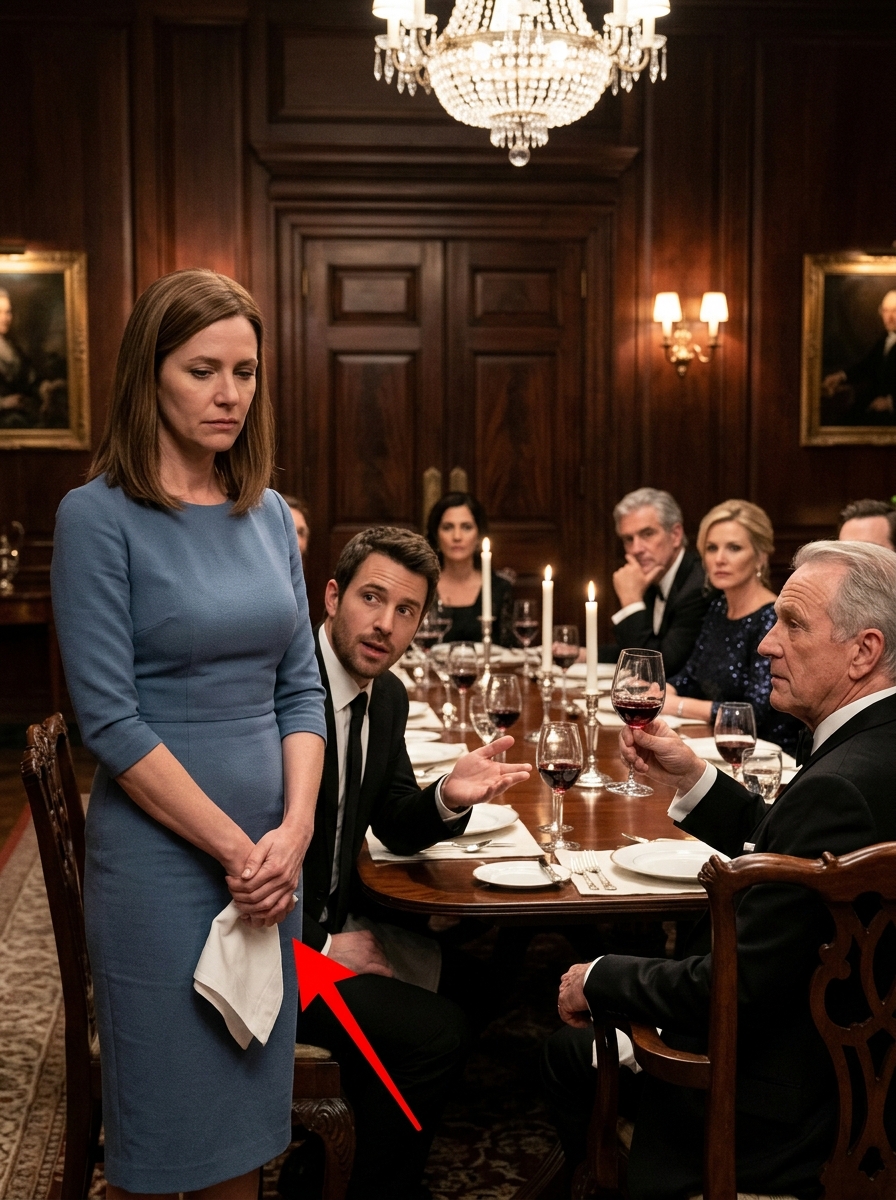
“Say it again,” Quinn hissed, his voice shaking, like he couldn’t believe his own ears.
William Harrington didn’t even look at his son.
He lifted his wineglass and spoke to the room—country club friends, business partners, people with pearls and polite smiles—like I wasn’t sitting ten feet away.
“My son deserves better than someone from the gutter,” he said. “Street garbage in a borrowed dress, pretending to belong in our world.”
The words landed like a slap you feel days later.
The table went silent. Forks hovered. Someone cleared their throat like they wanted to disappear into the linen.
I felt my nails dig into my palms so hard it stung.
And then I did the one thing nobody expected.
I folded my napkin—slow, neat, careful—like I had all the time in the world.
I set it beside my untouched salmon that probably cost more than my first month’s rent back when I was sleeping on a friend’s couch.
I stood.
“Thank you for dinner, Mr. Harrington,” I said, voice steady. “And thank you for finally being honest about how you feel. My name is Zafira Cross.”
Quinn’s hand shot out and grabbed mine like he was trying to anchor me.
“Zafira, don’t,” he whispered, eyes glossy. “Please.”
I squeezed his fingers, gentle, then let go.
“It’s fine,” I said softly, looking right at William. “Your father’s right. I should know my place.”
William’s mouth curled into that smug little smile men wear when they think they’ve broken you in public and can call it “class.”
I memorized it.
Then I walked out.
Past the framed paintings, the hushed staff who wouldn’t meet my eyes, the shiny luxury SUV in the drive William had made sure to mention cost more than I’d make in five years.
I walked straight to my car.
A sensible, slightly scratched Toyota that had never once pretended to be something it wasn’t.
Quinn came running after me, breathless, cheeks wet.
“I’m so sorry,” he choked out. “I didn’t know he would—”
I pulled him in and held him like I wasn’t the one bleeding inside.
“This isn’t your fault.”
“I’ll make him apologize,” he said. “I swear I will.”
“No.” I brushed his hair back with my thumb. “No more apologizing for him. No more pretending he’s just… difficult. He meant every word.”
He stared at me like he was watching something in me harden.
“Please don’t let him ruin us.”
I kissed his forehead.
“He can’t ruin what’s real,” I said. “But I need tonight to be over. I’ll call you tomorrow.”
He nodded like it hurt to breathe.
I got in my car and drove away from that mansion like I wasn’t supposed to have ever been there.
The minute I hit the main road, my phone started buzzing.
I didn’t answer.
I already knew what the calls would be.
Quinn’s mother, trying to smooth it over.
His sister, offering awkward comfort.
People who weren’t evil—just trained, for years, to stay quiet when William decided someone didn’t deserve air in the room.
But I had my own call to make.
I tapped voice dial and kept my eyes on the highway lights.
“Danielle,” I said. “I know it’s late.”
My assistant didn’t ask who I was with. She never did.
She just listened the way she always had—like she’d been waiting for the other shoe to drop.
“Is everything okay, Ms. Cross?”
“No,” I said. “Cancel the Harrington Industries merger.”
There was a pause so sharp it felt like someone sucked the air out of the car.
“Ma’am… we’re scheduled to sign on Monday,” Danielle said carefully. “Due diligence is complete. Financing is secured.”
“Kill it.”
“The termination fees alone will be—”
“I don’t care.” My voice came out low and flat. “Send notice to their legal team tonight. Cite irreconcilable differences in corporate culture and vision.”
She went quiet again.
Then her tone shifted—less assistant, more protector.
“Zafira,” she said softly. “What happened?”
I swallowed, and it tasted like metal.
“He called me garbage,” I said. “In front of a room full of people. Like I was something that wandered in off the street.”
Danielle didn’t hesitate.
“That man is done,” she said, and I could hear her typing already. “Want me to feed it to the business press?”
“Not yet. Let him wake up to the official notice first.” I exhaled. “Then by noon, they can have it.”
“Gladly,” she said. “Anything else?”
I stared at the dark stretch of road ahead and thought about the way William’s smile looked so sure.
“Yes,” I said. “Set a meeting Monday with Fairchild Corporation.”
Danielle made a sound—half shock, half delight.
“You’re going to buy his biggest competitor.”
“Why not?” I said. “If I’m ‘street garbage,’ maybe I should stick with the other trash.”
I ended the call.
And for the rest of the drive back to my penthouse in downtown Chicago, I let the quiet do what it always does.
It reminded me where I came from.
Shelters that smelled like bleach and tired bodies.
Free lunch tickets folded small so nobody would see.
Working at fourteen, then two jobs, then three—anything to keep moving forward.
William Harrington knew the beginning of my story.
He’d had people dig it up, like dirt under fingernails.
He knew I grew up poor.
He knew I started working young.
He knew I put myself through community college, then a state university, fueled by stubbornness and cheap coffee.
What he didn’t know—what he never bothered to look for—was who I became after survival stopped being the goal.
He didn’t know that Cross Technologies, the company Harrington Industries was desperate to merge with to stay relevant, belonged to me.
Not “worked for.”
Not “invested in.”
Owned.
Built.
Protected.
He didn’t know I’d spent the last decade buying patents, hiring talent, and moving quietly through the industry like a shadow.
Because I learned something early:
Real power comes when people underestimate you.
When they assume your past is your ceiling.
When they think you’re lucky just to be in the room.
By the time I reached my building’s garage, my phone lit up again.
Unknown number.
Then a name.
Martin Keating—Harrington Industries CFO.
That was fast.
I answered on the first ring.
“Zafira,” he blurted, voice tight. “We just received notice from Cross Technologies terminating the merger agreement. There has to be a mistake.”
“No mistake,” I said.
“But the board already approved,” he said, panic slipping through his polished tone. “Shareholders are expecting—”
“Then the board should’ve thought about that before your CEO humiliated me at dinner tonight.”
Silence.
Then, quieter: “What did William do?”
I almost laughed.
“Ask him,” I said. “I’m sure he’ll tell you a version that sounds like ‘protecting the family name.’ Good night, Martin.”
I hung up before he could beg.
I went upstairs, poured myself a scotch, and sat on my balcony watching the city glow like it didn’t care about anyone’s last name.
My phone buzzed again.
Quinn.
I stared at his name until it blurred.
Then I let it go to voicemail.
Because I didn’t trust my anger to stay in the right direction.
By morning, I had forty-seven missed calls.
Six were from William himself.
That part almost made me dizzy.
The man who called me “street garbage” was now dialing me like I held his oxygen tank.
Danielle called while I was eating breakfast and reading reports like nothing had happened.
“The financial press got wind of it,” she said, sounding way too pleased. “They want a statement.”
“Tell them Cross Technologies has decided to pursue other opportunities that better align with our values and vision,” I said.
Danielle chuckled. “Vague and devastating. Perfect.”
Then she lowered her voice.
“Also… William Harrington is in the lobby.”
I paused with my coffee halfway to my mouth.
“He’s where?”
“Downstairs. He showed up twenty minutes ago. Security won’t let him up without you, but he’s making a scene. Should I have him removed?”
I stared at the city outside my windows.
“No,” I said. “Send him up.”
Danielle made a satisfied sound.
“And make him wait.”
“How long?”
I checked the time and took a slow sip.
“Thirty minutes.”
Danielle laughed softly. “Conference room C?”
“The one with the uncomfortable chairs,” I said.
“Already done,” she replied, like she’d been born for this moment.
Forty-five minutes later, I walked into conference room C.
William Harrington stood up so fast his chair scraped.
He looked… smaller.
His hair wasn’t perfect.
His suit was rumpled.
His face had that tight, sleepless look of a man who’d spent the night watching his control evaporate.
“Zafira,” he said, and I could see how painful it was for him to say my name without spitting it. “Thank you for seeing me.”
I sat without offering my hand.
“You have five minutes.”
He swallowed like his pride had sharp edges.
“I apologize for last night,” he said. “My words were inappropriate.”
“Inappropriate,” I repeated, and it came out as a laugh that didn’t sound like me. “You called me garbage in front of everyone you respect. In your home. At your table. While I sat there as your guest. As your son’s partner.”
“I was drunk,” he said quickly, like that solved it.
“No.” I held up a finger. “You were honest.”
His jaw tightened.
Even now, desperate, he couldn’t fully hide the contempt.
“What do you want?” he snapped. “An apology? You have it. A public statement? Fine. Whatever you need. Just… the merger has to happen.”
I leaned back.
“Why?”
He blinked. “Excuse me?”
“Explain why I should do business with someone who treats me like something stuck to his shoe.”
His face reddened. “Because it’s business. Not personal.”
I stared at him.
“You made it personal the moment you opened your mouth.”
I stood and walked to the window, looking down at Chicago traffic like a moving bloodstream.
“You researched me,” I said, not turning around. “Foster homes. Free lunches. Night shifts. You saw the hard parts and decided that was all I was.”
He didn’t answer, but I felt it.
He’d thought my story ended where his comfort began.
I turned back.
“Do you know why my company works?” I asked.
“Because you make good products,” he muttered.
“No,” I said. “Because I remember what it feels like to be hungry. To be dismissed. To be told you don’t belong. I built a place where talent matters more than pedigree.”
William’s eyes flicked away.
“Your company,” I continued, “is the kind of place that keeps doors closed and calls it tradition.”
“That’s not fair,” he said, but his voice was thin.
“Name one person on your board who didn’t grow up wealthy,” I said. “One executive who worked their way through school. One senior leader who understands what it’s like to start with nothing.”
He didn’t.
Because he couldn’t.
The silence between us was the loudest thing in the room.
“The merger is dead,” I said. “Not just because you insulted me. Because you showed me who you are.”
His mouth trembled, the first crack in the mask.
“This will destroy us,” he said quietly. “Without this merger, Harrington Industries won’t survive two years.”
I walked back to the table and placed my hand on the smooth surface like I could feel his empire through it.
“Then maybe it shouldn’t,” I said.
His eyes flashed. “What about Quinn?” he spat. “You’re going to ruin his inheritance. His future.”
I paused at the door.
“Quinn is brilliant,” I said. “He doesn’t need to inherit a life. He can build one.”
William’s voice got cold. “He’ll never forgive you.”
I looked back at him.
“Maybe,” I said. “But at least he’ll know I have something you don’t.”
“What’s that?” he demanded.
“Principles you can’t buy.”
I walked out and didn’t look back.
Danielle was waiting outside with a folder and that look she gets when she’s trying not to smile.
“Fairchild Corporation confirmed Monday morning,” she said. “They’re very interested.”
“Good,” I replied. “Make sure William hears about it by this afternoon.”
Danielle’s eyes gleamed. “Already arranged.”
Then she tilted her head.
“And… Quinn is in your private office.”
My stomach dropped like a missed step.
“How long?”
“About an hour.” Danielle’s voice softened. “I brought him coffee. And tissues.”
I moved down the hall like my heels weighed a hundred pounds.
When I opened the door, Quinn was curled in my desk chair, eyes red but steady, like he’d already cried himself empty.
He looked up at me and I saw his father’s features—same jaw, same posture—but none of the cruelty.
“Hi,” he said quietly.
“Hi,” I whispered.
He swallowed.
“I heard what you said to him,” he admitted. “Danielle… let me see the conference room feed.”
My chest tightened.
“And?” I asked.
Quinn stood and walked toward me, hands shaking.
“I think I’ve been a coward,” he said. “My whole life. Making excuses. Letting him bulldoze people and calling it ‘family.’”
“Quinn—”
“No,” he cut in, voice cracking. “Let me say it.”
He took my hands like he was afraid I’d pull away.
“Last night, when he said that to you… I wanted the floor to swallow me.” His eyes glistened. “Not because of you. Because of him. Because of me.”
I breathed in slowly.
“What are you saying?” I asked.
He squeezed my hands.
“I’m saying… if you’ll still have me, I want to build something that isn’t tied to his money. His approval. His name.”
My throat burned.
“Are you sure?” I asked. “Walking away from that inheritance… that’s not small.”
He let out a shaky laugh.
“Zafira Cross,” he said, voice warm for the first time in days, “you just killed a billion-dollar deal because my father disrespected you.”
He leaned in, forehead pressed to mine.
“I think we’ll figure out the money part.”
I laughed, and it sounded like relief trying to crawl out of my chest.
“I love you,” I said, and it was raw and real and terrifying.
“I love you too,” he whispered. “Even if you just declared corporate war on my father.”
“Especially because I did,” I said, and kissed him like I needed to remember I was still human.
My phone buzzed again.
Danielle.
I put it on speaker.
“Ma’am,” she said, “William is holding an emergency board meeting. Our sources say they’re discussing going around him to reach you directly.”
I didn’t blink.
“Tell them Cross Technologies might be willing to talk,” I said. “Under new leadership. Emphasis on new.”
Quinn pulled back, eyes wide.
“You’re going to force him out.”
“I’m going to give them a choice,” I said. “Evolve or perish.”
Quinn exhaled, almost a laugh, almost a sob.
“He won’t go quietly.”
“I wouldn’t expect him to,” I said.
“This is going to get ugly.”
“Probably,” I admitted.
“My mother will cry.”
“Definitely.”
Quinn wiped his face and gave me a small, sharp smile.
“So when do we start?” he asked.
I looked at the skyline outside my window, the city pulsing like it always had, indifferent to old money and big names.
Then I looked back at the man I loved.
“Now,” I said.
By the following Monday, William Harrington was no longer CEO of Harrington Industries.
By Tuesday, Cross Technologies announced a merger with the newly restructured company.
By Wednesday, Quinn accepted a role with us—by choice, not inheritance—turning down his father’s furious offer to fund a rival venture.
And by Thursday, William Harrington learned the most expensive lesson of his life:
Never call someone garbage unless you’re prepared to be thrown out with it.
Six months later, Quinn and I got engaged.
Small ceremony. Quiet place. No country club crowd.
Just the people who understood the one truth William never learned until it was too late—
Respect isn’t inherited.
It’s earned.