
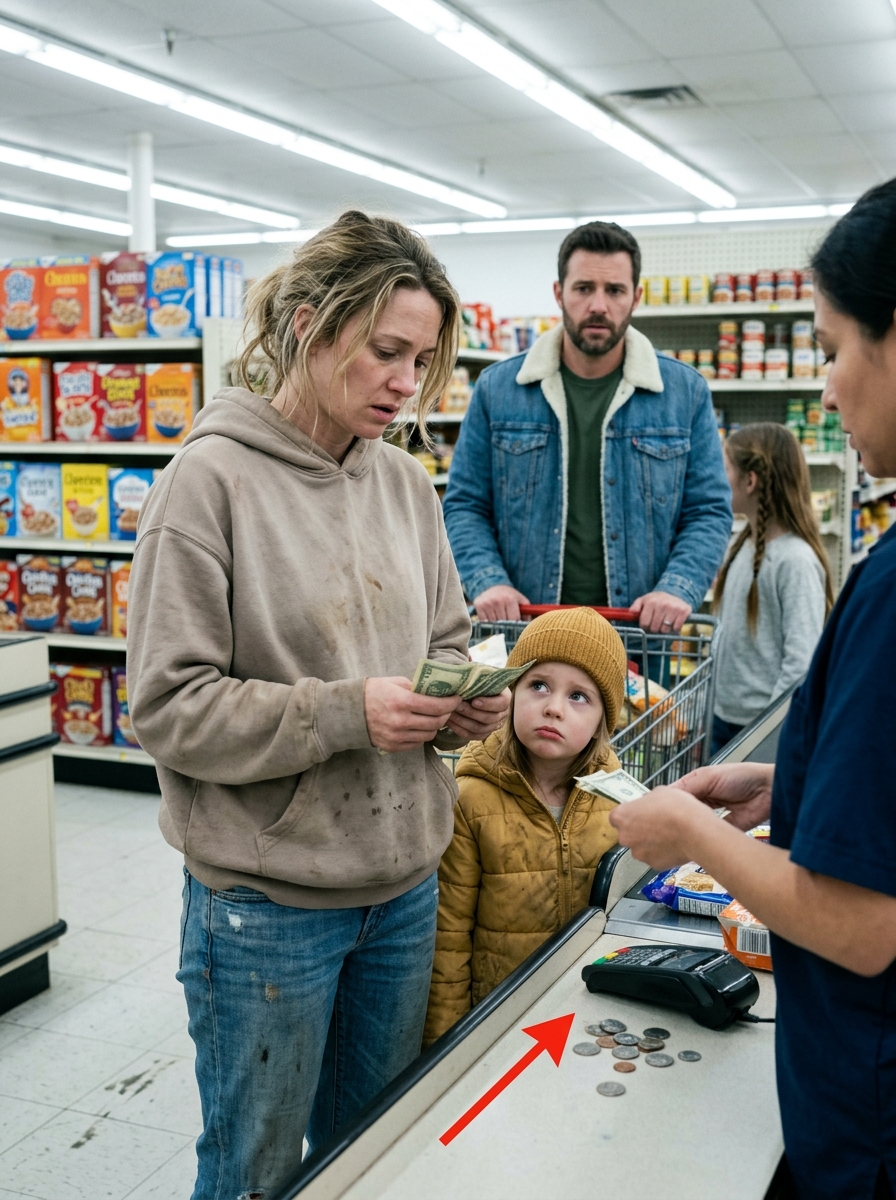
“Mom, what are we going to have for breakfast?”
The little girl’s voice carried farther than she probably meant it to.
Her mother froze at the checkout counter.
For one painful second, nobody moved.
Then the young woman looked down at the gallon of milk she had just handed back to the cashier.
“We’ll figure something out, honey,” she said softly.
Her voice cracked on the last word.
My eight-year-old daughter, Emma, was standing beside me in the next checkout line.
She stopped putting groceries onto the belt.
“Dad.”
I already knew what she was going to say.
“Dad, she needs that milk.”
I looked back toward the young mother.
She was counting crumpled bills and loose change into the cashier’s hand.
There was a baby carrier hooked over one arm.
Her older daughter wore a yellow jacket that looked a size too big.
The woman had removed three things from her order already.
A box of cereal.
A bag of apples.
And now the milk.
The little girl kept staring at the gallon sitting beside the register.
Her mother didn’t look at anybody.
Not the cashier.
Not the people behind her.
Not us.
She stared at her wallet as though another five-dollar bill might somehow appear inside it if she looked hard enough.
It didn’t.
The cashier handed her a receipt.
The woman whispered thank you, gathered two small grocery bags, and hurried toward the exit.
Emma grabbed my sleeve.
“Can we help?”
That question changed more lives than either of us understood at the time.
My name is David Harrison.
I’m sixty-one now.
This happened eight years ago, when I was fifty-three and Emma was eight.
By then, I had reached a place in life where money wasn’t something I worried about every morning.
That had not always been true.
I had spent years building a small software business.
Eventually, I sold my share and did well enough that I could live comfortably.
Very comfortably.
I owned a good house in a middle-class suburb outside Columbus, Ohio.
My car was paid for.
The refrigerator was always full.
If Emma needed new shoes, I bought them.
If the electric bill was higher than expected, I paid it.
If we wanted pancakes at the neighborhood diner on Saturday morning, we went.
I knew we were fortunate.
But knowing you are fortunate and understanding what that really means are two different things.
Emma’s mother had passed away years earlier.
I won’t turn that part of our life into a dramatic story.
It was simply something we carried.
Afterward, Emma and I became a team.
I packed school lunches badly at first.
She politely informed me that crackers were not a vegetable.
I learned how to braid hair from videos.
My early attempts looked like rope knots.
She laughed at them.
Eventually, I improved.
We built routines.
Tuesday grocery trips.
Friday pizza nights.
Saturday morning pancakes.
Sunday calls with family.
Ordinary things became our way of making a home feel whole again.
I tried hard not to raise Emma inside a bubble.
We had more than many families around us, and I wanted her to understand that having more did not make us more important.
So we lived in an ordinary neighborhood.
We shopped at the neighborhood grocery store.
Emma attended the local school.
She played with children whose parents were teachers, mechanics, office workers, nurses, restaurant servers, and people working two jobs just to keep everything moving.
I wanted her to see the world as it was.
I just didn’t expect the lesson to arrive in a checkout line over a gallon of milk.
Earlier that afternoon, Emma had noticed the woman before I did.
We were in the dairy aisle.
“Dad,” she whispered.
“What?”
She nodded toward the other end of the aisle.
A young mother stood there holding a baby while her older daughter waited beside the cart.
The mother picked up the milk.
She looked at the price.
Then she looked into her cart.
Then back at the milk.
Finally, she placed it inside.
Her little girl smiled.
I remember that smile.
At the time, I didn’t understand why a child would look so relieved about milk.
A few aisles later, we saw them again.
The mother was comparing prices on pasta.
She chose one box.
Then she noticed another that cost a little less.
She exchanged them.
Near the produce section, she put bananas into a plastic bag.
Then she counted them.
She removed two.
Every decision seemed to require calculation.
Not casual calculation.
Survival calculation.
Emma noticed all of it.
Kids notice more than adults think they do.
“She keeps putting stuff back,” she whispered.
“I know.”
“Why?”
“She may have a budget.”
“So do we.”
Emma was right.
Technically, we did.
But our grocery budget meant I preferred not to spend too much.
Her budget clearly meant something else.
Her budget had edges.
Hard ones.
If she crossed them, something necessary disappeared.
At the checkout, we finally saw how hard those edges were.
The total came up.
The woman checked her wallet.
Then came the cereal.
The apples.
And the milk.
When her daughter asked about breakfast, something inside me tightened.
But I still might have hesitated.
Adults are good at hesitation.
We can make hesitation sound responsible.
Maybe she doesn’t want help.
Maybe I’ll embarrass her.
Maybe it’s none of my business.
Maybe somebody else will do something.
Maybe I shouldn’t interfere.
We can build an entire wall out of maybes.
Emma didn’t.
She simply looked at me and asked, “Can we help?”
“Yes,” I said.
She blinked.
“Yes?”
“Yes. We can.”
I paid for our groceries as quickly as I could.
The cashier had barely handed me the receipt before I pushed our cart toward the side.
“Stay right here with our groceries.”
“What are you doing?”
“Getting another cart.”
I had never grocery-shopped that fast in my life.
Milk went in first.
Then cereal.
Eggs.
Bread.
Chicken.
Rice.
Pasta.
Sauce.
Cheese.
Peanut butter.
Jelly.
Apples.
Bananas.
Oranges.
Frozen vegetables.
Juice.
Baby formula.
Diapers.
Baby food.
Soap.
Shampoo.
Toothpaste.
Laundry detergent.
I passed the baby aisle and saw a soft blanket.
Into the cart.
Emma appeared beside me.
I gave her a look.
“I told you to stay with our cart.”
“I can see it from here.”
She pointed.
Technically, she was right.
Then she picked up a small stuffed rabbit.
“For the little girl?”
“She’s six, Emma. She might think that’s for babies.”
Emma frowned.
“She looked like she needed something soft.”
I had no answer to that.
The rabbit went into the cart.
At the register, the cashier stared at the pile.
“Big shopping day?”
“Unexpected one.”
I kept looking toward the doors.
I was afraid the woman would drive away before we reached her.
Emma bounced on her toes.
“Dad.”
“I know.”
“Hurry.”
“I’m trying.”
When the receipt finally printed, I pushed the cart toward the parking lot while Emma hurried beside me.
We found the woman three rows away.
She was loading her two grocery bags into an old sedan.
It had faded paint and one hubcap that didn’t match the others.
Her older daughter was already sitting in the back.
The baby was secured beside her.
The woman closed the trunk.
I called out.
“Excuse me.”
She turned around fast.
Her whole body seemed to tense.
I stopped several feet away.
I suddenly realized how this looked.
A strange man and his daughter pushing an overflowing grocery cart toward her car.
“I’m sorry,” I said. “I don’t mean to bother you.”
She looked from me to the cart.
Then at Emma.
“What is it?”
“My daughter and I were behind you inside.”
Her face changed.
Not much.
Just enough.
Embarrassment.
She knew what we had seen.
“I’m sorry,” I continued. “We saw what happened at the register.”
“I’m fine.”
She said it immediately.
Too quickly.
“I understand.”
“I said I’m fine.”
Her voice wasn’t rude.
It was protective.
I recognized that.
Pride isn’t always arrogance.
Sometimes it is the last thing a person has left when everything else feels uncertain.
Emma stepped forward.
“We bought your milk.”
The woman stared at her.
Emma pointed toward the cart.
“And some other stuff.”
The mother looked.
Really looked.
Her hand rose to her mouth.
“No.”
“It’s okay,” I said.
“No, I can’t.”
“You can.”
“That’s way too much.”
“We wanted to.”
“You don’t know me.”
She looked around the parking lot as if hoping another explanation might appear.
“There are diapers in there,” she said.
“Yes.”
“And formula.”
“Yes.”
“And all that food?”
“Yes.”
Her eyes filled.
Then she shook her head.
“I can’t take hundreds of dollars of groceries from a stranger.”
Emma looked at me.
Then at the woman.
“Why not?”
I almost laughed.
Not because anything was funny.
Because children have a way of walking straight through the complicated rules adults build around dignity.
The woman looked at Emma.
“Well…”
Emma continued.
“You need groceries.”
The woman nodded slowly.
“And we can buy groceries.”
Another nod.
“So why can’t you have them?”
The woman’s lips pressed together.
She turned away.
For a moment, she just stood beside the trunk of that old car with her back to us.
Then her shoulders began to shake.
She was trying not to cry.
Emma looked worried.
“Did I say something bad?”
“No,” the woman whispered.
She wiped her face and turned around.
“No, sweetheart. You said something very kind.”
I introduced myself.
“I’m David. This is my daughter, Emma.”
The woman took a breath.
“I’m Megan.”
She hesitated.
“Megan Carter.”
“Nice to meet you, Megan.”
She looked at the cart again.
“You really bought this for us?”
“We did.”
“Why?”
I could have given her some grand speech.
I didn’t.
“Because you needed help today.”
Her eyes dropped.
“I lost my job last week.”
Emma looked at me.
Megan continued.
“The office where I worked closed unexpectedly. I’ve been applying everywhere.”
She gave a tired little laugh.
“I thought I had enough money to get through another week.”
She looked toward her car.
“Then my rent came due. The electric bill was higher than I expected. The baby needed formula.”
Her voice faded.
“I came here with twelve dollars after paying everything I could pay.”
Twelve dollars.
I remember that number because it sounded impossible.
Not impossible in the mathematical sense.
Impossible in the human sense.
A mother.
Two children.
Three days.
Twelve dollars.
“I kept adding the prices in my head,” Megan said. “I thought I had it right.”
She wiped her cheek.
“Then the total was higher.”
Emma spoke quietly.
“So you put the milk back.”
Megan nodded.
“My older girl likes cereal in the morning.”
She looked toward the back seat.
“I told her we’d figure something out.”
Emma pointed toward the cart.
“Now she can have cereal.”
That broke Megan again.
She covered her mouth and cried.
Quietly.
No scene.
No dramatic collapse.
Just the kind of tears people cry after holding themselves together longer than they thought they could.
I opened the trunk.
“Come on. Help me make room.”
Megan laughed through her tears.
“You’re serious.”
“Very.”
The trunk was almost empty.
That told me something, too.
No extra bags.
No forgotten sports equipment.
No stroller.
No weekend stuff.
Just two grocery bags and an old emergency blanket.
We began loading food.
Emma carried the light things.
Bread.
Cereal.
The stuffed rabbit.
When Megan’s older daughter saw the gallon of milk through the window, she sat straight up.
“Mom!”
Megan turned.
“Mom! The milk!”
Megan laughed.
It was the first time I heard her laugh without sadness underneath it.
“Yes, Lily. We got the milk.”
Emma waved through the window.
Lily waved back.
Then Emma held up the stuffed rabbit.
Lily’s eyes widened.
“That’s for you,” Emma called.
Megan looked at me.
“You bought her a toy?”
“That was Emma.”
Emma shrugged.
“She needed something soft.”
Megan closed her eyes for a second.
“I don’t know what to say.”
“You don’t have to say anything.”
When the groceries were loaded, I took out my wallet.
Megan immediately stepped back.
“No.”
“I haven’t even done anything yet.”
“I know that look.”
“What look?”
“The wallet look.”
Despite everything, I smiled.
“You’re observant.”
“I’ve been a mother for six years.”
I took out five one-hundred-dollar bills.
Her face hardened.
“No.”
“Megan.”
“No, David.”
“Please listen.”
“You already bought enough food to fill my trunk.”
“This is for the next few weeks.”
“I can’t.”
“For gas. The things the girls need. Whatever gives you room to breathe.”
She folded her arms.
“I said no.”
I could see the line.
If I pushed too hard, generosity would turn into something else.
Control.
And I did not want that.
So I changed course.
“Okay.”
She seemed surprised.
“Okay?”
“I won’t force you.”
I put the money back.
Then I handed her my business card.
“This, at least.”
She took it cautiously.
“My number is on there.”
She read it.
“What do you do?”
“Business consulting these days. I used to work in software.”
She nodded.
“If you want help getting your résumé in front of somebody, call me.”
“You know people hiring?”
“I know people in different fields.”
She looked suspicious again.
“I don’t want a job I didn’t earn.”
“Good.”
She blinked.
“I’m not offering one.”
That got a tiny smile.
“I’m offering to make sure somebody actually looks at your résumé.”
She studied me.
“What did you do before your office closed?”
“Medical billing.”
“You’re certified?”
“Yes.”
“Experience?”
“Seven years.”
“Then call me.”
She slipped the card into her wallet.
“I might.”
Emma whispered loudly, “You should.”
Megan laughed.
“I’ll think about it.”
Before she got into the car, she turned toward me again.
“David?”
“Yes?”
“Thank you.”
“You’re welcome.”
“No.”
She shook her head.
“I mean really.”
Her eyes watered again, but she kept control this time.
“You have no idea what today felt like before you walked over.”
I did not tell her that I understood.
Because I didn’t.
Not completely.
I had known grief.
I had known uncertainty.
I had known years when money was tight.
But I had never stood in a grocery store wondering whether my daughter could have milk for breakfast.
There are moments when saying “I understand” is more about making ourselves comfortable than honoring what somebody else has lived.
So I simply said, “I’m glad we were here.”
Megan looked at Emma.
“So am I.”
We watched her drive away.
Emma held my hand as we walked back to our groceries.
After a few steps, she said, “Dad?”
“Yeah?”
“Why didn’t she want the food?”
“She did.”
“But she kept saying no.”
“Sometimes needing help can make people feel embarrassed.”
“Why?”
I thought about that.
“Because grown-ups sometimes think they’re supposed to handle everything alone.”
“That doesn’t make sense.”
“No.”
“It doesn’t.”
“If I fall down at school, my teacher helps me.”
“Right.”
“If I don’t understand math, you help me.”
“Usually after staring at it longer than I should.”
Emma smiled.
“So why is food different?”
I opened the back of our SUV.
“It shouldn’t be.”
She climbed inside.
For the entire ride home, she talked about Lily.
“Do you think she likes the rabbit?”
“Probably.”
“Do you think they have enough cereal?”
“Yes.”
“Did you get chocolate cereal?”
“No.”
“Dad.”
“What?”
“If you’re going to rescue breakfast, you have to do it correctly.”
I laughed.
“I’ll remember that next time.”
There almost wasn’t a next time.
Two days passed.
Megan didn’t call.
Then three.
By Friday afternoon, I assumed she had decided against it.
That was fine.
I had offered.
The decision belonged to her.
At 4:17 that afternoon, my phone rang.
I didn’t recognize the number.
“Hello?”
There was a pause.
“David Harrison?”
“Yes.”
“This is Megan Carter.”
I sat up.
“Megan. How are you?”
“Better.”
I could hear children in the background.
“A lot better.”
“I’m glad.”
“Lily has eaten cereal every morning.”
“That will make Emma happy.”
“And the baby is doing great. We have enough of everything right now.”
Her voice caught.
“I haven’t opened my refrigerator and seen that much food in months.”
I stayed quiet.
Then she said, “You told me I could call about work.”
“I did.”
“I almost didn’t.”
“What changed your mind?”
Another pause.
“Lily.”
I smiled.
“What did Lily say?”
“She asked why the nice man gave me his card.”
“And?”
“I told her you said you might know someone hiring.”
Megan laughed.
“She said, ‘Then why are you sitting there?’”
I laughed too.
“Smart kid.”
“Unfortunately.”
“Send me your résumé.”
“I can do that.”
“I’ll see what I can find.”
“David?”
“Yes?”
“Please don’t tell anyone some sad story about me.”
“I won’t.”
“I don’t want pity.”
“You won’t get any from me.”
“I just want a chance.”
“That’s exactly what I’ll ask for.”
After we hung up, I opened my laptop.
Megan emailed the résumé fifteen minutes later.
She had not exaggerated.
Seven years of experience.
Additional training.
Good references.
Steady employment history.
She had done everything people tell you to do.
Work hard.
Learn useful skills.
Show up.
Build experience.
Keep going.
Then the office closed.
And suddenly she was standing at a grocery counter removing milk from an order.
Life can change faster than our assumptions about people.
I made four calls that evening.
Two people weren’t hiring.
One knew of an opening that had already been filled.
The fourth told me a large medical practice across town was expanding its billing department.
“Send me her résumé,” he said.
“I can’t promise anything.”
“I’m not asking you to.”
“Do you know her well?”
“No.”
He laughed.
“That inspires confidence.”
“I met her at a grocery store.”
There was silence.
“You met her at a grocery store?”
“Just read the résumé.”
He did.
The following Monday, Megan called me.
“Did you send my résumé somewhere?”
“I did.”
“A woman called me this morning.”
“That sounds promising.”
“I have an interview Wednesday.”
“Good.”
She became quiet.
“David?”
“Yeah?”
“What if I mess it up?”
The question surprised me.
Not because people don’t get nervous before interviews.
Because Megan had sounded tough every other time we spoke.
Even while crying in a parking lot, there had been steel in her.
Now I heard fear.
“You know your work?”
“Yes.”
“You told the truth on your résumé?”
“Of course.”
“Then walk in and talk about what you know.”
“That simple?”
“No.”
I smiled.
“But simple and easy aren’t the same thing.”
She exhaled.
“Okay.”
“And Megan?”
“Yes?”
“You don’t owe me a successful interview.”
“What does that mean?”
“It means this isn’t repayment.”
“I know.”
“Do you?”
She didn’t answer.
“I helped because I wanted to help. You don’t have to turn your life around on my schedule to prove I made a good choice.”
For a few seconds, the line was silent.
Then she said, “I didn’t know I needed to hear that.”
“Go get ready for Wednesday.”
The interview went well.
But she didn’t get an offer.
That part matters.
Stories like this often skip the disappointing parts.
Somebody helps.
A door magically opens.
Everything changes by Friday.
Real life rarely works that neatly.
Megan called me Thursday evening.
“They chose somebody with more supervisory experience.”
“I’m sorry.”
“I thought I had it.”
“I know.”
“I really thought…”
She stopped.
I could hear her trying to keep her voice steady.
“Lily asked me if this means we’re going to run out of food again.”
That sentence hurt more than anything else she had said.
“What did you tell her?”
“That I’m going to keep trying.”
“Good answer.”
“I don’t know how many more times I can do this.”
“Yes, you do.”
“How?”
“You already applied before you met me.”
“That was different.”
“Why?”
“Because now…”
She struggled for words.
“Now I thought maybe the hard part was over.”
I understood that.
Hope can hurt when it arrives too early.
“Then be disappointed tonight,” I told her.
She was quiet.
“You’re allowed.”
“That sounds strange coming from a business guy.”
“I contain multitudes.”
She laughed despite herself.
“Tomorrow, send two more applications.”
“Two?”
“Only two.”
“That’s oddly specific.”
“You have two kids.”
“Fair.”
“And I’ll keep my eyes open.”
We hung up.
Ten days later, another opening appeared.
This one was closer to Megan’s apartment.
The pay was slightly better.
The schedule was more predictable.
And the person hiring needed exactly the kind of experience Megan had.
I forwarded the posting to her.
Five minutes later, she called.
“I already applied.”
“Good.”
“How did you even find this?”
“People talk.”
“You know too many people.”
“That becomes useful when you’re fifty-three.”
She got an interview.
This time, she did not call me before it.
She called afterward.
“I think it went well.”
“That sounded dangerously confident.”
“I know.”
“They asked me to stay an extra twenty minutes.”
“Good sign.”
“They had me meet the department supervisor.”
“Also good.”
“They said I should hear something by Monday.”
Monday came.
Nothing.
Tuesday morning.
Nothing.
At lunchtime Tuesday, my phone rang.
Before I could say hello, Megan shouted, “I GOT IT!”
I pulled the phone away from my ear.
Emma looked up from her homework.
“Who is that?”
“Megan.”
Emma jumped out of her chair.
“Lily’s mom?”
I put the call on speaker.
Megan was laughing and crying at the same time.
“I start in two weeks.”
Emma yelled, “YES!”
Megan laughed harder.
“Is that Emma?”
“Yes.”
“Tell her Lily is dancing around the living room.”
“I’m dancing too!” Emma shouted.
She was.
Right beside the kitchen table.
I watched my daughter spin in circles over a job offer for a woman she had known less than a month.
Something shifted inside me.
I had spent much of my adult life measuring success in ways that fit neatly into columns.
Revenue.
Growth.
Savings.
Property.
Returns.
Targets.
That afternoon, none of those numbers meant much.
A mother had a job.
Two little girls had stability.
And my eight-year-old was dancing in the kitchen because another family had caught a break.
That felt like success.
Megan’s first paycheck was still weeks away.
A few days later, she called.
“I have a question.”
“Sure.”
“Can I borrow the five hundred dollars you tried to give me?”
I smiled.
“Of course.”
“I said borrow.”
“I heard you.”
“I mean it.”
“Understood.”
“I can pay you back after I start working.”
“We can talk about that later.”
“No. We can talk about it now.”
There was the steel again.
“Megan—”
“David.”
I laughed.
“Fine.”
She came by our house that evening.
It was the first time.
Emma waited by the front window.
When Megan’s car pulled up, she ran to the door.
“Where’s Lily?”
“At home with my sister.”
Emma’s disappointment was enormous.
Megan laughed.
“Next time.”
She stood awkwardly in our entryway.
I could see her taking in the house without trying to look like she was taking in the house.
Not a mansion.
But clearly comfortable.
She looked at the framed photographs.
At Emma’s backpack tossed beside the stairs.
At the stack of mail on the entry table.
Ordinary things.
“I expected your house to be…”
She stopped.
“What?”
“Different.”
“Gold walls?”
She laughed.
“Maybe.”
“Sorry to disappoint you.”
“You have socks on the floor.”
I looked down.
One of Emma’s socks lay beside the couch.
“Luxury socks.”
Emma picked it up.
Megan smiled.
Then she became serious.
“I only need enough for gas and the rest of this month’s rent.”
I handed her an envelope.
She checked it.
“Five hundred?”
“Yes.”
“I’m paying this back.”
“Okay.”
“And the groceries.”
“No.”
“David.”
“The groceries were a gift.”
“Then this is a loan.”
“If calling it that helps you take it, yes.”
She looked at me.
“You think I’m difficult.”
“I think you care about standing on your own.”
Her expression softened.
“Yes.”
“I respect that.”
For the first time, she reached forward and hugged me.
Very briefly.
Like she almost changed her mind halfway through.
“Thank you.”
Then she stepped back.
“Don’t make a big deal out of that.”
“Never happened.”
“Good.”
Two weeks later, Megan started work.
The first morning, she sent me a picture.
Not of herself.
Not of the office.
A lunchbox.
Lily’s lunchbox.
Inside were a sandwich, apple slices, crackers, and a note.
Megan’s message said:
“I packed this without counting pennies.”
I stared at that photograph for a long time.
We talk about money as though it is only about things.
Cars.
Houses.
Vacations.
Clothes.
Sometimes money is about an apple in a child’s lunchbox.
Sometimes it is about putting gas in the car without wondering which bill will be late.
Sometimes it is about walking through a grocery store and buying the gallon of milk without doing math in your head.
Three months passed.
Megan settled into the job.
Her supervisor liked her.
She caught mistakes.
She was organized.
She arrived early.
Eventually, she started helping train new employees.
One Saturday, she called.
“What are you and Emma doing tomorrow?”
“Probably pancakes.”
“Of course.”
“Why?”
“I want to take you to lunch.”
“You don’t have to.”
“I know.”
“That means I can refuse.”
“No.”
I laughed.
“Where?”
“There’s a family diner on Maple Avenue.”
“I know it.”
“Meet us there at noon.”
“Us?”
“Lily is coming.”
Emma nearly exploded when I told her.
The diner had vinyl booths, paper placemats for children, and coffee that appeared in your cup whether you asked for more or not.
Nothing fancy.
Exactly right.
Lily ran to Emma.
They acted like lifelong friends instead of two kids who had waved at each other through a car window once.
They colored.
They argued about which animal could beat a bear in a race.
They invented a story involving a flying horse and a school principal.
Megan sat across from me.
For several minutes, neither of us said much.
We watched the girls.
Eventually, she said, “I almost didn’t come back into that grocery store.”
“What?”
“That day.”
She stirred her coffee.
“I sat in my car for ten minutes before going inside.”
“Why?”
“I knew I didn’t have enough.”
“You had twelve dollars.”
“Exactly.”
She gave me a tired smile.
“I kept thinking maybe I could stretch things another day.”
She looked toward Lily.
“But she asked for cereal.”
Megan’s eyes lowered.
“We were almost out of formula, too.”
She paused.
“I was scared all the time.”
I didn’t interrupt.
“That’s the part people don’t see.”
“What part?”
“The thinking.”
She tapped her temple.
“You wake up thinking about money.”
“You drive thinking about money.”
“You stand in the grocery aisle thinking about money.”
“You put your kids to bed thinking about money.”
“You lie down and your brain keeps adding numbers.”
“Rent.”
“Gas.”
“Food.”
“Daycare.”
“Laundry.”
“Every dollar already has five jobs.”
She looked at me.
“And then something costs three dollars more than you expected, and you feel like the whole world is falling apart.”
I nodded.
“That sounds exhausting.”
“It was.”
She looked back at the girls.
“Now I sleep.”
Two simple words.
Now I sleep.
I had spent far more money on things that gave me far less joy than hearing those words.
Megan reached into her purse.
She slid an envelope across the table.
“What’s this?”
“Open it.”
Five hundred dollars.
“Megan.”
“I told you.”
“You just started getting stable.”
“And I’m stable enough to pay it back.”
“Keep it.”
“No.”
“Put it toward savings.”
“No.”
“Take the girls somewhere.”
“No.”
“Megan.”
“David.”
We stared at each other.
Emma looked over.
“Are you guys fighting?”
“No,” we said together.
Lily giggled.
Megan pushed the envelope closer.
“I need you to understand something.”
I leaned back.
“Okay.”
“When I took that money, I needed it.”
“I know.”
“I’m not ashamed of that anymore.”
“Good.”
“But paying it back matters to me.”
“Why?”
“Because I want the story in my head to end with me standing again.”
That stopped me.
She continued.
“You helped me up.”
Her fingers rested on the envelope.
“But I need to know I can stand.”
I took the money.
“Okay.”
Her shoulders relaxed.
“Thank you.”
“For accepting money from you?”
“Yes.”
“Life is strange.”
“It really is.”
I thought that was the full circle.
It wasn’t.
About a year later, Emma and I were grocery shopping again.
Same store.
Same Tuesday routine.
We had just turned toward the checkout when Emma stopped.
“Dad.”
I followed her gaze.
A man stood near the register with a young boy.
He was putting several items aside.
Bread.
Lunch meat.
A bag of potatoes.
Before I could say anything, Emma asked, “Do you have cash?”
“What?”
“Cash.”
“Yes.”
“How much?”
I smiled.
“Why?”
She gave me a look that said I knew exactly why.
We quietly paid for the items he had removed.
No big speech.
No dramatic introduction.
The cashier simply added them to our order, and Emma caught up with the man near the doors.
“You forgot these.”
He looked confused.
Then he understood.
His eyes moved from the bag to Emma.
“Did you…”
Emma shrugged.
“My dad says everybody has rough weeks.”
I had never actually said that sentence.
But it sounded like something I should have said.
The man thanked us.
We left.
In the car, I asked, “How did that feel?”
Emma shrugged again.
“Normal.”
Normal.
That word stayed with me.
Kindness should feel normal.
Not remarkable.
Not newsworthy.
Not suspicious.
Normal.
Megan changed, too.
She started carrying twenty dollars in a separate pocket of her purse.
She called it her “milk money.”
The first time she told me that, I thought she meant money for groceries.
She laughed.
“No.”
“What is it?”
“If I see a mom putting something back, I have twenty dollars ready.”
“You do that?”
“Whenever I can.”
She told me about buying diapers for a young father one evening.
Another time, she paid for groceries for an elderly woman who had miscalculated her total.
Nothing huge.
Nothing that would become a newspaper story.
Twenty dollars.
Thirty.
Sometimes ten.
“Does it make things harder for you?” I asked once.
“Sometimes.”
“Then why do it?”
She answered immediately.
“Because I remember the milk.”
Over the years, our families became close.
Not because I rescued Megan.
I hate that word in this story.
I didn’t rescue her.
She already had the skills.
She already had the work ethic.
She already loved her children.
She already knew how to fight for them.
What she lacked in one specific moment was room.
Room to breathe.
Room to think.
Room to get to the next opportunity.
I helped create a little room.
Then Megan did the rest.
There is a difference.
We spent Thanksgiving together more than once.
We had backyard cookouts.
Emma and Lily became close.
The girls grew.
The stuffed rabbit from that first grocery trip somehow survived years of childhood.
One evening, when Lily was eleven, she brought it to our house.
One ear was floppy.
The fur was worn.
The ribbon around its neck had disappeared.
“You still have that?” I asked.
“Of course.”
“Emma picked that in about three seconds.”
Lily hugged it to her chest.
“Mom told me where it came from.”
I looked at Megan.
She was standing near the kitchen counter.
“You told her everything?”
“When she got old enough.”
Lily looked at me.
“She said we were really poor.”
Megan didn’t flinch from the word.
“For a while,” she said.
Lily looked down at the rabbit.
“I remember the milk.”
I stared at her.
“You do?”
“A little.”
She thought about it.
“I mostly remember Mom looking sad.”
Then she looked at Emma.
“And you holding this rabbit outside the car.”
Emma smiled.
“I thought you needed something soft.”
Lily laughed.
“My mom told me you said that.”
“You did.”
“I was a very wise eight-year-old.”
“You were weird.”
“Also true.”
The girls ran upstairs.
Megan stayed in the kitchen.
“Do you ever think about that day?” she asked.
“All the time.”
“Me too.”
She leaned against the counter.
“It’s strange.”
“What is?”
“That my girls remember kindness more clearly than they remember being broke.”
I had never considered that.
Megan smiled.
“I’m glad.”
Years passed.
Megan was promoted.
Then promoted again.
Eventually, she became a supervisor.
She bought a small house.
Nothing extravagant.
Three bedrooms.
A narrow front porch.
A backyard just big enough for the girls to complain about mowing.
The day she got the keys, she invited us over.
There were no chairs yet.
We sat on cardboard boxes eating takeout.
Megan kept looking around the empty living room.
“I own a house.”
“You do.”
“I own an actual house.”
“You keep saying that.”
“Because I still don’t believe it.”
Emma and Lily were upstairs choosing bedrooms.
Megan walked toward the front window.
“You know what I thought when I signed the papers?”
“What?”
“Milk.”
I laughed.
“Of course you did.”
“No, seriously.”
She turned.
“I thought about standing at that register.”
Her eyes glistened.
“I had twelve dollars.”
“I remember.”
“I felt like twelve dollars was my whole life.”
She looked around.
“And now I’m standing here.”
I raised my paper cup.
“To standing.”
She tapped hers against it.
“To getting help when you need it.”
Then she added, “And helping somebody else when you can.”
By the time Emma reached high school, the grocery store story had become part of our family language.
If she saw someone struggling, she noticed.
If a classmate forgot lunch money, she shared.
If a new student sat alone, she moved.
She wasn’t perfect.
No child is.
She rolled her eyes when I embarrassed her.
She complained about chores.
She left cups in places where cups should never be.
She once drove my car with the gas light on for so long I considered grounding myself for teaching her badly.
But underneath all the normal teenage behavior, there was something steady.
She saw people.
At sixteen, Emma began volunteering at a community food pantry.
One afternoon I picked her up.
She climbed into the passenger seat and didn’t say anything.
That was unusual.
“How was it?”
“Fine.”
“You look upset.”
“I’m not.”
“Emma.”
She stared out the window.
Then she said, “A mom came in with two kids.”
I waited.
“The little girl was wearing a yellow coat.”
My hands tightened slightly on the steering wheel.
Emma looked at me.
“I know it wasn’t the same.”
“No.”
“But for a second…”
“I understand.”
“She kept apologizing.”
“For what?”
“For needing food.”
Emma’s eyes filled.
“She kept saying she was sorry.”
I didn’t know what to say.
Finally, Emma whispered, “Why do people apologize for being hungry?”
I wished I had a good answer.
I didn’t.
So I told her the truth.
“I don’t know.”
She wiped her eyes.
“I remembered Megan.”
“So did I.”
Emma looked down at her hands.
“I want to do something like this when I’m older.”
“Volunteer?”
“No.”
She shook her head.
“For work.”
“What kind of work?”
“I don’t know yet.”
“Then you have time.”
She nodded.
A year later, she started looking seriously at colleges.
She talked about social work.
Community programs.
Family services.
Things I had never imagined when she was small.
One night, she found me sitting on the front porch.
She sat beside me.
“Dad?”
“Yeah?”
“Do you ever wish you had raised me differently?”
“That question sounds dangerous.”
“I’m serious.”
“Differently how?”
“I don’t know.”
She gestured toward our house.
“With less guilt about having money.”
I frowned.
“Did I make you feel guilty?”
“Not exactly.”
“Then what?”
She thought for a moment.
“You always told me we were lucky.”
“We are.”
“And that we should help.”
“Yes.”
“And that having more means we can do more.”
“I believe that.”
She nodded.
“I think I do too.”
Then she leaned against the porch railing.
“I don’t feel guilty.”
“Good.”
“I feel responsible.”
The word hit me.
Responsible.
Not guilty.
There is a difference.
Guilt looks backward.
Responsibility looks outward.
Emma continued.
“I used to think that grocery store day was about you helping Megan.”
“It was partly about that.”
“But now I think it was about her helping us too.”
I turned toward her.
“How?”
“She changed what I thought adults were supposed to do.”
Emma smiled faintly.
“I saw somebody having the worst day of her life.”
“And?”
“And I saw you not look away.”
I didn’t deserve how much weight she put on that moment.
I told her so.
“I almost did look away.”
“But you didn’t.”
“Because you asked me not to.”
She shrugged.
“Maybe we helped each other.”
I looked at my daughter and realized the eight-year-old in the grocery store was gone.
But the lesson she had carried out of that parking lot had grown with her.
A few months later, Megan joined us for dinner.
She arrived carrying an envelope.
I groaned.
“No more repayment.”
She laughed.
“It’s not money.”
“Good.”
Inside was a photograph.
The original grocery store.
Taken from across the parking lot.
“What is this?”
“They’re remodeling it,” Megan said.
“I drove past yesterday and got sentimental.”
“About a grocery store?”
“About a parking space.”
She pointed near the front of the building.
“I think we were right there.”
Emma took the photograph.
“That’s where we met?”
Megan nodded.
Emma smiled.
“We should frame it.”
I stared at both of them.
“You want a framed photograph of a grocery store?”
“Yes,” they said together.
We framed it.
It still hangs in my home office.
Visitors sometimes ask about it.
“Why do you have a picture of a grocery store?”
I usually say, “Long story.”
Because it is.
The money I spent that day was not extraordinary.
A cart of groceries.
Some help later.
Nothing compared with what people spend on vacations, cars, furniture, or things forgotten within a year.
Yet eight years later, I can still see every detail.
The yellow jacket.
The milk beside the register.
Megan counting bills.
Emma tugging my sleeve.
The overflowing cart.
The mismatched hubcap.
Lily pressing her face toward the car window.
The stuffed rabbit.
The first phone call.
The first job rejection.
The second interview.
Megan shouting through the phone when she got hired.
The envelope she insisted on repaying.
The photograph of Lily’s lunch.
The little house with the front porch.
All of it started with one question.
“Can we help?”
I used to believe generosity began with having enough.
Now I think it begins earlier.
It begins with noticing.
Plenty of people were in that grocery store.
I don’t judge them.
They had their own lives.
Their own bills.
Their own worries.
Some may not have had extra money themselves.
Others may simply not have understood what was happening.
I might not have understood either.
Emma did.
Children sometimes see situations before adults explain them away.
She saw a mother put back milk.
She saw a little girl worry about breakfast.
To Emma, the conclusion was obvious.
They need something.
We have something.
So help.
Adults make that equation complicated.
Is it appropriate?
Will they be offended?
Am I responsible?
What if I misunderstand?
What if it becomes awkward?
Emma was eight.
Her entire moral calculation lasted about three seconds.
“Can we help?”
Eight years later, Megan sometimes speaks to groups of volunteers at the food pantry where Emma once helped.
She never uses my full name.
I asked her not to.
This isn’t a story about a rich man being generous.
If that’s all somebody sees, they missed the point.
Megan tells people about the milk.
About the twelve dollars.
About the embarrassment of standing at the register.
About a child noticing.
And about what happened after.
Her favorite line is simple.
“I didn’t need someone to fix my life. I needed enough help to keep moving.”
That is exactly what happened.
She kept moving.
That job led to stability.
Stability gave her choices.
Choices gave her confidence.
Confidence allowed her to help other people.
And the kindness moved outward.
Twenty dollars from Megan’s “milk money.”
A bag of groceries from Emma.
A few volunteer hours.
A meal delivered to a neighbor.
A résumé forwarded.
A phone call made.
A person noticed.
That is how kindness often works.
Not as one giant heroic act.
As a chain.
One person holds the door open long enough for another person to get through.
Then that person holds it for somebody else.
I used to measure the value of things by what they produced.
A business deal had value because it generated profit.
An investment had value because it grew.
A property had value because someone could put a number on it.
I still understand those things.
But now, when I think about returns, my mind sometimes goes to a grocery cart.
What did that afternoon return?
It gave Megan time.
It gave Lily breakfast.
It gave a tired mother a little room to breathe.
It eventually gave an employer a very good employee.
It gave Emma a friend.
It gave me a friend.
It helped shape what my daughter wanted to do with her life.
It encouraged Megan to help families she might once have walked past.
The return keeps growing.
And I can’t put it on a spreadsheet.
Last year, Megan and I walked into that grocery store together.
The remodel was finished.
The checkout lanes were different.
The dairy aisle had moved.
Nothing looked exactly the way we remembered.
Megan stood near the front.
“Do you know what I hate?”
“What?”
“They moved the milk.”
I laughed.
“Terrible.”
“Ruined the whole historical site.”
We bought groceries for a family whose name we would never know.
Not because there was a dramatic scene.
Not because someone asked.
Megan simply filled a second cart.
I looked at her.
“What are you doing?”
“You know exactly what I’m doing.”
The cart filled.
Cereal.
Bread.
Pasta.
Eggs.
Fruit.
Diapers.
Formula.
And milk.
Always milk.
We paid and delivered everything anonymously through a local community pantry.
When we finished, Megan stood beside the empty cart.
“You know something?”
“What?”
“Eight years ago, I thought needing help meant I had failed.”
“And now?”
“Now I think everybody needs someone eventually.”
She pushed the cart back toward the store.
“The trick is making sure somebody notices.”
That afternoon, I came home and found Emma studying at the kitchen table.
I put the framed grocery-store photograph beside her.
She looked up.
“What?”
“Nothing.”
“You’re being weird.”
“I’m allowed.”
“Why are you staring at me?”
“Because you started all of this.”
She laughed.
“What did I start?”
I pointed at the photograph.
“That.”
“I was eight.”
“Exactly.”
“I just wanted Lily to have milk.”
“I know.”
Emma looked at the picture for a moment.
Then she smiled.
“Did she?”
“Did she what?”
“Have milk the next morning?”
I thought back.
Megan had told us Lily ate cereal.
“Yes.”
Emma nodded.
“Then it worked.”
Maybe that’s the simplest way to tell the whole story.
It worked.
Not perfectly.
Megan still had difficult months.
She lost the first job opportunity.
She worried.
She struggled.
She had to rebuild slowly.
There was no magic.
No instant transformation.
Just groceries.
A phone number.
An introduction.
An opportunity.
And somebody determined enough to keep going.
Eight years ago, a woman stood at a grocery counter and realized she did not have enough money for milk.
A little girl in a yellow jacket asked what they would eat for breakfast.
Another little girl heard her.
And instead of looking away, she tugged on her father’s sleeve.
That was all.
One tug.
One question.
One decision.
Sometimes I wonder what would have happened if Emma had been distracted that day.
What if she had been staring at candy near the register?
What if I had been checking my phone?
What if we had chosen another checkout lane?
What if we had left five minutes earlier?
Life contains thousands of moments that almost never happen.
Most disappear without us noticing.
This one didn’t.
And because it didn’t, I have spent eight years thinking about a truth I should have understood much sooner.
People rarely walk around wearing signs that explain what they are carrying.
The exhausted mother in front of you may have spent all morning applying for jobs.
The quiet parent counting change may be trying desperately to keep things normal for a child.
The person putting something back on a shelf may have done the math ten times already.
We do not need to know every detail of someone’s life to treat them with dignity.
We don’t need their full history.
We don’t need proof that they deserve kindness.
And helping does not always mean money.
Sometimes it is an introduction.
Sometimes it is a meal.
Sometimes it is an hour.
Sometimes it is listening.
Sometimes it is simply refusing to make someone feel small when life has already made them feel that way.
I had money that afternoon.
That made one kind of help possible.
But the most important thing I brought into that parking lot wasn’t my wallet.
It was my daughter.
Because I might have hesitated.
Emma didn’t.
She saw a problem.
She saw a person.
And she asked the question adults too often forget to ask.
“Can we help?”
I still hear her voice whenever I notice somebody struggling.
Eight years later, Megan has a steady career.
Lily is a teenager.
Emma is sixteen and preparing for college.
The stuffed rabbit is still around somewhere.
The grocery store has changed.
The yellow jacket is long gone.
And nobody in either family thinks about that gallon of milk every single day.
But sometimes, usually when we are all together around a dinner table, somebody mentions the grocery store.
Megan rolls her eyes.
Emma teases her.
Lily tells us she barely remembers it.
Then Megan gets quiet.
She looks around the table.
And she says the same thing.
“I remember.”
So do I.
I remember a woman trying not to cry at a register.
I remember a child worrying about breakfast.
I remember an eight-year-old girl refusing to accept that nothing could be done.
And I remember realizing that being fortunate means very little if fortune stops with you.
The groceries mattered.
The job connection mattered.
The money mattered.
But none of those things happened until someone noticed.
That is the part I carry with me.
Not how much the cart cost.
Not how quickly Megan found work.
Not how much she eventually earned.
I remember the moment before all of that.
A gallon of milk sitting beside a checkout register.
A tired mother walking away.
And a little girl tugging on my sleeve.
“Dad, she needs that milk.”
She was right.
And thank God I listened.